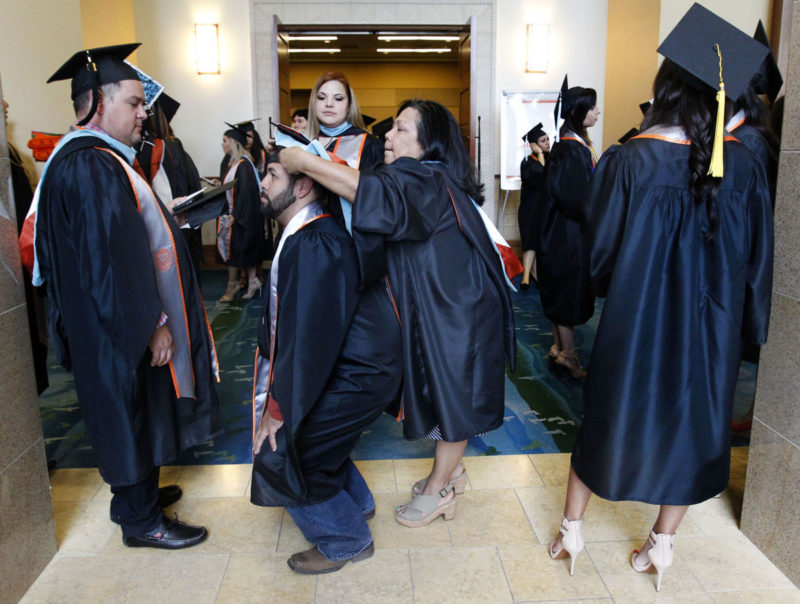
Latinos have made great strides in education in recent years, with more enrolling two- and four-year colleges and universities than ever before. However, there is still a significant gap between Latinos and other racial and ethnic minorities in obtaining college degrees. Education is one of the main determinants of health; the more education you obtain, the better your chances for higher paying jobs, financial stability, upward mobility, and better long-term mental and physical health. Overall, the economy has rebounded from the mid-2000s economic downturn. However, according to a new report by the Federal Reserve, those households that do not have a college degree are struggling more than ever. As reported by Reuters, the annual report serves as “temperature check” on the ...
A growing number of U.S. children may develop vision problems before they reach kindergarten, according to a study, Newsmax reports. Latino children were the most likely group to have vision problems.
Study results
Study researchers examined U.S. census records and eye exams of 12,000 children ages 6 and younger. They estimated that 174,000 U.S. children ages 3-5 had vision impairment as of 2015. That number could grow to more than 220,000 children by 2060. The study also found that Latino kids accounted for 38% of vision impairment cases, compared to 26% among white kids and 25% among black kids. "Researchers estimated [the Latino] proportion would climb [from 38%] to 44% by 2060 aided by higher birth rates in this population relative to other racial and ethnic groups," ...
Attaining an education is one of the key social determinants of health. Education impacts future economic well-being, job growth, and your long-term physical and mental health. Latinos have made great strides in education in the last decade. As of recent reports, the rate of Latino high school dropouts is at an all-time low while rates of graduation are at all-time highs. Latinos are also enrolling in more two- and four-year colleges and universities. While things are looking up, there is still a significant gap in educational attainment between Latinos and other racial and ethnic groups. In order to make an impact on this gap, more colleges and universities are addressing this problem in creative and “outside-the-box” manners. In order to reduce health disparities, it is ...
Lack of access to quality healthcare is one of the main inequities that keep many Latinos from obtaining the best quality healthcare possible. However, the advent and proliferation of telehealth or telemedicine looks to be a way to bridge the gap between Latinos and their healthcare providers. Developed as a remote way to monitor patients, treat chronic illnesses and/or conditions, and eliminate barriers (such as a lack of transportation), technology – in the form of telemedicine – looks to be the way of the future as far as healthcare goes, especially for Latinos. Studies have shown that more and more Latinos are accessing the Internet, especially through smart phones and other hand-held devices. This is the essence of telemedicine. Now, in Texas (38.42% Latino population), a ...
More Latino and Black youth are “disconnected”—not in school and not working—than their White peers, according to recent County Health Rankings data. How can we connect more minority youth to healthy, successful futures? Let’s use #SaludTues on Tuesday, May 30, 2017, to tweet about the latest strategies and resources to connect Latino and other minority youth to opportunities in education, jobs, and civic engagement from the earliest ages into adulthood: WHAT: #SaludTues Bilingual Tweetchat: “Connecting Minority Youth to Opportunity”
TIME/DATE: 1-2 p.m. ET (Noon-1 p.m. CT), Tuesday, May 30, 2017
WHERE: On Twitter with hashtag #SaludTues
HOST: @SaludAmerica
CO-HOSTS: County Health Rankings (@CHRankings), The United Way (@UnitedWay)
Optional hashtags: ...
A quality education is key to health, science shows. Latinos are making progress in educational achievement. The Latino high-school dropout rate is at an all-time low. Graduation rates are at an all-time high. More Latinos are enrolling in two- and four-year universities than ever before. But there remains a large educational gap between Latinos and their peers. A new initiative by the Chan Zuckerberg Initiative (CZI), founded by Facebook CEO Mark Zuckerberg and his wife, and The College Board is trying to significantly close this gap. The two-year effort aims to expand access to “unique personalized learning pathways” to help lower-income and rural area students prepare for key “college gateway tasks,” such as the PSAT, SAT and Advanced Placement courses.
What's ...
A healthy movement is growing in Los Angeles (48.5% Latino) where schools are saying no to the unhealthy marketing of McTeachers nights. This week of May 12, 2015, schools are being asked to vote on nutrition and fundraising policies, including voting on policies around food marketing for local wellness school policies. The United States Department of Agriculture (USDA) has outlined updates for school districts on local wellness policies (LWP) to include a policy around food marketing in schools by June 30, 2016. School marketing includes any advertising, promotion of oral written, or graphic statements made for the purpose of promoting the sale of food or beverages, explains a resource from Voices for Healthy kids and the Center for Science in the Public Interest ...
Momsrising.org is asking mom's to become school wellness heroes to help make sure physical education and healthy foods are a part of school wellness policies. Kids spend most of their day at school, eating most of their calories and expending most of their energy at school, so it is vital for the school environment to be healthy. Currently, over 99% of schools are meeting new healthy snack standards, but with the new healthy school meal standards being rolled back around sodium, non-fat and flavored milk and whole grains, there is still so much work to do to make sure kids are in a safe and healthy school environment all day. You can help support health and wellness in schools before the end of June while school districts update their wellness policies. Get involved by dropping off ...
Attaining an education is one of the key social determinants of health. For many Latinos, getting an education beyond high school prevents them from obtaining a higher quality of life. While more and more Latinos are enrolling in two- and four-year universities, the gap in achievement is still vast between them and their white peers. Excelencia in Education, a non-profit organization founded to accelerate higher education access for Latino students, was recently announced as the recipient of a $1.5 million in grants from the Great Lakes Higher Education Guaranty Corporation and Lumina Foundation to “expand strategies that accelerate Latino student success in higher education.” “This important collaboration highlights Lumina’s continued commitment to accelerate Latino student ...