The Food and Drug Administration (FDA) is considering whether to allow some flavored e-cigarettes on the market, according to new draft guidance. However, any new vape flavors could only be marketed to adults. Under the new guidance, the FDA may approve vape flavors like “mint, coffee, tea and spices like clove or cinnamon,” but it “will continue rejecting sweet or fruit-flavored products” that appeal more to teens, according to HealthDay, a news agency. FDA states that certain e-cigarette flavors can help facilitate adults switching away from tobacco cigarettes and increase quit attempts. However, public health leaders warn of harm. “Allowing any flavors on the market benefits only corporations and harms public health,” Kelsey Romeo-Stuppy of Action on Smoking ...
Hey San Antonio, ready to quit smoking?! Join the Quitxt Study in English or Spanish to take a powerful step toward quitting smoking. The study features Quitxt, a free bilingual text messaging program that helps Latino young adults in South Texas to quit smoking. Quitting smoking can help you save money and help with more independence, better fitness, better breath, and better health. "No matter where you are on your quitting journey, our Quitxt Study is here to help you every step of the way," said Dr. Patricia Chalela, study leader and tobacco researcher at UT Health San Antonio. QUIT SMOKING WITH QUITXT!
What Is the Quitxt Study?
The Quitxt Study aims to understand the impact of Quitxt, UT Health San Antonio's bilingual, evidence-based text messaging smoking ...
Nicotine-based vapes, or e-cigarettes, are likely to cause cancers of the lung and oral cavity, according to a new study led by the UK’s University of South Wales. “[Our study] is the most definitive determination that those who vape are at increased risk of cancer compared to those who don’t,” said study leader Bernard Stewart. Let’s dive into what the study results mean for those who vape.
E-Cigarettes and Cancer Risk
Little attention has focused on whether e-cigarettes might cause cancer on their own. So, study researchers – pharmacists, epidemiologists, thoracic surgeons, and public health experts – examined clinical studies, animal experiments, and laboratory research to understand the chemicals produced by e-cigarettes, according to a news release. They ...
In 1998, the U.S. Surgeon General released a landmark report calling for tobacco control interventions for Hispanic and Latino and other populations. Has this goal been met? To find out, Dr. Amelie G. Ramirez of UT Health San Antonio analyzed public health efforts since 1998 and identified a mix of replicable successes and remaining challenges in tobacco control, according to her recent article in JNCI Monographs. "Although progress has been made in the years since the report's release, [Latino and other] tobacco users continue to have limited access to cessation medication and support services," Ramirez wrote. "Cultural barriers and tobacco industry marketing have also complicated cessation efforts." "Despite these challenges, some outreach and cessation efforts have shown ...
The 2026 New Year brings about new resolutions for many hoping to adopt a healthier lifestyle like eating healthier or exercising more. Quitting smoking could help, too. With several health problems stemming from smoking including cancer, heart disease, and respiratory infections, why not quit smoking as a resolution? Let’s dive into the facts and benefits of leaving smoking behind in 2025!
Rates of Latino Smokers
49.2 million (19.8%)—or nearly 1 in 5—U.S. adults reported current tobacco product use in 2022, according to the CDC. How does this impact Latinos? About 1 in 13 (7.7%) Hispanic or Latino adults in the U.S. smokes cigarettes, according to the CDC. Cigarette smoking also is more common for Latino men than Latinas. Latino youth can also be targeted ...
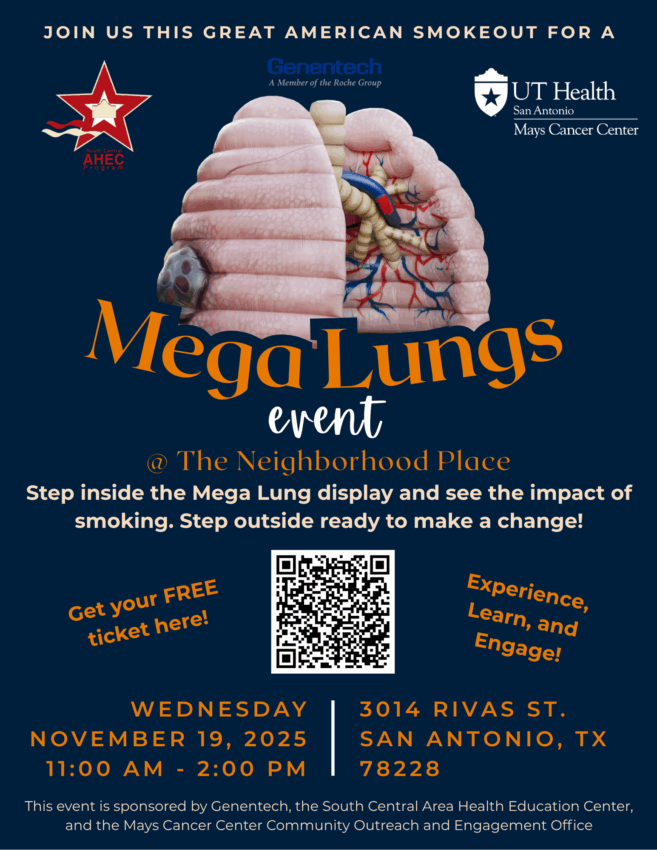
Do you smoke cigarettes and want to quit? On Thursday, Nov. 20, 2025, you can join thousands of people who will begin their smoke-free journey with the Great American Smokeout, an annual quitting event. To get help, enroll in Quitxt, a free English or Spanish texting service that turns your phone into a personal “quit smoking” coach from UT Health San Antonio. To join Quitxt, text “iquit” (for English) or “lodejo” (for Spanish) to 844-332-2058. And, if you’re in the San Antonio area, visit the “Mega Lung,” a giant model of a human lung that shows the importance of the respiratory system’s most vital organ.
Step Inside the Mega Lung
The MEGA Lung is open 11 a.m. to 2 p.m. on Wednesday, Nov. 19, 2025, at the Neighborhood Place cafeteria, 3014 Rivas Street, San ...
We know smokers have an increased risk of dementia. Now new research suggests that quitting smoking, even after later in life, can slow cognitive decline. Researchers from the University College of London collected data from more than 9,000 participants ages 40 and older across 12 countries. “They matched people who had quit smoking with continuing smokers according to their starting cognitive scores and other characteristics, including sex, age, education level and birth country,” according to NPR. Results showed verbal fluency declined at a rate roughly half for those who quit smoking compared to that of their smoking counterparts. For memory, the decline was reduced by 20%. Let’s dive deeper into this study and what this can mean for those who quit smoking.
Why ...
Smoking cigarettes is the top cause of preventable death in the United States. The good news is that help is out there—just ask Katherine Saucedo. Saucedo, a San Antonio resident, got help quitting smoking from the no-cost Quitxt bilingual text-message service from UT Health San Antonio. Quitxt, created by Dr. Amelie G. Ramirez and Dr. Patricia Chalela at UT Health SanAntonio with the support of the Cancer Prevention and Research Institute of Texas, sends texts messages to help South Texas adults quit smoking. Messages help with motivation to quit, setting a quit date, handling stress, using nicotine replacement (if needed), and more. Saucedo has been smoke-free for the past three months using Quitxt. “Huge improvements, just better lung capacity. I don't feel short of ...
The U.S. Food and Drug Administration (FDA) is proposing a new rule that, if finalized, would make cigarettes and certain other combusted tobacco products minimally or nonaddictive by limiting the level of nicotine in those products. Smoking cigarettes, which contain nicotine, an addictive chemical, is estimated to kill nearly half a million people in the U.S. each year. The proposed rule aims to make cigarettes less addictive, prevent young people from starting smoking, and promote quitting smoking among all groups. The FDA wants your comment on the proposed rule. You can submit a model comment created by Salud America! urging the FDA to make cigarettes and other tobacco products less addictive. This comment period closed Sept. 15, 2025. November 2025 ...





268 People Commented to Urge the FDA to Reconsider Allowing Flavored E-Cigarettes
The Food and Drug Administration (FDA) is considering whether to allow some flavored e-cigarettes on the market, according to new draft guidance. However, any new vape flavors could only be marketed to adults. Under the new guidance, the FDA may approve vape flavors like “mint, coffee, tea and spices like clove or cinnamon,” but it “will continue rejecting sweet or fruit-flavored products” that appeal more to teens, according to HealthDay, a news agency. FDA states that certain e-cigarette flavors can help facilitate adults switching away from tobacco cigarettes and increase quit attempts. However, public health leaders warn of harm. “Allowing any flavors on the market benefits only corporations and harms public health,” Kelsey Romeo-Stuppy of Action on Smoking ...
Read More