by
by 
Share On Social!
When we get older, our body changes.
The foods we like don’t respond quite the same way, it may be harder to get around, or it might even be difficult to recall certain memories.
While these are all symptoms of aging, there are also lesser-known factors that contribute to how we age and how quickly some of these issues are brought on.
One surprising factor is drought.
For instance, a recent study has found that environmental stressors like long periods of drought can cause faster cognitive decline.
Check out our new fact sheet, Does Drought Impact Brain Health in Older Latinos?, to help our abuelos and abuelas understand how environmental stressors can impact their brain health.
This fact sheet was created by Dr. Amelie G. Ramirez of Salud America! and UT Health San Antonio based on a research brief from the San Antonio Center for AD/ADRD Population Aging and Social Studies (San Antonio CAPAS) at UT Health San Antonio.
What is Drought?
Drought is an extreme weather condition that occurs after long periods of little to no rainfall, according to the National Oceanic and Atmospheric Administration.
Lack of rain can cause drier-than-usual conditions that can lead to watering restrictions to ration an area’s water supply. When accompanied by extremely hot temperatures, drought can impact the moisture in soil.
Long-term drought conditions can severely impact the agricultural industry, killing crops and resulting in fewer fruits and vegetables for harvest.
A lack of food creates a ripple in the food chain, leaving animals less to eat and therefore creating less meat for us to consume.
However, for those working in the farming industry, the cost is also a financial one.
With many Latinos working in the agricultural industry and living in hot, drought-prone areas it’s important to understand how drought effects the brain.
Does Drought Impact Brain Health in Older Latinos?
The Does Drought Impact Brain Health in Older Latinos? fact sheet aims to help adults and caregivers understand how drought conditions impact brain health and give the rest of us a chance to take action to improve health outcomes for aging Latinos.
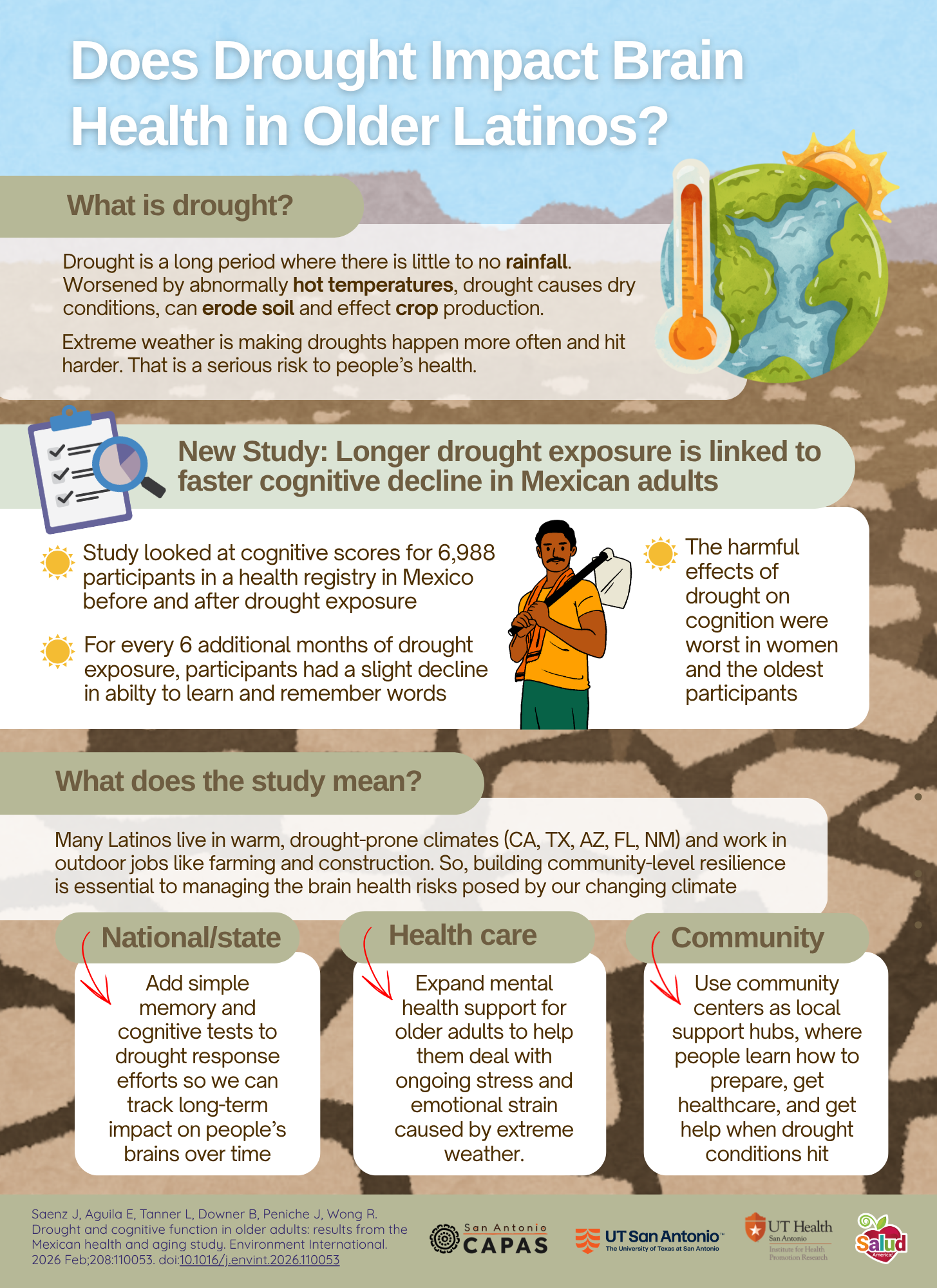
The fact sheet covers what drought is, how the mind is impacted by drought conditions, and why drought impacts Latinos more than others.
Also, learn some of the ways federal, healthcare, and community leaders can help provide better resources and interventions to address the impact of drought and weather conditions to slow the effects of drought-related cognitive decline.
The information in the fact sheet is based on findings from the recent study, Drought and cognitive function in older adults: results from the Mexican health and aging study, led by researchers at Arizona State University, the University of Southern California, the University of Texas Medical Branch, and UT Health San Antonio.
The study is also featured in a research brief.
Download the fact sheet to discuss how drought may be impacting you or your loved one’s brain health or print it out as resource for your community center, health provider’s office, school, or senior living center.
You can also use the guide to argue for better drought responses in your community.
Together, we can make an impact!
Addressing Alzheimer’s and Dementia in South Texas
Alzheimer’s and related dementias continue to ravage communities and families in South Texas, where many Latinos call home.
There are many societal and background-prevalent factors that contribute to inconsistencies in the Alzheimer’s and dementia care continuum.
Many of these factors stem from some of the modifiable risk factors included on this list.
To address some of these inconsistencies, UT San Antonio launched the San Antonio Center for Alzheimer’s Disease and Related Dementias (AD/ADRD) Population Aging and Social Studies (CAPAS), which is funded by the National Institute on Aging.
Led by Drs. Rebeca Wong and Fernando Riosmena, CAPAS seeks to bring together multidisciplinary groups of experts and research networks in demography, sociology, AD/ADRD epidemiology, neuropsychology, public health issues, and experience conducting longitudinal studies for AD/ADRD research and Latino aging.
“By combining our strengths, we can address Alzheimer’s disease from every angle — from molecules and biomarkers to families, neighborhoods and communities,” Dr. Wong told UT San Antonio Today.
For more information on Alzheimer’s Disease, dementia, or what researchers are doing to improve health outcomes in aging Latino adults, please visit the CAPAS center website.
Additional Alzheimer’s resources for patients and caregivers are available in Englishand Spanish on the Alzheimer’s Association website.
Editor’s note: This blog post was curated and published by Salud America! with support from the San Antonio Center for Alzheimer’s Disease and Related Dementias Population Aging and Social Studies (CAPAS) at UT Health San Antonio, funded by the National Institute on Aging. CAPAS is striving to address issues related to the aging Latino population in South Texas.
Explore More:
DementiaBy The Numbers
142
Percent
Expected rise in Latino cancer cases in coming years