by
by 
Share On Social!
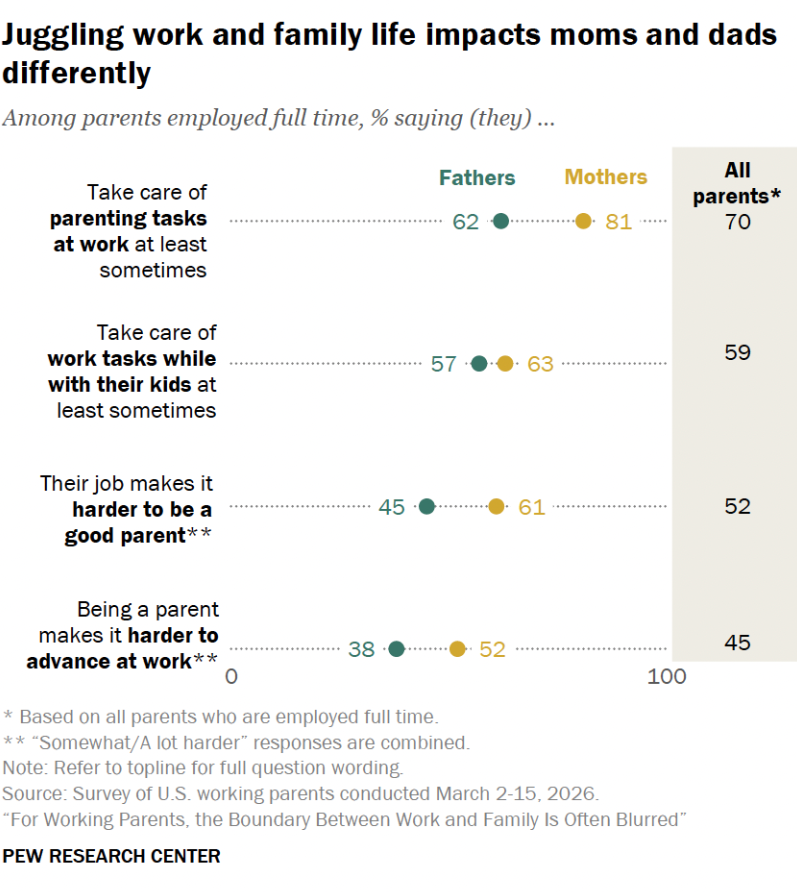
More than half (52%) of parents say that their job makes it harder to be a good parent, according to a report from the Pew Research Center.
This especially takes a toll on working moms.
In fact, 62% of full-time working moms say it’s difficult for them to balance work and family responsibilities, compared with 47% of dads.
“Compared with dads, working moms take on more at home and have a harder time finding balance,” Pew Research states.
Let’s dive deeper into this topic and how it impacts parents and families.
Working Parents by the Numbers
Of the nation’s 85.9 million families, 79.8% had at least one employed member in 2025, according to the U.S. Department of Labor.
It can be difficult to define the line between work and family for many U.S. working parents.
While 70% say they take care of parenting-related tasks while they’re working, 59% say they take care of work-related tasks when they’re with their children.
Additionally, 52% say the mom takes on more parenting tasks, while smaller shares say the dad does more (10%) or that these tasks are shared equally (39%).
“Parents – especially moms – often carry the mental load that comes with trying to balance what their families need with what their work demands,” the Pew Research Center states.
The report finds that parents tend to have very different views of how parenting tasks and household chores are divided.
“Most moms say they themselves handle more of these responsibilities than their spouse or partner. Dads are more likely than moms to say these tasks are shared equally,” according to the Pew Research Center.
Most full-time working parents also reported that they don’t think they spend enough time with their children due to work obligations.
They also said that they don’t have enough time for hobbies, friends, exercising, or relaxing.
“Nearly half (47%) say their work responsibilities at least sometimes cause them to miss activities their children are involved in, such as school concerts or sporting events,” according to the report.
Flexibility and Workplace Benefits
According to the Pew Research Center report, most full-time working parents say having flexibility to work from home when needed would be extremely or very helpful.
However, only 24% of working parents report that they have a lot of flexibility to telework.
Additionally, only half of working parents have access to paid parental, family, or medical leave.
“Those who regularly work from home see some advantages to this arrangement, like being able to attend their children’s activities when they overlap with work hours,” the Pew Research Center states.
Part-time working parents face many of the same challenges as those who work full time.
“Part-time working parents are less likely to have access to workplace benefits such as health insurance, paid time off and other paid leave through work,” the report states.
Data shows that among working parents who are not self-employed, those with upper and middle family incomes are much more likely than those with lower incomes to say they have access to:
- Health insurance (95% and 84% vs. 58%)
- PTO (94% and 84% vs. 59%)
When looking at income levels, cost of childcare is a big challenge.
“Lower- and middle-income parents are more likely than those with higher family incomes to rely on family, friends or neighbors for childcare,” according to the Pew Research Center.
About half of lower-income working parents would be highly worried about losing pay if they had to take time off from work to care for a sick child.
Black and Hispanic working parents (42% and 43%) are more likely than to say they would be highly worried about losing pay in these situations.
“For working parents with upper family incomes, daycare or preschool is the most common arrangement (used by 72%). But among parents with lower or middle family incomes, there’s no dominant care arrangement,” according to the Pew Research Center.
The complete findings and additional information can be found here.
Knowing the Health of Your Community
Work, families, and childcare are a part of everyday life.
What do those factors look like in your community?
Find out by downloading the Salud America! Health Report Card for your town!
Enter your county name and get auto-generated local data with interactive maps and comparative gauges on several health indicators.
See how your county stacks up compared to the rest of your state and nation.
Then email the Report Card to local leaders to raise awareness, include the data in a presentation or grant proposal, or share it on social media to drive healthy change in your community!
Explore More:
Healthy Families & SchoolsBy The Numbers
142
Percent
Expected rise in Latino cancer cases in coming years