by
by 
Share On Social!
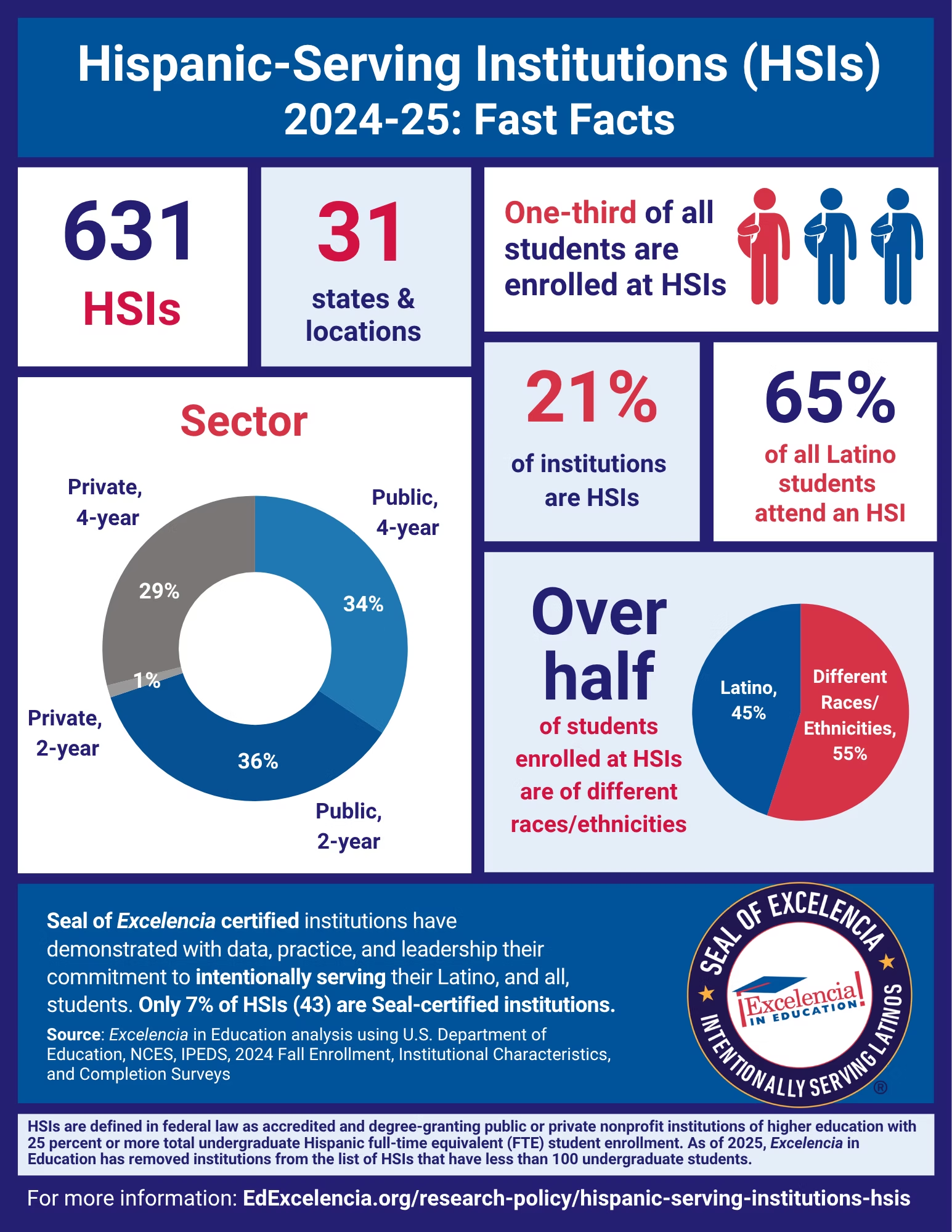
There are now 631 colleges and universities registered as Hispanic-Serving Institutions (HSIs) across 29 states, Washington, D.C., and Puerto Rico.
This is an increase over the 602 reported last year, according to a new report from ¡Excelencia in Education!.
HSIs are defined as “accredited, degree-granting public or private not-for-profit institutions of higher education with 25% or more total undergraduate Hispanic full-time equivalent student (FTE) enrollment.”
Let’s explore what this means and how it impacts students.
By the Numbers: Hispanic-Serving Institutions (HSIs)
HSIs represent 21% of all colleges and universities but enroll 65% of Latino and 32% of all undergraduates, according to ¡Excelencia in Education!.
The graduation rate for HSIs include 67% of Latino and 32% of all undergraduates earning a degree in the U.S.
The number of HSIs that offer graduate programs has significantly increased, going from 45 to 276 over 31 years.
“The purpose of the Developing HSIs program legislated in 1992 of the Higher Education Act is to meet a clear national need—ensuring that institutions with low educational and general expenditures, a high enrollment of needy students,” according to ¡Excelencia in Education!.
By the Numbers: ‘Emerging’ Hispanic-Serving Institutions (HSIs)
In addition, there is a large number of emerging Hispanic-Serving Institutions (eHSIs) – those with 15.0-24.9% undergraduate FTE Hispanic enrollment.
427 colleges and universities qualify as eHSIs (representing 14% of all institutions), according the report from ¡Excelencia in Education!.
Most states have at least one eHSI and most are four-year institutions (74%).
Overall, the report found that, out of 3,018 institutions of higher education, 1,058 (35%) were either an HSI or eHSI.
Hispanic-Serving Institutions (HSIs) by Geography
¡Excelencia in Education! data show that HSIs are geographically concentrated.
California has the most HSIs (175) followed by Texas (109), Puerto Rico (54), and Illinois (41).
There are also states that have HSIs, but not known to have large Latino populations, including Arkansas, Indiana, Kansas, and Oklahoma.
The report also finds that HSIs are often smaller institutions, with over half enrolling between 1,000 and 10,000 undergraduates.
Additionally, most HSIs are public (70%), four-year universities (63%), while 37% are two-year universities and 30% are private.
Looking to Future of Hispanic-Serving Institutions (HSIs)
HSIs provide many important benefits for students, especially with the help of federal funding, according to ¡Excelencia in Education!.
“Federal appropriations for Title V also grew significantly, and investment in HSIs increased steadily for a decade. Yet even at peak funding, less than a third of HSIs had competed successfully for Title V funding,” according to the report.
Excelencia in Education highlighted the opportunities that would not be possible without federal support through Title V funds, such as:
- Embedding career exploration into core coursework
- Leveraging AI for financial education
- Strengthening industry partnerships
- Elevating high-impact research opportunities
- Implementing evidence-based course redesign
“Support for HSIs is imperative to meeting the needs of these colleges and universities that enroll and graduate a wide array of students that extend far beyond the Latino demographic,” said Antonio R. Flores, President and CEO of the Hispanic Association for Colleges and Universities.
Explore the report’s full data here.
Support for Community Health
Education plays a part in your overall health.
How is the state of education – and health – in your community?
Find out by downloading a Salud America! Health Report Card for your town!
Enter your county name and get auto-generated local data with interactive maps and comparative gauges on several health indicators. This can help you visualize and explore local issues in education, housing, transportation, food, health, and more.
See how your county stacks up compared to the rest of your state and nation.
Then email the Report Card to local leaders to raise awareness, include the data in a presentation or grant proposal, or share it on social media to drive healthy changes in your community!
By The Numbers
44
million
immigrants live in the United States