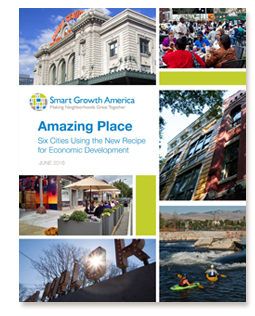
Economic development is a key factor in every city’s growth. Over the last several decades, local economic development in the United States has usually involved cities, states, and regions battling against one another in an effort to attract new residents, companies, and jobs. Typically, the trend for economic development comes in the form of tax breaks, subsidies, location incentives, and favorable tax rates. However several cities are now using a new strategy to generate economic development. Boise (7.74% Latino population), Denver (31.2% Latino population), and Pittsburgh (2.66% Latino population) are some of the many cities that are creating walkable, vibrant, inclusive neighborhoods that are attracting residents and employers, supporting existing businesses, and fostering ...
New reports on healthy foods in school meals show that there still remains issues for underserved children of color. The Centers for Disease Control and Prevention state that many children consume most of their daily calories- a third to a half- at school, making school one of the most important food environments that impact a child's future health. A recent report from the CDC looking at schools across the U.S. from 2006-07 to 2013-14, shows that more schools in the West have the availability of salad bars in their schools than all other regions and most schools serving socio-economically disadvantaged students were less likely to have salad bars. Also revealed in the report, were that many majority-Latino schools were less likely to offer fresh fruit in school meals. Latino ...
Having healthy eating habits from early ages is important to setting up a healthier future. According to a recent study article, one in five children in the U.S. entering elementary school is overweight, but new research has revealed that the USDA's Special Supplemental Nutrition Program for Women, Infants, and Children (WIC) program has improved roughly four million children's' diet quality. Researchers funded by the National Institute of Health looked at how diets changed with new WIC food packaging, discovering that children in WIC households had eaten some vegetables while only one in five children, not receiving WIC, had any vegetables. Studies also show Latino kids often face less access to healthy foods in their schools and neighborhoods, resulting in poorer ...
Many Americans take a large number of factors into consideration when choosing where they live. These factors include the quality of the schools in the area, the strength of the local economy, and the safety of the area. Still, most people do not control where they are born, live or move to. Millions of Americans find themselves living in cities that lack jobs, amenities, and security. Online magazine 24/7 Wall St. reviewed the data from 550 U.S. cities with populations of 65,000 or more according to the U.S. Census Bureau. Based on a number of variables, such as crime rate, employment growth, access to restaurants, educational attainment, and housing availability, the site identified the worst cities to live in. Income is highly associated with numerous social and economic factors. ...
It has been a long-held belief that, if you have a college degree, you have a better chance of landing a job. A new study from the Center on Education and the Workforce at Georgetown University has all but confirmed that. Of the 11.6 million jobs created after the Great Recession, nearly 8.5 million went to those with at least a bachelor’s degree. Another 3 million of those jobs went to individuals with an associate’s degree or some college education. According to the Robert Wood Johnson Foundation, for millions of Americans, a steady job in safe working conditions means more than a paycheck; it also comes with potential benefits (such as health insurance), and stability necessary for good health. Americans with only a high school diploma represent a shrinking share of the ...
The popular song lyrics found on soda cans and in soda marketing are not the only song being sung. A new song from Mexican band, Ave Sol, released a new album, Dulce Veneno (Sweet Poison), to help bring awareness to the health risks of drinking sugary beverages. A free concert featuring the song, "Sugary Soul" will be featured in Chapultepec Park in Mexico City.
Inspired by The Bigger Picture and the first youth poet who performed live at The Soda Summit in 2014, this project is a counter-marketing open-the-truth initiative to spark awareness and public dialogue about sugary drinks and the diabetes epidemic in Mexico and hopes to support awareness-raising efforts throughout the Americas.
The record is a collaboration among the Mexico City School of the Word of Rock, an ...
Most Americans are still not aware of the many serious health consequences associated with being obese. Additionally, misconceptions about what healthy weight and obesity look like further complicates adults' and parents' ability to correctly identify weight status, thus they are unable to correctly identify their and their children's risk for life-long health complications. According to the Nutrition and Physical Activity Initiative at the Bipartisan Policy Center (BPC) 2012 report, "obese people are far more likely to develop chronic diseases like diabetes, hypertension, asthma, heart disease and cancer. Obese children are more likely to have one or more risk factors for cardiovascular disease, to be prediabetic (i.e., at high risk for developing diabetes), and to suffer from bone ...
A recent article reports that Santiago, Chile is working to combat obesity by providing consumers with warning labels on unhealthy foods. Chile deals with high obesity and diabetes rates. In 2014 an article reported Chile to be the fattest nation in the world, with 37% of boys overweight or obese and girls at 32%. The legislation passed back in 2012, will now be implemented with restrictions on advertising unhealthy foods to kids and also will indicate caloric content with black octagons and warnings showing high fat, sugar, sodium or caloric content. Latino kids in the U.S. also deal with higher diet-related diseases like diabetes and obesity. Studies show that incorporating guidelines in schools that restrict access to unhealthy foods and beverages positively impact ...
Latinos represent nearly 25% of all public high school students. It has been projected that this is a trend that will continue increasing for years to come. Latinos have made progress in terms of college and career readiness, but more work still needs to be done. A new brief, authored by Excelencia in Education and ACT, Inc., offers recommendations that policymakers and schools can implement to increase Latino college and career readiness. The report, entitled College & Career Readiness 2015 – Hispanic Students provides a snapshot of the academic performance of Latino high school students that graduated in 2015 and took the ACT college readiness assessment. Key findings from the brief include determining that Latino students have high postsecondary aspirations. Parents are ...