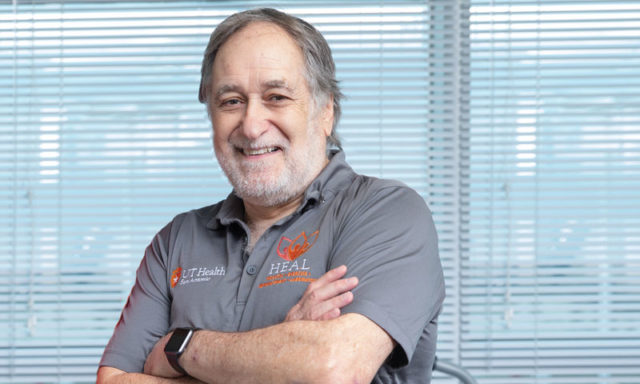
Daniel Carlos Hughes thought he wanted to be a chemical engineer. He worked at Dow Chemical for 23 years, moving up to a middle management position. But then he had a midlife crisis. Now he works as a kinesiologist focuses on sport and exercise psychology. He researches holistic interventions for cancer prevention and with an emphasis on exercise and stress in Latina breast cancer survivors as a faculty member of the Institute for Health Promotion Research (IHPR) at UT Health San Antonio. While the career switch was risky and required many years of schooling, Hughes is glad to have found a calling where he can help cancer survivors live longer, fitter, better lives.
Hughes, a First Generation Mexican American in His Second Career
Hughes was born in Mexico City. His family ...
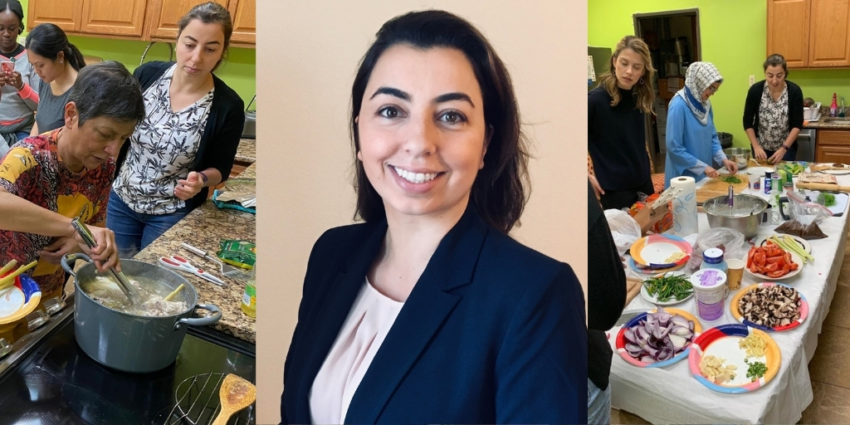
From a young age, Flávia Fernandes wanted to practice medicine. Thanks to years of resiliency and dedication, she is now working toward a medical degree as a medical humanities student at UT San Antonio. But she’s already working hard to improve the health of her community. Fernandes, who is originally from Brazil, is part of the El Bari UT Health Healthy Choices Team — a group of San Antonio doctors, students, and community members who are creating and sharing healthy recipes online along with health education resources. For Fernandes, this is a life-long goal realized. “The work I’m doing now is better than what I dreamed for,” she said. “I wanted to learn about the ways doctors engage with the community and promote positive changes in people’s lives. ...
What we engineer and build impacts public health, safety, and welfare. However, transportation engineering prioritizes convenience for people driving over safety for people walking or biking. This makes streets more dangerous for everyone, including drivers. Now is our opportunity to change all that. Public comments are wanted on revisions to one of transportation engineering’s “bibles,” the 700-page Manual on Uniform Traffic Control Devices for Streets and Highways (MUTCD). The MUTCD, which was last rewritten 50 years ago from the point of view of expediting vehicle movement, is full of assumptions, restrictions, and contradictions that hinder efforts to improve safety and create vibrant, welcoming streets. Submit one of three Salud America! model comments to tell ...
Everyone should have a fair and just opportunity for the best possible health and well-being. That’s health equity. And that’s the mission of the Health Opportunity and Equity (HOPE) Initiative. The HOPE Initiative is led by the National Collaborative for Health Equity and Texas Health Institute in partnership with Virginia Commonwealth University’s Center on Society and Health. The Robert Wood Johnson Foundation provides funding. The HOPE Initiative tracks data on 27 indicators related to social and economic factors, community & safety, physical environment, access to healthcare, and health outcomes. “Our unique analyses use an opportunity framework to set aspirational but achievable goals to improve life outcomes—especially populations of color most affected ...
Have you ever wondered how your county compares to others in healthcare, education, and opportunities? County Health Rankings & Roadmaps is a program by the University of Wisconsin Population Health Institute and Robert Wood Johnson Foundation that measures health disparities in different counties based on local data to help improve health and quality of life. The 2021 update of the County Health Rankings reflect the inequities worsened by the COVID-19 pandemic and shines a brighter lens on racial equity and justice. “And while the Rankings do not measure COVID-19 risk, they do help to show the root causes that contribute to poor health. Creating conditions for everyone to thrive requires looking to multi-layered social, economic, and structural factors that run much longer ...
Not all children in Texas have equal access to healthy food and quality healthcare, and stable economic security. Latino children and other children of color face disparities in these areas due to historic systemic racism. The details of these disparities are covered in a new report, “Texas KIDS COUNT: Health Equity for Every Texas Child,” led by nonprofit group Every Texan with support and funding from the Annie E. Casey Foundation and Methodist Healthcare Ministries of South Texas. The report explores three key areas ─ food insecurity, health insurance, and economic opportunity ─ and what public policy can address inequities so all Texas children can live healthier lives.
The ‘Texas KIDS Count’ Report on Food Insecurity
Food insecurity is prevalent in the United ...
Data continue to show that systemic inequities, from discrimination to unstable housing to a lack of healthcare access, lead to worse health outcomes for Latinos. How can we promote system and policy change to address inequities? Our Salud America! #SaludTues Tweetchats, a weekly hour-long discussion series on Twitter about Latino health equity issues, are an emerging way to engage people in learning and advocacy for change, according to our new study in the Journal of Medical Internet Research (JMIR). "The study proves that planned, culturally relevant tweetchats like #SaludTues can be a powerful tool for public health practitioners and advocates to engage audiences on Twitter around health issues, advocacy, and policy solutions for Latino health equity," said Dr. Amelie G. ...
As the impacts of climate change continue to wreak havoc on communities across the globe, US Latinos are calling on leaders in Washington to do something. The new Biden presidential administration—one that has voiced its support for science and wants to do something about this issue—is working to make headway, despite four years of environmental rollbacks and the ongoing COVID-19 pandemic. Still, communities of color, who will face the most significant harm, need wide-sweeping and immediate change, according to Ben Monterroso, a board chair of the national non-profit, Corazón Latino. “The strong support for the environment and climate action among Latinos continues a trend that has been building for years,” Monterroso writes in a recent USA Today op-ed. “Our elected ...
President Joe Biden’s COVID-19 Task Force is in full swing, and their main focus is tackling health equity. On Jan. 21, 2021, Biden signed an executive order to create a task force focused on COVID-19 related health and social inequities. “As the COVID-19 pandemic continues to plague the country, it has had a disproportionate impact on some of our most vulnerable communities. Shortly after COVID-19 was first identified in the United States, disparities in testing, cases, hospitalizations, and mortality began to emerge. These inequities were quickly evident by race, ethnicity, geography, disability, sexual orientation, gender identity, and other factors,” according to the White House press briefing. As a result, the Biden administration selected people from diverse ...