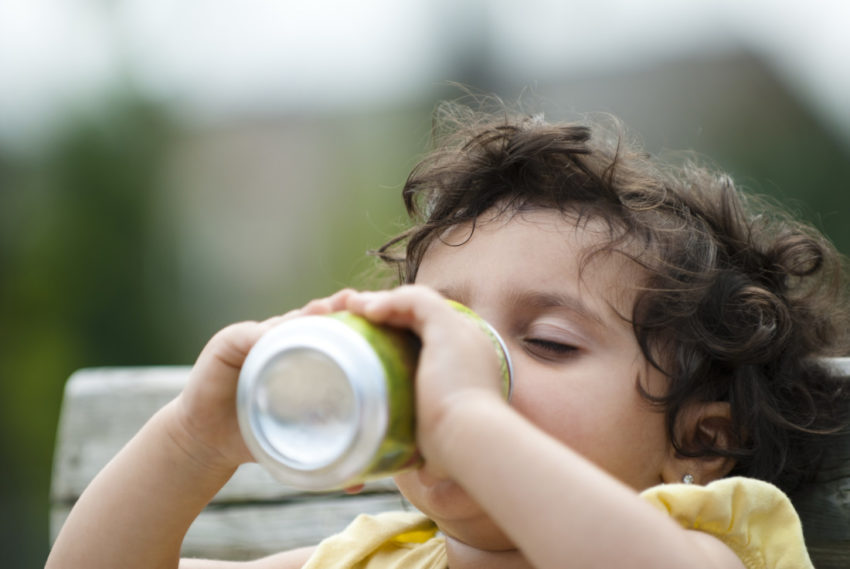
Recent reports have shown a leveling off in childhood obesity rates. But, for Latino kids, the crisis of obesity is continuing at significantly higher rates than among their peers, according to new data from the Robert Wood Johnson Foundation, Trust for America’s Health, and the Child and Adolescent Health Measurement Initiative. Across the nation, Latino kids ages 10-17 were more overweight or obese (39.9%) than their black (38.2%) and white (26.3%) peers. “Children as young as 11 from socially and economically disadvantaged families and neighborhoods appear more likely to have thicker carotid artery walls, which in adults may indicate higher risk for heart attack and stroke in later life," said Nancy Brown, American Heart Association CEO, in a recent statement. "Elected ...
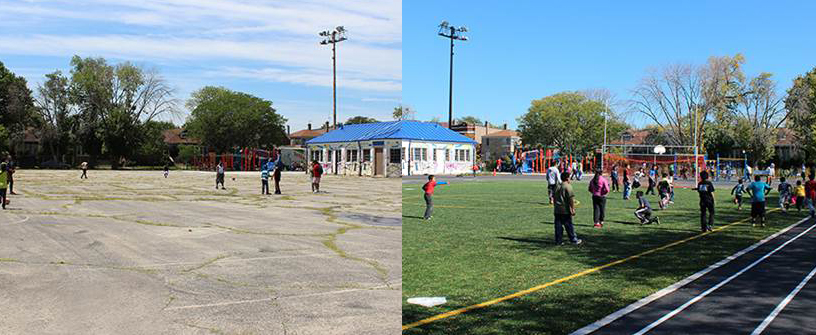
Finding safe places for kids to play hasn't been easy for Latino families in Chicago. For example, 30 years ago, the federal government sued the Chicago Parks District for favoring parks in white neighborhoods and neglecting parks in African-American and Latino ones. Schools in Chicago didn't have equitable funding to maintain their own playgrounds over the years, either. At the same time, the nation was shifting to a school day with less time for recess—creating a "recess drought." But school officials wanted to play a role in increasing access to safe green space for Latino kids and families.
Solving the 'Recess Drought' (and Preventing Floods)
Chicago Public Schools, the third largest school district in the nation, took a big first step in 2011. They passed a recess ...
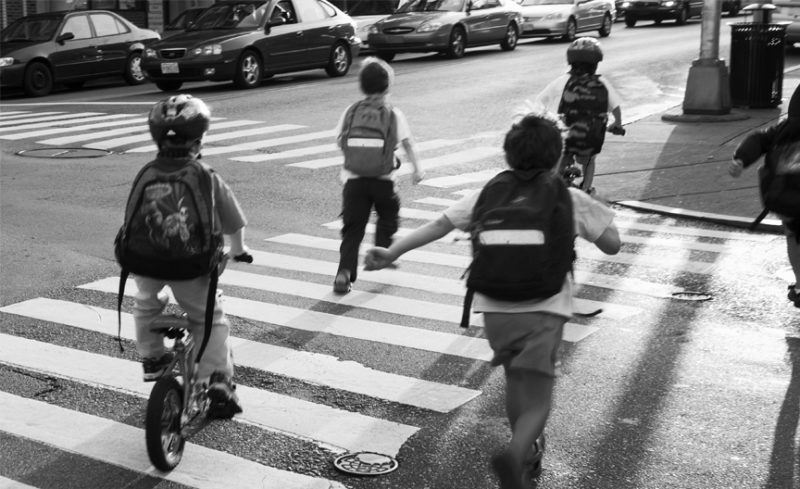
The U.S. is failing five of nine factors that reflect walking and walkable communities, according to a new report card. Children's walking behavior, pedestrian infrastructure, safety, institutional policies, and public transportation were graded an "F" by the new 2017 United State Report Card on Walking and Walkable Communities. The report is from the National Physical Activity Plan Alliance, which developed a system to evaluate U.S. walking and walkability.
Why walking is critical in Latino neighborhoods
Walking is a natural and inexpensive activity to improve health and prevent chronic disease. However, safe places to walk are often not accessible, particularly in Latino neighborhoods, according to our own research. Thus, many Latino children and adults don't walk and suffer ...
President Donald Trump's administration recently rescinded the Deferred Action for Childhood Arrivals (DACA), an American immigration policy signed by President Barack Obama five years ago. DACA allows unauthorized immigrants who arrived in the United States as children to work, go to school, and get a driver’s license without fear of deportation. The clock is now ticking for a Congressional fix for people who qualify for DACA. If not, recipients could lose their status starting March 5, 2018.
Who are DACA recipients?
Since the program started in June 2012, most DACA recipients are in Latino-centric states: California (222,795) followed by Texas (124,000) and Illinois (42,376). Unauthorized immigrants from Mexico make up more than three-quarters of all DACA ...
Latinos are a big focus of National Suicide Prevention Week on Sept. 10-16, 2017. Young Latinos are more likely than their peers to attempt suicide. High levels of stress, from discrimination, poverty and bullying, play a big role in this high percentage rate, according to our new Mental Health & Latino Kids Research. What can you do to help raise awareness and prevent suicide in your community? Start by knowing the signs. Here is a few examples of warning signs, according to the Mental Health America of Texas. Feeling hopeless. According to our research, 32.6% of Latino students reported feelings of hopelessness and sadness that continued for more than two weeks and resulted in decreased participation in activities they had previously enjoyed, a study found.
...
Schools in Fresno, CA (52.8% Latino) opened their green and blue spaces to the public. Green spaces are parks, playgrounds, sports fields and other outdoor play spaces. Blue spaces are swimming pools, lakes and rivers. Latino kids lack safe green and blue spaces, thus face higher rates of chronic disease, drowning, and drowning related injuries compared to white kids. In June 2016, the Fresno Parks, After School, Recreation, and Community Services Department (PARCS) started a new Weekend Recreation and Fitness Program (WRFP) to get help kids and families stay more active. With a $1.2 million dollar budget from the City of Fresno, Fresno Unified School District, and Central Unified School District, they opened school facilities, like playgrounds, sports fields and green space, ...
Latinos report the highest levels of stress among groups, due to money, employment, and family and health issues, according to the recent American Psychological Association (APA) annual Stress in America survey. When it comes to stress and mental health, Latinos often go untreated or undiagnosed. Persistent stress in young children can become toxic, according to new research from the National Center for Child Traumatic Stress. This toxic stress has been shown to cause “brain changes” that can interfere with learning and lead to more problems in adulthood. The research was unable to pinpoint exactly how many children have been harmed to date by toxic stress, but the data showed that many live in circumstances that experts say “put them at risk.” Other findings ...
Bullying can stress a Latino child's emotions and mental health, and can contribute to high blood pressure, heart disease, obesity and diabetes. That's bad enough. But bullying also can keep a child from attending school and impact the finances of school districts across the country, according to a new study by UT Austin, Medline reports. About 10% of kids in California (38.39% Latino population) missed at least one day of school in a month because they felt "unsafe" due to bullying, according to the study. That's about 301,000 kids missing school. And California schools—which get funding based on student attendance instead of total enrollment like in many other states—lose in excess of $275 million in funding each year when these bullied kids stay home. “Bullying ...
Latinos are the nation’s largest racial/ethnic minority group. They are expected to grow from 1 in 6 people today to 1 in 4 by 2035 and 1 in 3 by 2060. The long-term health and success of Latinos is going to be crucially important to the United States for decades to come. In the Pacific Northwest community of Walla Wall, WA (23.68% Latino population), one group has taken steps to ensure their Latino community has all the tools necessary for their success. The Walla Walla Valley Early Learning Coalition is offering a free, 10-week series of parenting master classes aimed at Latinos. Using “cultural perspective” and taught in Spanish, the Abriendo Puertas (Opening Doors) program is designed to support Latino parents in their roles as family leaders and teachers to their ...