by
by 
Share On Social!
This content is from UT Health San Antonio’s book, “Advancing Cancer Research for Latinos and All Populations: 2026 Conference Proceedings,” which highlights results of the same-named conference in February 2026.
Tumor Progression and Pancreatic Cancer
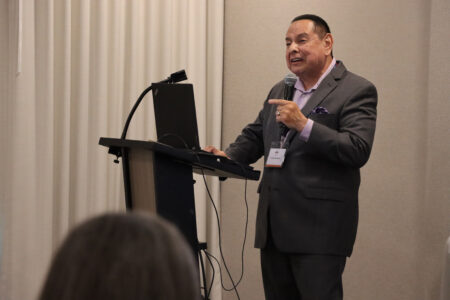
Dr. Jose Trevino is Chair of the Division of Surgical Oncology at the Virginia Commonwealth University (VCU) School of Medicine, and Surgeon-in-Chief at VCU Massey Cancer Center.
Improved mortality among Latino pancreatic cancer patients

Dr. Trevino began the presentation by underscoring the severity of pancreatic cancer, which is projected to be the number 2 cause of cancer deaths by 2030. In Puerto Rico, however, although incidence of pancreatic cancer has been rising over the past decade, mortality has remained relatively constant. This finding led Dr. Trevino and colleagues to further investigate pancreatic cancer mortality in Latino individuals.
In the US as a whole, according to data from the national cancer database (NCDB) in 2020, the Latino population had the best overall survival compared to other racial and ethnic groups. In light of the heterogeneity of the Latino population, pancreatic cancer mortality was evaluated even further by country of origin. This analysis revealed that Dominican individuals had the best overall survival.
A counterintuitive finding based on weight
Global analysis of pancreatic ductal adenocarcinoma incidence and mortality from 2010 to 2025 revealed similar trends. Although Latino patients presented with later stage cancer, which is seen with many cancer types, they had better outcomes than non-Hispanic White or Black patients. Further analysis even found that overweight Latino patients had better outcomes than underweight patients or obese patients. In fact, underweight patients had a 45% higher risk of death than overweight patients. Overweight and obese Latino pancreatic cancer patients also had a significant survival advantage compared to overweight and obese non-Hispanic White and Black patients. While the reasons for the statistical advantage among Latinos–and in particular overweight Latinos–remain unknown, these findings represent important areas of future research into pancreatic cancer survival.
A frequent finding among pancreatic cancer patients is malnourishment and muscle loss. Interestingly, there is a histological difference in the muscle of Latino, non-Hispanic White, and Black pancreatic cancer patients. Black patients tend to have increased fat and collagen deposition, making their muscles unhealthy. Genomic differences are also observed, including differences in upregulated and downregulated gene ontology pathways between non-Hispanic White and Black patients. However, this type of data is unavailable for Latino patients.
Much more Latino participation in clinical trials is needed to close the data gaps in oncology research. However, as noted in other presentations, Latino participation in clinical trials is well below the level of Latino representation in the US population. Some of this discrepancy is due to barriers to participation at the level of the individual, a lack of understanding, and a lack of willingness to participate. However, a large part of the responsibility for Latino involvement also falls on clinicians, who need to engage in concerted efforts to enroll participants from all backgrounds in order to obtain the best data possible.
Cooperation is key
Another approach to addressing data gaps among Latino cancer patients is to increase the collection of biological samples from this population. Unlike efforts to improve clinical trial participation, this can be implemented more immediately through partnerships with clinicians. By collaborating across institutions and geographic regions, researchers can access samples from a broader range of patient populations. These biospecimens can then be analyzed to isolate key components and better understand disease processes. This is particularly relevant for examining histological differences in muscle among pancreatic cancer patients across racial and ethnic groups.
Dr. Trevino ended the presentation with a call for increased cooperation and sharing of tissue samples for improved research. Through the sharing of samples, insight, data, and information, questions involving differences in pancreatic cancer outcomes can be answered. Insights into variance in muscle tissue based on race may also lead to an understanding of why overweight Latino pancreatic cancer patients have improved mortality rates.
Disparities in Biomarker-Driven Therapies: Are Latinos Underrepresented in Precision Medicine?
Dr. Luis E. Raez is Chief Scientific Officer and Medical Director at Memorial Cancer Institute/Memorial Healthcare System, Research Professor of Medicine at Florida Atlantic University (FAU), and Past-President of the Florida Society of Clinical Oncology (FLASCO).
Biomarker testing for lung cancer patients

Dr. Raez began by discussing the importance of biomarker testing and how it impacts non-small cell lung cancer (NSCLC) outcomes. Lung cancer is the leading cause of cancer-related deaths in the US and worldwide, and NSCLC accounts for 85% of all cases. Lung cancer outcomes are typically dire, with 57% of lung cancer patients presenting at stage IV, and a 5-year overall survival rate for stage IV disease of 6%.
However, biomarker-driven therapies improve overall survival. Immunotherapy and kinase inhibitors lead to improved 5-year overall survival in stage IV NSCLC, with reported rates ranging from 15% to 60%. Researchers have already identified 12 oncogenic drivers in NSCLC, and 25 therapies have been approved for appropriate precision treatment. As a result, patients with one of these drivers have much higher overall survival rates. Biomarker testing is therefore fundamental to the treatment of advanced NSCLC.
Barriers to testing
In Latin America, however, barriers to molecular testing adoption prevent adequate testing. Policy barriers include unequal access to tests and therapies, insufficient funding, lack of appropriate insurance billing codes for next-generation sequencing (NGS), limited acceptance of the benefits and impact of molecular testing, and fragmented administrative and reimbursement processes. Barriers at the individual level include a lack of awareness and training of medical personnel, a shortage of trained personnel, and poor availability of molecular tumor boards. Barriers in infrastructure include poor research and local data in genomics, poor digital transformation of healthcare stakeholders, and low availability of molecular biology laboratories.
Although Latino lung cancer patients are less likely to receive molecular testing than non-Hispanic White patients, variations in the frequency of certain oncogenic drivers based on race and ethnicity have been seen. Latino patients living in the US, for example, have a higher rate of EGFR mutations (25%) than non-Hispanic White patients (15%). The frequency of these mutations also varies based on country of origin, with patients from Peru having the highest frequency (55%), followed by Mexico (25%), Brazil (20%), and Argentina (15%). These findings may be good news for Latino patients since the presence of oncogenic drivers allows for precision therapy and therefore better outcomes.
However, even in the US access to precision treatment is limited, with only 12.1% of NSCLC patients receiving targeted treatment during first-line therapy, and only 15.8% of patients receiving targeted treatment in any line of therapy. A recent survey of US physicians identified several barriers to NGS: reimbursement challenges, lack of knowledge or awareness, lack of evidence of clinical utility, lack of availability of supportive resources, and logistical barriers.
Solutions to improving lung cancer outcomes
One solution to increased NGS testing is increased clinical trial participation. However, only 3.3% of NSCLC patients participate in clinical trials. Participation is even lower among Latino lung cancer patients, with only 2.2% clinical trial participation. This lower rate of participation may be associated with rural locations or language barriers.
In order to improve outcomes, liquid biopsies should be used to make frontline treatment decisions in patients with metastatic NSCLC. Liquid biopsies are non-inferior to tissue biopsies in identifying actionable genetic alterations in patients with NSCLC. However, liquid biopsies are able to generate NGS results significantly faster than tissue biopsy NGS and bypass the logistical barriers of finding and shipping tissue samples for sequencing.
Dr. Raez ended the presentation by stressing the need to address non-medical drivers of health such as social connections, tobacco use, depression, physical activity, transportation needs, caregiver education and work, violence, alcohol use, financial resource strain, stress, food insecurity, housing stability, and caregiver health. Screening for these non-medical drivers of health can trigger important interventions to improve care. Addressing non-medical drivers of health, along with increased molecular testing, can improve outcomes for all lung cancer patients, in particular Latino patients.
The Impact of Ancestry and Population Genetics on Breast Cancer Risk and Treatment Response
Dr. Elad Ziv is Professor of Medicine at Helen Diller Family Comprehensive Cancer Center at the University of California, San Francisco.
The impact of ancestry on cancer

Dr. Ziv’s presentation focused on breast cancer and how tumor genomics vary in Hispanic populations. Some evidence already exists showing that ancestry affects the type of molecular genetic changes that occur in tumors. A study from the Cancer Genome Atlas project, for example, showed variation in tumor mutations based on African, East Asian, and European ancestry. However, due to a lack of genetic backgrounds in the project, more research is needed to fully understand how ancestry alters tumor genomics.
Responses to tumors also vary based on ancestry. Another study from the Cancer Genome Atlas project identified 6 possible inflammatory responses. Findings revealed that genetic ancestry affected the rates of these inflammatory responses.
Latina ancestry and tumor genetics
INSPIRE, a recent study by Dr. Ziv and colleagues at the City of Hope Cancer Center, sought to build on this knowledge by analyzing women with breast cancer. Latina patients were typically younger than non-Hispanic White patients, and had later stage disease. Of the 5 subtypes of breast cancer tumors–with the most common being luminal A, luminal B, HER2, and basal–Latina patients were found to have more basal and HER2 tumors than non-Hispanic White patients.
Germline whole exome sequencing, tumor whole exome sequencing, and tumor RNA-sequencing were also performed. Non-Hispanic White patients were found to primarily have European ancestry, while Latina patients primarily had a combination of European and Indigenous American ancestry. Latina patients were found to have more TP53 mutations (40%) than non-Hispanic White patients (28%). This discrepancy may have been associated with the different rates of basal and HER2 tumors. Another difference between Latina and non-Hispanic White patients was the rate of CTCF mutations, which are typically rare. About 3% of Latina patients had this mutation compared with 1% of non-Hispanic White patients.
Copy number aberrations—large chromosomal amplifications or deletions—play an important role in breast cancer biology and treatment outcomes. Both the Latina and non-Hispanic White cohorts exhibited large amplifications consistent with HER2-positive tumors, and patterns of deletion were similar between the 2 groups.
Tumor immune ecotypes
RNA sequencing data were analyzed using CIBERSORTx to estimate cell-type composition, including immune cell fractions and their activation states. A software called Ecotyper was then used to combine cell states into 10 tumor immune ecotypes. The 2 most important tumor immune ecotypes were ecotype 9 and 10, both of which tend to be inflamed tumors.
Ecotype 9 is the most inflamed tumor immune ecotype, meaning it has the best prognosis and the best response to immunotherapy. Latina patients had a higher occurrence of ecotype 9, even after adjusting for all tumor subtypes. Further analysis revealed that Latina patients with the most Indigenous American ancestry had the highest occurrence of ecotype 9. Ecotype 9 was also associated with more somatic mutations, meaning a larger immune response. Breast cancer patients with inherited mutations in BRCA1, BRCA2, and PALB2 were also more likely to have ecotype 9.
Similar findings were observed for ecotype 10. Ecotype 10 was associated with better outcomes than most other ecotypes, was higher in Latina women, and was the highest in women with Indigenous American ancestry. Ecotype 10 and Indigenous American ancestry were also associated with the APOBECC3A/B genotype, which is a deletion that is a breast cancer risk factor.
Dr. Ziv concluded the presentation by summarizing findings and stressing that this knowledge is vital to important treatment decisions that are based on these molecular subtypes. Rare CTCF mutations were more common among Latina women. Ecotype 9 and 10, which are associated with a better prognosis, were also more common among this group. Ecotype 9, which is associated with inherited mutations in BRCA1, BRCA2, and PALB2, and ecotype 10 were also more common among Latina women with Indigenous American ancestry.
By The Numbers
142
Percent
Expected rise in Latino cancer cases in coming years