by
by 
Share On Social!
This content is from UT Health San Antonio’s book, “Advancing Cancer Research for Latinos and All Populations: 2026 Conference Proceedings,” which highlights results of the same-named conference in February 2026.
Think Tank: Cancer Researchers Against Cancer
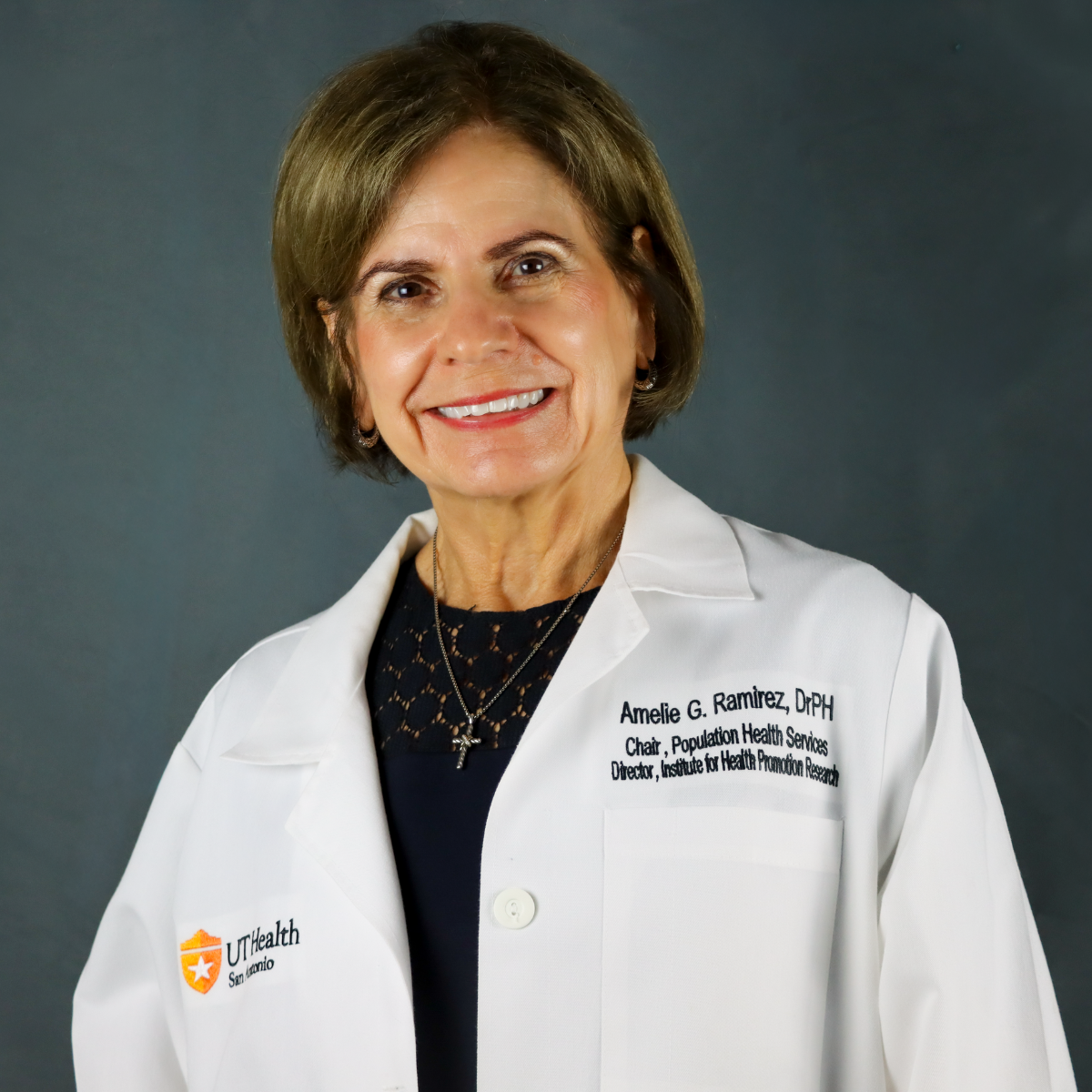
Dr. Amelie G. Ramirez is Director of the Institute for Health Promotion Research, Chair of the Department of Population Health Sciences at UT Health San Antonio, and Associate Director of Cancer Outreach and Engagement at Mays Cancer Center UT Health San Antonio. Dr. Ramirez spoke about a program called Task Force: Researchers Against Cancer, which brought together leaders from across the country to explore not only the causes of cancer in Latino populations, but also the multi-level drivers that are impacting health in this population.
One of the key findings from year one of the Task Force was that cancer stands alongside heart disease as the top killers of Latinos, driven by high rates of infection-related cancers. These elevated rates of infection and certain cancers are largely linked to non-medical drivers of health, such as low insurance, environmental exposure, and poverty. Another finding was that the broad “Latino” label hides heterogeneity, and clinical trial participation remains low. Survivors also face unmet mental health needs, financial toxicity, and limited palliative care. Finally, closing gaps requires a workforce that better reflects the U.S. population, more populations participating in clinical trials, and culturally and linguistically tailored interventions.
In year 2, the Task Force recommended several approaches to addressing the findings from year 1. The first recommendation involved investing in trust-based local engagement to remove practical barriers to care and prioritize low-cost, high-impact prevention initiatives. Another recommendation was to deliver bilingual, culturally relevant education for both patients and providers, including information on prevention, risk factors, genetics, self-advocacy, and the reduction of stigma and financial toxicity. The Task Force also stressed the importance of decentralizing care and clinical research through partnerships with local organizations, expanded technology-enabled access, and the development of satellite trial sites. Finally, the Task Force called for policy and systemic changes to protect and expand insurance coverage, update screening approaches in areas where earlier onset occurs, increase Latino representation in the healthcare workforce, reduce exposure to environmental toxins among exposed populations, and decrease the burden of healthcare costs.
Task Force members included: Amelie G. Ramirez, DrPH, Patricia Chalela, DrPH, Edgar Munoz, MS, and Adolfo Diaz Duque, MD (UT Health San Antonio); Lorna Rodriguez-Rodriguez, MD (City of Hope National Medical Center); Leon Bernal-Mizrachi, MD (Emory University); José López, MD (University of Washington), Paulo S. Pinheiro, MD, PhD (University of Miami); Barbara Segarra-Vasquez, DHSc (University of Puerto Rico); Gregory Talavera, MD, MPH (San Diego State University); Luis G. Carvajal-Carmona, PhD (University of California, Davis); and Edward J. Trapido, ScD, FACE (Louisiana State University School of Public Health).
The Task Force was made possible thanks to the generous support of Bristol Myers Squibb, Genentech, and Gilead. The funder was not involved in the project design, collection, analysis, interpretation of data, the writing of this article, or the decision to submit it for publication.
By The Numbers
142
Percent
Expected rise in Latino cancer cases in coming years