by
by 
Share On Social!
Quality childcare plays an important role for parents, children, and the economy.
Yet America has a fragmented childcare and early learning system that doesn’t meet the needs of families, businesses, or early educators, according to a new report from the organization Child Care Aware of America.
The report unpacks the childcare funding landscape throughout the U.S.
“Families struggle to find and afford child care, the child care workforce is woefully underpaid, child care programs operate on razor thin margins, and businesses are suffering lost productivity and workforce turnover due to child care issues,” according to the report.
Let’s dig deeper into these issues and how they can impact children and their families.
1. States Are Still Not on an Even Playing Field When it Comes to State Childcare Funding
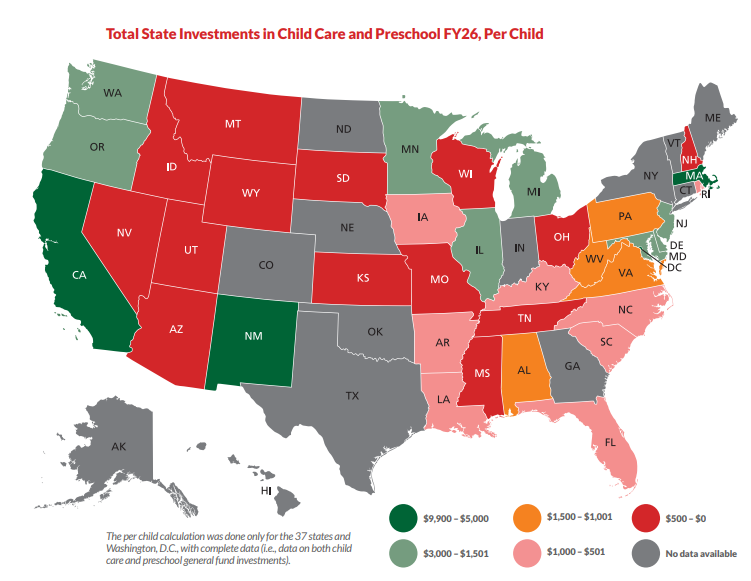
The report found that funding for childcare and preschool differs across states.
Funding ranged from less than $500 per child to more than $5,000 per child with Washington, D.C., as an outlier, investing over $9,800 per child.
“Funding levels differed for three states in FY 2026, compared to FY 2025: Maryland, Michigan, and New Jersey all moved from the $1,001-$1,500 per child level in FY 2025 to the $1,501-$3,000 level in FY 2026,” the report states.
However, seven states, including Arkansas, Idaho, Missouri, Nevada, Rhode Island, West Virginia, Wyoming, allocate no childcare funds beyond required federal matches and maintenance of effort.
2. Some States Are Increasing Funding
Total per-child investments in childcare and preschool increased from FY 2025 to FY 2026 in most states that had data for both years, according to the report.
Additionally, the average increased to about $1,700 per child ages birth to 5 in FY 2026, from about $1,400 in FY 2025.
The per-child average funding also increased across 26 of the states.
3. States Are Still Coming Up Short for Young Children
Prior research has shown that public spending on children younger than 5 is substantially less than that for school-aged children.
“For example, a recent study found that for every public dollar spent on education and care for school-aged children, preschoolers received only 21 cents and infants and toddlers just 11 cents,” the report stated.
Additionally, available data showed that some states that invest heavily in early education still fall short in comparison to their K-12 spending.
Underspending during this critical window means missing a vital chance to support and strengthen children’s long-term development and success.
“Birth to age 5 is a period of rapid, intense brain development, creating an unparalleled opportunity for learning and growth,” according to the report.
4. Tracking and Reporting Funding Remains Challenging
Tracking and reporting state childcare and preschool funding remain challenging, due to fragmented governance and funding streams, the report states.
These challenges stem from most states’ funding for childcare and preschool being spread across multiple state agencies or departments like Health and Human Services, Education, and Social Services, among others.
This can ultimately reduce transparency and accountability, making tracking spending complicated, with funds for childcare or preschool sitting in different department budgets.
“In addition, states often blend funding, combining multiple funding streams into a general pool for child care and preschool,” according to the report. “States can also braid funding, layering various funding streams while still tracking and reporting spending from each source.”
With funding being difficult to distinguish and track, challenges hindered data collection for the new study.
“In addition to these complexities, staff turnover complicated data collection, as some informants for the FY 2025 study were no longer employed at their agencies at the time of FY 2026 data collection,” the report said.
5. Recommendations for the Future
With all of the data collected, Childcare Aware of America recommends ways to improve the support for childcare across the U.S.
The first is to increase investments in childcare and preschool funding.
“Based on the findings of this study, it is clear that states should significantly increase investments in child care and preschool to address the wide disparities and ensure they are making meaningful progress toward strengthening their early learning systems,” the report states.
Secondly, the authors encourage improving transparency in across agencies to better track funding.
“Policymakers should also improve transparency by streamlining how child care and preschool funding is tracked across agencies and funding streams, allowing stakeholders to clearly understand the current landscape and identify opportunities for improvement—building on the detailed state profiles included in this report,” according to the report.
The final recommendation involves strengthening coordination between childcare and preschools with agencies that fund them.
“States should consider restructuring or enhancing coordination among the agencies and departments that administer child care and preschool programs, as more unified governance can improve clarity, reduce inefficiencies, and better serve children and families,” the report said.
Find the full report here.
Additionally, register for a webinar that dives deeper into the report and state funding at 3 p.m. ET on Wednesday, April 15, 2026.
Examine the Health of Your Community
Childcare and preschool funding can contribute to the health of children and families.
How does the health of your community do the same?
Find out with Salud America’s Health Report Card.
Download the report card for your county and see details on topics like
- Housing
- Education
- Food access
- Transportation and more
Compare the data to other counties and states across the nation.
Share the results with neighbors, local leaders, and others in the community to start important conversations about your area.
By The Numbers
142
Percent
Expected rise in Latino cancer cases in coming years