by
by 
Share On Social!
Skin cancer is one of the easiest cancers to treat and one of the most preventable if you take action to protect your skin from the harm of sun exposure.
Yet too many are still being diagnosed with the disease.
This is especially true for people in overlooked communities, especially Latinos and others who work under the sun in construction, farming, and other outdoor jobs.
May is Skin Cancer and Melanoma Awareness Month and we’re bringing attention to skin cancer by sharing these helpful resources and actions.
1. Calculate Your Skin Cancer Risk
The National Cancer Institute (NCI) has an online tool to calculate your risk for skin cancer.
Input your demographics (i.e., eye color) and UV-related habits (i.e., number of sunburns) and get your risk for developing skin cancer within the next five years.
The calculator is not a diagnosis, but a starting point in evaluating your risk so that you can talk to your health provider about preventative steps or specialist referral.
2. Examine Your Moles
Abnormal moles, like ones that change in appearance over time, can signal skin cancer.
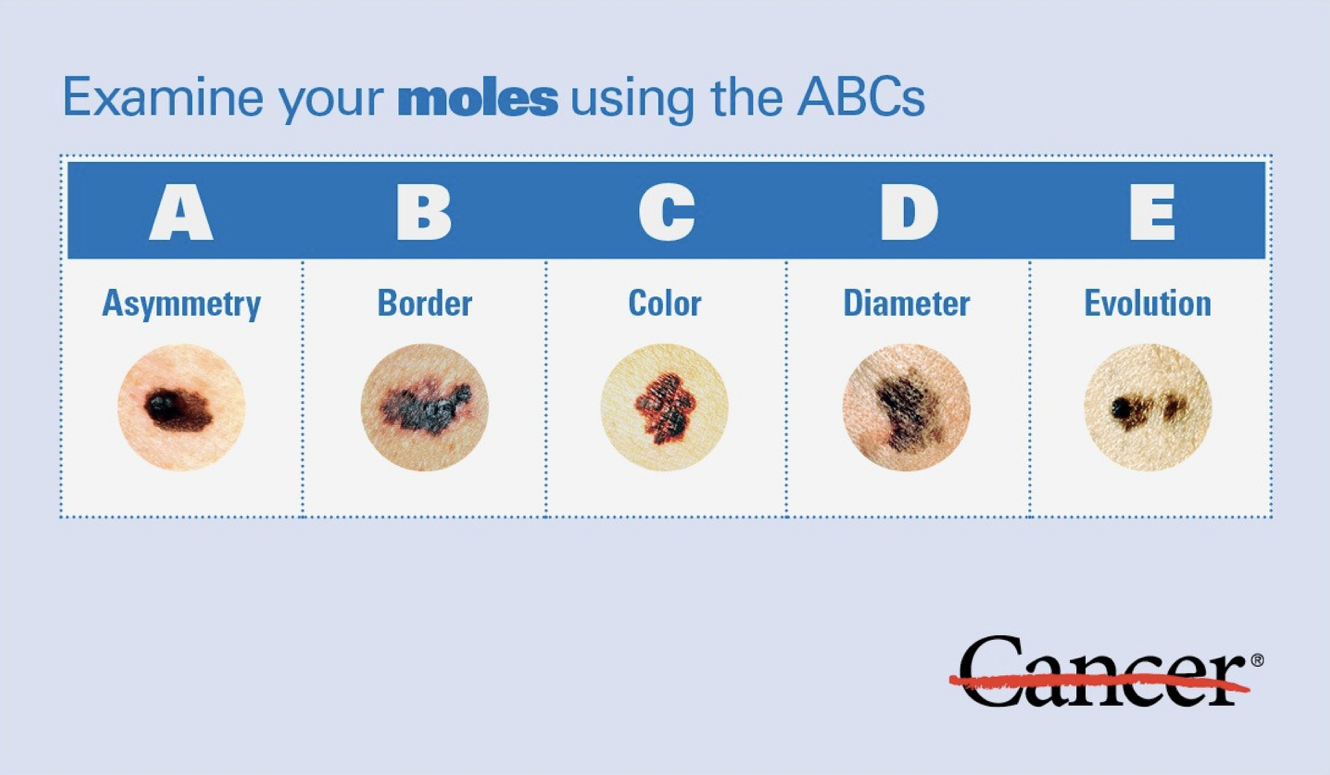
The American Academy of Dermatology Association has a simple “ABCDE” test to self-check any abnormal moles on your skin.
A is for asymmetry, B is for border, C is for color, D is for diameter, E is for Evolving.
After you’ve examined yourself, you can use their Skin Cancer Body Mole Map to track the changes, so you can give your provider the full report.
3. Raise Awareness About Skin Cancer
In honor of Skin Cancer Awareness Month, the Skin Cancer Foundation is looking to educate the public on skin cancer through their Skin Cancer Awareness Toolkit.
The toolkit is filled with ways to share, educate, combat incorrect information, and make an impact in your community.
The social media campaign has several ways to share, including designated hashtags, social media badges, downloadable infographics on skin cancer, sharable graphics containing facts to run your own social media campaign, and more.
4. Share Sun Protection Resources
Preventing skin cancer starts with knowing basic preventative care when out in the sun.
The Centers for Disease Control and Prevention (CDC) has numerous resources, including animated videos to prep you and your familia about how to have safe fun in the sun.
They have created everything from sharable graphics to podcasts on skin cancer and preventative measures.
They’ve even translated some in Spanish, so you can stay protected in any language.
check out the resources in english!
check out the resources in spanish!
5. Monitor UV Rays
One of the best ways to protect your skin is knowing the level of UV rays are for your area.
This helps you understand your risk for sun damage every day so you can stay protected.
With modern technology, you can get this information as easily as most people check the weather on their phones.
Download the SunSmart Global UV Map on your phone or other mobile device to stay in the know about UV levels in your area.
6. View Resources for Health Professionals
One of the primary ways of preventing skin cancer is being an informed health care professional and providing information and education to patients.
AIM at Melanoma Foundation has compiled a slew of resources for health professionals to help treat patients for melanoma and other cancers.
For instance, there is a website designed for nurses, which contains toolkits, symptom trackers, and sample patient action plans.
A separate website is dedicated to immunotherapy for oncologists, which contains helpful information for all cancers, including skin cancer and melanoma.
There’s also another website aimed at oncologists.
7. Join a Skin Cancer Clinical Trial
Have experience with skin cancer as a patient, survivor, or caregiver?
Do you have a family history of skin cancer?
Your unique experience may help researchers learn more about skin cancer and find ways to treat and prevent it.
Researchers do this through clinical trials.
Clinical trials are studies with volunteers that enable advances that can slow, manage, and treat diseases such as cancer for current and future family members.
However, the benefits of these studies only work if everyone is counted!
The truth is, too few overlooked populations participate in research, and their voice is needed now more than ever.
Visit our clinical trials page to find a clinical trial, read about hero volunteers, and more!
In San Antonio, find clinical trial opportunities at the Mays Cancer Center at UT Health San Antonio’s Find a Clinical Trial database.
On a national level, visit clinicaltrials.gov to find a clinical trial near you.
8. Share Your Melanoma Survivorship Story with Avanzando Caminos
The Avanzando Caminos Hispanic/Latino Cancer Survivorship study is a longitudinal observational study that explores the factors that mark the Hispanic/Latino cancer survivorship journey in South Texas and Florida.
The South Texas study site, led by Dr. Amelie Ramirez of UT Health San Antonio and Mays Cancer Center, is specifically looking at factors such as the community, familial, behavioral, mental, biological, and medical impacts on life after cancer.

Under the management of Dr. Derek Rodriguez, the study team is meeting with 1,500 participants in South Texas over the course of seven study visits spread out over five years in hopes that certain patterns may emerge.
By isolating this data, the study team hopes to address inconsistencies in cancer care related to the non-medical drivers of health and come up with interventions that ultimately go toward bettering the lives of future cancer survivors.
Through the study experience, Dr. Rodriguez hopes it gives cancer survivors an opportunity to process what they’ve been through.
“We want to be able to promote healing because for the first time in a long time, this may be someone’s first opportunity to give their cancer story,” Dr. Rodriguez told Salud America! “We want to be able to empower others to share their story as well. And we want to be able to better understand, detect, treat, and prevent cancer in the long run for other future survivors.”
To participate, you must live in South Texas, be 18 or older, and have completed primary cancer treatment for prostate, colorectal, lung, stomach, liver, endometrial, breast, cervical, kidney, bladder, melanoma, ovarian, thyroid, and lymphoma cancers within the last 10 years.
To volunteer for Avanzando Caminos or ask questions, contact Dr. Ramirez’s team at the Institute for Health Promotion Research at UT Health San Antonio at 210-562-6514 or caminos@uthscsa.edu.
Alternatively, visit the Avanzando Caminos website in English or Spanish to fill out a quick eligibility survey and a member of the study team will be in touch!
SHARE YOUR STORY WITH AVANZANDO CAMINOS!
Explore More:
Latino CancerBy The Numbers
142
Percent
Expected rise in Latino cancer cases in coming years