About the Author

Author Picture

Amanda Merck

Merck completed her MPH with a concentration in Physical Activity and Health. She curates content for Salud America! (@SaludAmerica), a Latino childhood obesity prevention project based at the Institute for Health Promotion Research at UT Health San Antonio. She focuses on the latest research, resources, and stories related to policy, systems, and environmental changes to enhance equitable access to safe places for kids and families to walk, bike, and play.


Connect with Amanda:
Twitter Link

Articles by Amanda Merck

DOT Asks You to Explore 2015 Traffic Fatalities Data


On August 29, 2016, the U.S. Department of Transportation (DOT) released an open data set containing detailed, anonymized information about nationwide traffic fatalities. This release is not business as usual. The DOT is requesting public input to help them understand what the data are revealing in communities across the country. Some private sector firms and academic institutions are already exploring the data by combining new data with their own, hosting hackathons, and launching new analytical platforms, such as StreetLight Data, CARTO, Mapbox, and Waze. Streets and sidewalks are not created equally in all neighborhoods. Inequities in transportation systems act as a barrier to health and economic opportunity, particularly in Latino communities, who rely more on public ...

Read More

6 Reasons Why Parks Matter for Health


national park 100

Access to safe parks plays a huge role in overall health and wellness by promoting promoting physical activity and improving mental health. Parks even have the potential to reduce health care costs. Unfortunately, there are inequities in Latino kids' access to parks and safe places to play; therefore, they are at increased risk for mental and physical health problems, according to a Salud America! research review. Learn more about why equitable access to safe places to walk and play are so important here. The National Park Service celebrates 100 years of stewardship the week of August 22, 2016. To celebrate this milestone in American history, the Robert Wood Johnson Foundation Culture of Health blog's editorial team asked six leaders to their reasons why parks matter for ...

Read More

Study: More Than 6 Teaspoons of Sugar is Bad for Children


Consuming more than six teaspoons of sugar a day is dangerous for children, concluded a report conducted by Emory School of Medicine and published in the American Heart Association's (AHA) journal Circulation, the Daily Mail reports. The report also warns that children under two should have zero sugar in their diets. "Our target recommendation is the same for all children between the ages of two and 18 to keep it simple for parents and public health advocates,” Dr. Miriam Vos told the Daily Mail. Foods / drinks with over 6 teaspoons of sugar include popular snacks such as a can of coke (9.25 tsp), M&M’s (7.25 tsp) and Sprite ( 8.25 tsp). “If your child is eating the right amount of calories to achieve or maintain a healthy body weight, there isn't much room in their ...

Read More

How is the U.S. Doing on Traffic Safety?


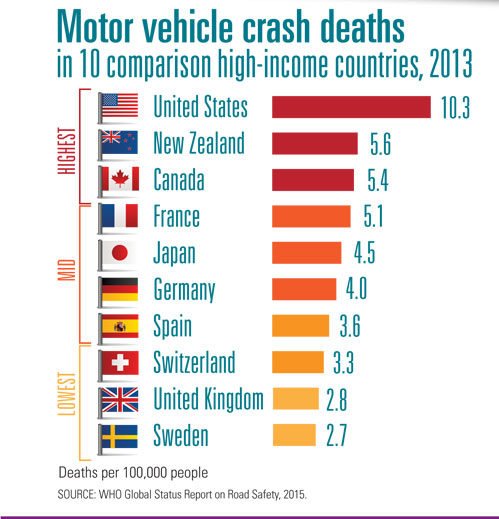
When it comes to traffic safety, the U.S. lags far behind other countries. The National Highway Traffic Safety Association's (NHTSA’s) analysis of 2015 data shows that 35,200 individuals were killed on U.S. roads last year, which is the largest year-over-year percentage increase (7.7%) since national record-keeping began. Traffic safety is a public health issue. It is also a social justice issue because there are drastic disparities in fatalities and injuries among people walking and biking, and minorities. "We won’t save the number of lives we aim to without shifting our understanding of traffic violence from an individual behavior problem to a design, policy, and organizational practices problem," according to the Vision Zero Network. Moreover, the shift in ...

Read More

Massachusetts Wellness Trust Aligns Health Care System with Prevention Efforts


An investment as little as $10 per person per year in evidenced-based, community prevention programs, such as those that increase physical activity and improve nutrition, could create health care savings of more than $16 billion annually within five years. In 2012, the Massachusetts (11.2% Latino) became the first state to use a wellness trust as an effort to reduce health care costs by preventing chronic conditions when the Massachusetts Legislature established the Prevention and Wellness Trust (PWTF) through a one time assessment on acute hospitals and payers, totaling $57 million. The Trust supports nine community-based partnerships, including municipalities, clinical organizations, healthcare systems, community-based organizations, businesses, regional planning organizations, ...

Read More

Policy Intervention to Increase Physical Activity Among Early Childcare and Education Programs


About 60% of kids under the age of 6 are placed in some form of non-parental care-early childcare and education (ECE)-during the work week. Thus, these settings are promising environments to provide obesity-prevention resources and establish physical activity habits early in childhood, particularly for Latino kids who are at greater risk for obesity-related health problems than their white peers. In 2012, researchers in Wisconsin developed a year-long, quasi-experimental study to examine the efficacy of the Active Early guide, an 80-page guide developed by experts and statewide partners in the fields of ECE, public health, and physical activity, to improve physical activity opportunities in ECE settings using low- to no-cost strategies along with training and environmental ...

Read More

Policy Brief: 4 Strategies for Creating Healthy, Equitable Land Use in Los Angeles


All neighborhoods are not created equal. Your city's land use policies determine your access to public goods and resources like transit options, employment opportunities, healthy food, walkable and bikeable neighborhoods, quality schools, parks and green space, and much more. Thus, your city's land use policies shape your health. Read about nationwide disparities in active zoning and land use policies here. On behalf of the Healthy, Equitable, Active Land Use Network (HEALU Network), the Prevention Institute prepared a policy brief with four strategies to move Los Angeles to a healthier, more equitable land use system. Increase the percentage of public funds invested in health-promoting infrastructure in low income communities of color. Build capacity in government, ...

Read More

YMCA is Teaching Skills that Save Lives to 18,000 Kids in Underserved Neighborhoods


Swimming

Lack of diversity in USA Swimming's infrastructure became a hot topic in 2006, after Cullen Jones became the first African-American to hold a world record (4×100-meter freestyle relay) in swimming. Lack of diversity resurfaced this year at the Rio 2016 Olympics after Simone Manuel became the first ever African-American woman to win an individual Olympic Gold medal in swimming. A lack of minorities in competitive swimming is attached to deeper historical and generational roots - historically, segregation; generationally; fear, according to one source. Lack of pools in low-income, minority communities is part of the problem. For example, Minneapolis has one pool per 138,000 people compared to its wealthier twin city, St. Paul, which has one pool per 28,000 ...

Read More

Health Worker Starts Free Fitness in the Park


Pete Garcia spent several years as a personal trainer in San Antonio, learning first-hand that many residents in at-risk parts of the city struggled with obesity and related health problems. So when Garcia became the city’s supervisor of athletics and programs, he wanted to develop and implement programs that would increase access to physical activity opportunities for at-risk residents across the city. With grant funding and the city’s formation of the Mayor’s Fitness Council a few years ago, Garcia was able to capitalize on partnerships and collaboration to develop the “Fitness in the Park” program to provide free fitness classes in parks in each of the city’s 10 council districts. San Antonio Inactive and Unhealthy Pete Garcia worked for many years as a personal ...

Read More