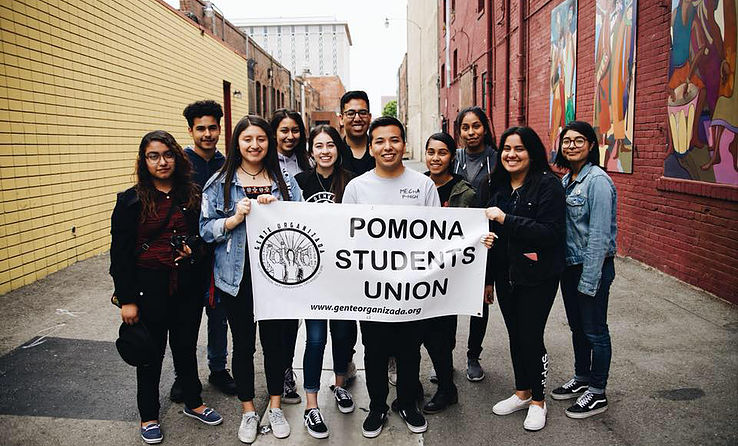
Thanks to the efforts from the student-led community organization Gente Organizada, Pomona Unified School District will no longer allow police patrols to monitor campuses. The decision comes after years of campaigning against discriminatory practices by school police, which was amplified after the racial justice protests of 2020. Removing school police means Latino youth are safer from discrimination in school, as Pomona (71% Latino), a city in Los Angeles County, is home to many Latino and immigrant families. “This is a milestone that has been met,” said Caroline Lucas, a Pomona youth organizer, according to Los Angeles Times. “For me, it means that leaders can experiment with what transformative activists have been trying to do.”
A Campaign Sparked by an Act of ...
Doctors have implicit, subconscious preferences for white patients over those of color, studies show. This is implicit bias. These biases — stereotypes that affect our understanding and decisions about others beyond our conscious control — lead to discrimination and health disparities. Fortunately, implicit bias can be “rewired” for compassion for patients of color. Download the free Salud America! Action Pack “Health Care Workers and Researchers: Find If You Have Implicit Bias and What to Do Next.” "This Action Pack will help you see if you have implicit bias, learn from others who have overcome their own implicit bias, and encourage colleagues to learn about implicit bias, too," said Dr. Amelie G. Ramirez, director of the Salud America! Latino health equity ...
Poverty rates among Latino families have grown immensely during the pandemic. The rates are worst for the children of Latino immigrants, according to new data from the National Research Center on Hispanic Children & Families (Center). The disparity is mainly due to the heavy economic impact that the pandemic has had on immigrant families. “The increase in poverty rates among Latino children in immigrant families during the pandemic reflects, in part, a confluence of factors in the labor market,” according to the Center. There may also be a stigma against seeking federal assistance as well as a fear of the expired public charge rule. With equitable policies that target economic recovery for immigrants and education about the end of public charge, we can address these ...
After a federal moratorium on evictions put in place by the CDC last fall expired on July 31, 2021, the CDC has issued a new two-month moratorium through Oct. 3, 2021. This new moratorium will extend protections for the millions of families behind on rent due to the economic fallout of the pandemic, particularly Latino and Black families, who have been hit the hardest. Update 11/15/21: The Supreme Court ruled on August 26 to end the temporary stay on a lower court ruling seeking to overturn the CDC's federal eviction moratorium. "In doing so, the Supreme Court’s ruling invalidates the federal eviction moratorium, eliminating vital eviction protections that have kept millions of households – predominantly people of color – stably housed," according to the National Low Income ...
When Giselle Rincon decided to start a nonprofit to help immigrants and offer humanitarian aid to her home country, she had no idea where to start with her background in teaching. “None of us have a nonprofit background, no clue how to begin a nonprofit, how to manage it. We have been learning every day, how to do it and talking to people, asking for consultants, asking for advice,” Rincon said. In 2014, Rincon started Venezuela’s Voice in Oregon along with a group of Venezuelan immigrants in the Portland, Oregon area. She and her team of eight team members work entirely pro-bono and volunteer their time outside of their full-time jobs. Through connecting with other nonprofit leaders and members in the Latino community, Rincon has taught herself how to run her growing ...
Poverty disproportionately impacts Latinos and other people of color. Child poverty rates are more than twice as high for U.S. Latino children (23.7%) than White children (8.9%), according to a Salud America! research review. Hardships stemming from poverty, like difficulty meeting basic needs for food, medicine, housing, and transportation, also lead to worse health and life outcomes. We know that poverty hurts poor neighborhoods and counties that are predominately non-white and low-income. However, did you know that even in the healthiest counties, children of color still experience poverty at often twice the rate of white children? “Nearly 1 in 10 children are living in poverty in the nation’s healthiest counties and children of color, particularly Black, Hispanic ...
This week, millions of working families in the U.S. will receive the first payment from the expanded child tax credit implemented by the Biden Administration. “The Child Tax Credit in the American Rescue Plan provides the largest Child Tax Credit ever and historic relief to the most working families ever – and most families will automatically receive monthly payments without having to take any action,” according to the White House website. Although the IRS and banks have been prepping for the credit for months, there is still some confusion on what the tax credit is and who qualifies for it. Here’s what Latino parents need to know about the new child tax credit that will be deposited on July 15, 2021.
What is the child tax credit?
In March 2021, President Biden signed ...
Younger generations of Latinos are more likely than their immigrant parents to talk about issues like racism and discrimination, particularly when it comes to discrimination against Black people. “Most of our societies are fundamentally racist against darker people,” said political science professor Eduardo Gamarra, according to Carmen Sesin and Cora Cervante of NBC Latino. Generation Z, typically defined as those born between 1997 and 2015, may be more willing to confront their immigrant parents about racism because they are more racially diverse than past generations and active in social justice movements. Let’s examine how Latino youth compare to older generations, some characteristics of Generation Z, and the implications for how Latinos can tackle discrimination and ...
A widening socioeconomic gap, racism, and discrimination contribute to inequitable distribution of healthcare and mental and physical health disparities among Latinos and other people of color. This is especially true amid COVID-19. How can we change this? Let’s use #SaludTues on Tuesday, Aug. 3, 2021, to discuss emerging strategies to promote a cohesive culture for health equity is one where everyone works individually and as a group to ensure that each person has a fair, just opportunity for health and wealth! WHAT: #SaludTues Tweetchat: Breaking Down Systemic Injustices in Healthcare
TIME/DATE: 1-2 p.m. ET (Noon-1 p.m. CT), Tuesday, Aug. 3, 2021
WHERE: On Twitter with hashtag #SaludTues
HOST: @SaludAmerica
CO-HOSTS: The Praxis Project (@Praxis_Project); ...