Dr. Amelie G. Ramirez of UT Health San Antonio is launching the new ACS Avanzando Center thanks to a 4-year, $4.08-million grant from the American Cancer Society (ACS). The ACS Avanzando Center, which began work in February 2023, is a response to the severe cancer burden in South Texas. The center will unite South Texas research scholars and the community to improve health across the cancer care continuum by targeting the non-medical drivers of health that prevent people from obtaining equitable care. “Our new center will conduct a unique combination of community-engaged research, training, patient assessment, and promotion to address the non-medical drivers of health, such as financial strain and food insecurity, to improve access to cancer care, prevention, early detection, ...
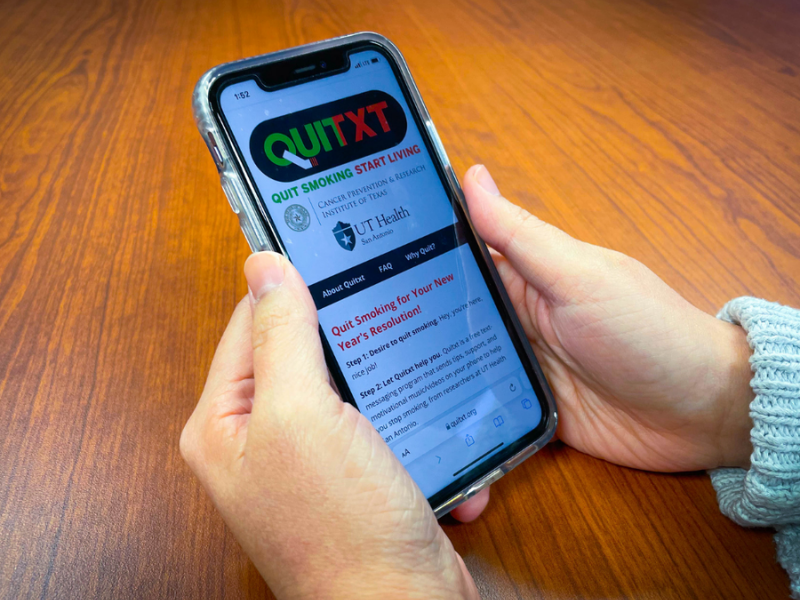
Dr. Patricia Chalela of UT Health San Antonio has received a new five-year, $2 million research grant to test the impact of Quitxt, a bilingual text messaging program that helps Latino young adults in South Texas to quit smoking. The grant is among $90 million for new cancer prevention and research projects from the Cancer Prevention & Research Institute of Texas (CPRIT). For the grant, Dr. Chalela and her team will recruit 1,200 Latino smokers ages 18-29 who agree to try to quit smoking. Half will receive Quitxt, a free texting service with background appropriate visual, video, and audio content fueled with evidence-based techniques to prompt and sustain smoking cessation. The other half will get abbreviated text messages and referral to the "Yes Quit" smoking cessation ...
Some Latinos fear becoming a guinea pig. Others worry about cost or trust. But clinical trials can provide volunteers potentially life-saving treatments and help researchers learn how to manage and treat different diseases for their family and communities. UT Health San Antonio held a Zoom webinar — “Busting the Myths and Challenges to Clinical Trials” — at 11 a.m. CT on March 9, 2023. This webinar features health experts and real Latino clinical trial volunteers to help define clinical trials, bust several common myths about clinical trials and share testimonials of trial participation. Panelists will also connect audience members with culturally relevant resources and available opportunities to participate in clinical trials at the Mays Cancer Center at UT Health San ...
About 150,000 Americans are diagnosed with colorectal cancer. For Latinos, colorectal cancer mortality rates remain stagnant due to a number of differences including lack of access to healthy and nutritious food and less access to health insurance and healthcare. While many do experience symptoms when developing colorectal cancer, some may not. Therefore, it is important for Latinos and all people to take measures that can decrease the risk for the disease through making healthy choices, and create healthier environments for healthy lives! Let’s use #SaludTues on March 7, 2023, to dive into the importance of National Colorectal Cancer Awareness Month. WHAT: #SaludTues: National Colorectal Cancer Awareness Month
TIME/DATE: 1-2 p.m. EST (Noon-1 p.m. CST), Tuesday, ...
This is part of the "Advancing the Science of Cancer in Latinos: 2022 Conference Proceedings," which summarizes findings and discussions of the 2022 Advancing the Science of Cancer in Latinos Conference on Feb. 23-25, 2022, in San Antonio, Texas.
Conclusion
To eliminate cancer differences in Latino populations, Advancing the Science of Cancer in Latinos brought together researchers, scientists, physicians, healthcare professionals, patient advocates, and students from across the US and Latin America. These presenters shared research advancements, identified gaps, developed actionable goals, updated clinical best practices, described effective community interventions, and detailed professional training programs aimed at addressing differences. In the process, most of the speakers made ...
This is part of the "Advancing the Science of Cancer in Latinos: 2022 Conference Proceedings," which summarizes findings and discussions of the 2022 Advancing the Science of Cancer in Latinos Conference on Feb. 23-25, 2022, in San Antonio, Texas.
Using Science to Address Latino Health Inconsistencies in Research
Eliseo J. Pérez-Stable, M.D., is Director of the NIMHD at the National Institutes of Health (NIH). Health Differences and Non-Medical Drivers of Health Dr. Pérez-Stable began his presentation by discussing the ways in which science can reduce differences in healthcare. First, standardized surveys, tools, and measurements are needed so that data can be combined, facilitating discovery through large data sets. Science should also be an engine for promoting variety in ...
This is part of the "Advancing the Science of Cancer in Latinos: 2022 Conference Proceedings," which summarizes findings and discussions of the 2022 Advancing the Science of Cancer in Latinos Conference on Feb. 23-25, 2022, in San Antonio, Texas.
Transformative Strategies in Science and Access in the US
Dr. Edith A. Perez is the Serene M. and Frances C. Durling Professor of Medicine at the Mayo Clinic College of Medicine and the Chief Medical Officer at Bolt Biotherapeutics. Her presentation outlined strategies for health improvement as exemplified by important committees of the National Academies of Sciences, Engineering, and Medicine (NASEM) and Stand Up To Cancer (SU2C). The NASEM initiative, which was requested by congress, focuses on improving the reflectivity of people in ...
This is part of the "Advancing the Science of Cancer in Latinos: 2022 Conference Proceedings," which summarizes findings and discussions of the 2022 Advancing the Science of Cancer in Latinos Conference on Feb. 23-25, 2022, in San Antonio, Texas.
Leading Pathways: The Hispanic/Latino Survivorship Study
Dr. Frank Penedo is Associate Director of Cancer Survivorship & Behavioral Translational Sciences at the Sylvester Comprehensive Cancer Center at the University of Miami. The Leading Pathways Study Dr. Penedo began by presenting a summary of Leading Pathways, a Hispanic/Latino survivorship study, a collaboration between the Mays Cancer Center at UT Health San Antonio and the Sylvester Comprehensive Cancer Center at the University of Miami. The study has five key aims, the ...
This is part of the "Advancing the Science of Cancer in Latinos: 2022 Conference Proceedings," which summarizes findings and discussions of the 2022 Advancing the Science of Cancer in Latinos Conference on Feb. 23-25, 2022, in San Antonio, Texas.
Novel Therapeutic Approach to Reduce Health Challenges in B-cell Acute Lymphoblastic Leukemia in Hispanic/Latino Children
Dr. Sinisa Dovat is Professor of Pediatrics, Pharmacology, and Biochemistry and Molecular Biology at Pennsylvania State University College of Medicine. He is also Four Diamond Endowed Chair and Director of Translational Research and Experimental Therapeutics in Pediatric Hematology/Oncology at Penn State University. B-Cell Acute Lymphoblastic Leukemia and Latino Children B-Cell acute lymphoblastic leukemia (B-ALL) ...