About 20% of cancer diagnoses in the United States are for rare cancers, according to a new American Cancer Society report, MedicalXpress reports. The number is worse for racial/ethnic groups. Latinos face higher rates of rare cancers (24%), as do Asian/Pacific Islanders (22%), than blacks (20%) and whites (19%). Rare cancers challenge both patients and doctors. For most rare cancers, research to identify causes or ways for prevention or early detection is limited or nonexistent, according to MedicalXpress. Rare cancers also can be tough to diagnose and treat, leading to delays in diagnosis and less effective means of treatment than for more common cancers. "Efforts are needed to develop interventions for prevention, early detection, and treatment to reduce the burden of ...
For 30 years, a group of small community health centers have provided primary healthcare to residents in Maricopa County, Ariz. (30% Latino population). A few years ago, center leaders Dr. Avein Saaty Tafoya and Lisa Blue recognized that local residents continued to face cultural, language, financial, and other barriers to proper comprehensive healthcare. They felt compelled to change the entire approach of their centers. Adelante Healthcare began to seek grants and partnerships to add personnel to expand beyond their historical focus on primary care. Today their new team—primary care physicians, specialists, bilingual health coaches, mental and behavioral health social workers, and others who connect families to insurance, health education, and more—provides more ...
A few years ago, only 1 in 10 Latino children were screened for autism when they came in for well-child visits at Unity Health Care's Upper Cardozo Health Center in Washington, D.C. None were flagged for autism. The problem? Latino parents often misunderstood the center's written autism screening questions. Questions were designed for English speakers and, even when translated into Spanish, tended to mystify or confuse Spanish speakers, Spectrum News reports. The answer? A Georgetown University researcher created a culturally and linguistically tailored oral screening test where clinicians asked Latino parents the autism questions. Trained multilingual interviewers, and later center clinicians, gave the oral screening to parents. Of 1,400 children screened, 4% were ...
A lack of access to quality healthcare coverage has been one of the most persistent causes of health inequity for many Latino families. Despite significant gains made under the Affordable Care Act (ACA), Latinos still remain the largest uninsured population in the country. In May 2016, the Department of Health Care Services (DHCS) of California (38.39% Latino population) implemented new legislation that allows for all children in the state under the age of 19 to be eligible for full Medi-Cal benefits. Previously, undocumented children would have only received emergency care benefits through Medi-Cal and would not have had access to dental or mental health care. From May through April of 2017, 189,434 undocumented children had been signed up for the “Medi-Cal for All Children” ...
Despite being the country’s largest racial and ethnic minority group and despite the fact that the Latino population in the United States is growing at exponential rates, they suffer from vast differences in health conditions compared to whites. These health disparities are rooted in “social disadvantage” and affect Latinos in their abilities to access quality healthcare, attain better paying jobs and quality education. With serious issues plaguing them, what can be done? The National League of Cities recently collaborated with the George Washington University Milken School of Public Health to analyze the options that cities have in addressing the educational and healthcare needs of residents. In order to reduce health disparities, it is critical to address ...
Latinos often face many obstacles that prevent them from obtaining health equity. One of the bigger hurdles they frequently have to overcome is a lack of access to quality healthcare. Lack of transportation equity prevents many Latinos from regularly accessing preventative care. According to the Community Transportation Association of America, about 3.6 million patients miss medical appointments each year because of transportation issues. A new, unique initiative between Blue Cross Blue Shield (BCBS) and an unlikely partner is looking to alleviate some of these concerns. The rides-sharing service Lyft is partnering with the health coverage provider to help cut down on missed healthcare appointments. In order to reduce health disparities, it is critical to address ...
Latinos often face hurdles like language, culture, and cost to get proper healthcare, which contributes to heavier disease burdens and health inequities. Transportation is another big hurdle to healthcare access. In fact, 3.6 million patients miss medial appointments each year due to transportation issues, according to the Community Transportation Association of America. A new partnership between ride-sharing service Lyft and major healthcare insurer Blue Cross Blue Shield (BCBS) are forming an unlikely partnership to solve the issue. BCBS will offer free Lyft services to its members as part of a new service delivery model for select companies to reduce missed appointments for nonemergency care in areas that lack adequate transportation options, HealthCare Dive ...
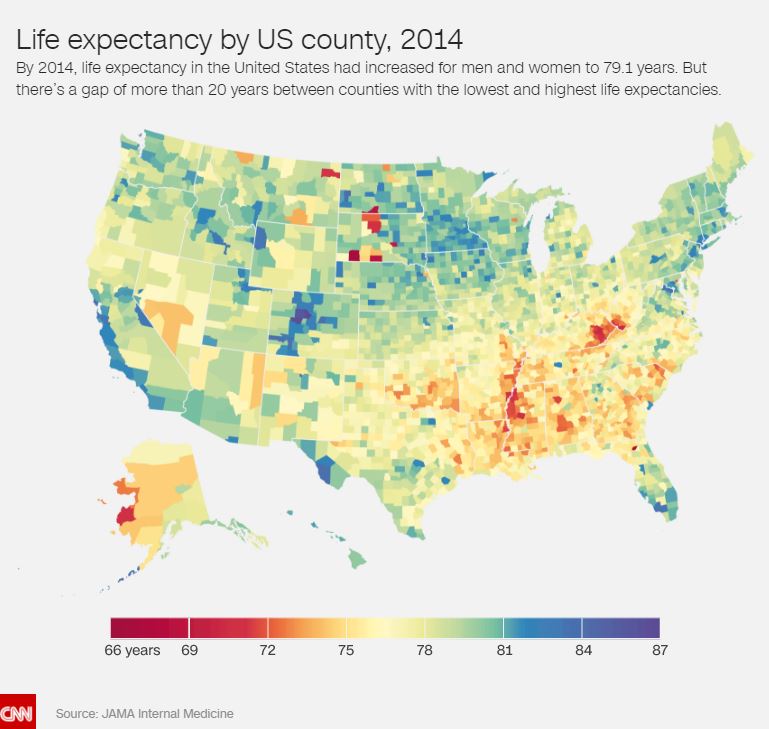
Fact: Where you live greatly impacts how healthy you will be. Lifespans differs by as much as 20 years at birth between the longest- and shortest-rated counties United States, revealing massive health inequities in different parts of the country, especially Latino-centric area, according to a new study, CNN reports. For the study, researchers from the Institute for Health Metrics and Evaluation (IHME) at the University of Washington in Seattle examined county data for life expectancy from 1980-2014. They then applied mathematical models to estimate the average lifespan. Findings showed life expectancy at birth increased by 5.3 years for adults (going from age 73.8 to 79.1) between 1980 and 2014. Over that time, men gained 6.7 years (going from age 70 to 76.7) while women ...
Fact – where you greatly determines how healthy you will be. A recent study by the Institute for Health Metrics and Evaluation at the University of Washington determined that the life expectancy at birth differs by as much as 20 years between the lowest rated and highest rated counties surveyed in the United States. Dr. Christopher J.L. Murray and his team studied the life expectancy of each U.S. county from 1980-2014 analyzing county-level data and applied mathematical models to estimate the average length of lives. According to the findings, life expectancy at birth increased by 5.3 years for both men and women (from 73.8 years to 79.1 years) between 1980 and 2014. Over that time, men gained 6.7 years (going from 70 years on average to 76.7 years) while women gained four ...