by
by 
Share On Social!
Only 30% of Latino adults have earned an associate degree or higher, compared to about 50% of all adults, according to a new data from Excelencia in Education.
“Enrollment gains have not translated into closing gaps in degree attainment — a persistent gap documented,” according to Excelencia in Education.
Let’s dive deeper into degree attainment and why it matters for Latinos and all people.
Latino Degree Attainment by the Numbers
There’s some good news in Latino degree attainment.
Latino attainment of an associate degree or higher increased by 8 percentage points and bachelor’s degree attainment increased by 6 percentage points, according to the new data.
Despite this progress, Latinos have the lowest levels of college degree attainment at 31% with an associate degree or higher and 22% at the bachelor’s level.
“A 23 percentage-point gap between Latino and White adults at the associate level, and a 21 percentage-point gap at the bachelor’s level. The data make clear that similar rates of improvement have not narrowed these gaps,” according to Excelencia in Education.
Latino Degree Attainment by Region
There are also differences in degree attainment based on U.S. region.
In the South, college enrollment is surging. But attainment gaps persist across every state, with many Latino students stalled by structural challenges and uneven transfer pathways.
In the Midwest, Latino enrollment is approaching equivalence compared to other students in several states. Yet degree attainment gaps of 15 to 25 percentage points signal that college access alone is not enough.
In the West, Latino students enrolling at near-equal rates yet leaving without degrees at higher rates due to financial constraints and uneven transfer pathways.
In the Northeast and Puerto Rico, degree attainment is the highest in the nation. Yet a 17-percentage-point gap between Latino and other populations persists, showing that leading the nation is still not the same as closing the gap.
Go here for a more in-depth look at degree attainment by region.
Behind the Gaps in Latino Degree Attainment
Latinos pursing higher education are a “representative of the post-traditional student majority in college today,” according to Excelencia in Education.
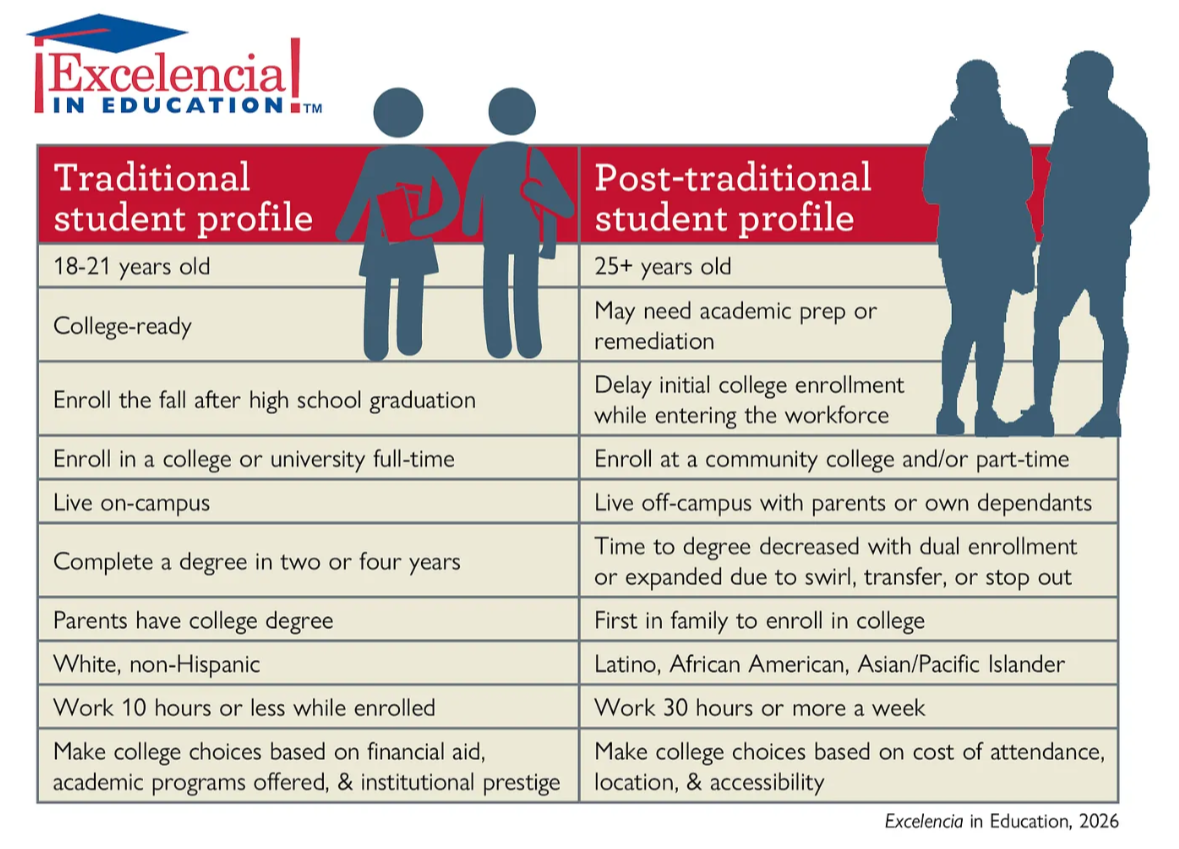
They are more likely to be younger, lower-income, first-generation students, work more than 30 hours per week while enrolled, and navigate affordability challenges.
Many Latino students are also not completing degrees within 150% normal time to completion because they stopped out or are still enrolled.
At two-year institutions, 55% of Latino students are still or no longer enrolled, showing a 10 percentage-point gap compared to other populations.
35% of Latino students are still or no longer enrolled at four-year institutions, creating a 13 percentage-point gap compared to other populations.
Results indicate that many Latino students have earned credits but have not yet completed a credential due to factors like financial pressures, work and family responsibilities, or life disruptions that interrupt their education.
“With intentional outreach, flexible pathways, and targeted supports, these students can be re-engaged and brought back to completion,” Excelencia states.
Looking To the Future of Latino Degree Attainment
Along with the numbers and challenges, Excelencia also highlights ways that universities can help close these gaps in degree attainment.
“It is about accelerating access to excellence — ensuring that all students, particularly post-traditional students, have access to high-quality postsecondary education and the supports necessary to succeed,” according to Excelenica in Education
Excelencia suggests additional financial support through state and federal policy and investments, which can strengthen students’ efforts by:
- Sustaining and scaling programs that help with Latino student success
- Investing in quality higher education
- Fostering low-debt education
- Supporting re-engagement and re-entry pathways so institutions can identify, re-enroll, and support students with prior credits
“Investment in proven strategies for Latino, and all, student success is necessary for the development of our nation’s future workforce,” Excelencia states.
Go here for the full Excelencia in Education report findings.
Support for Community Health
Education plays a part in your overall health.
How is the state of education – and health – in your community?
Find out by downloading a Salud America! Health Report Card for your town!
Enter your county name and get auto-generated local data with interactive maps and comparative gauges on several health indicators. This can help you visualize and explore local issues in education, housing, transportation, food, health, and more.
See how your county stacks up compared to the rest of your state and nation.
Then email the Report Card to local leaders to raise awareness, include the data in a presentation or grant proposal, or share it on social media to drive healthy changes in your community!
By The Numbers
142
Percent
Expected rise in Latino cancer cases in coming years