Year by year, Latinos have become an increasingly important part of the U.S. workforce. Latinos currently account for 16% of the country’s labor pool and these numbers are growing rapidly, according to the Society of Human Resource Management (SHRM). By 2025, one out of every two new workers will be Latino as 66,000 Latino teens are turning 18 each month. As Latinos grow in numbers, their importance to the economy will only continue to increase. However, a new report shows that Latinos generally are not living in the best cities for jobs. The employment website Glassdoor recently unveiled a ranking of the top 25 cities in the country for jobs. The site based its rankings on the ability to find a job, satisfaction with the job and, quality of life. “If you weigh (those ...
You can apply now for the 2018 Éxito! Latino Cancer Research Leadership Training program and optional $3,250 internships at the Institute for Health Promotion Research (IHPR) at the UT Health San Antonio. Éxito! (English: Success!) recruits trainees annually for a culturally tailored curriculum to promote pursuit of a doctoral degree and cancer research career. This year, program leaders will select 25 master’s level students and professionals from across the country to take part in a five-day Éxito! summer institute June 4-8, 2017, in San Antonio. The summer institute features Latino researchers, mentors, and doctoral candidacy experts to inform about the latest in Latino cancer, enhance career development, and provide motivation to take the next step in education and ...
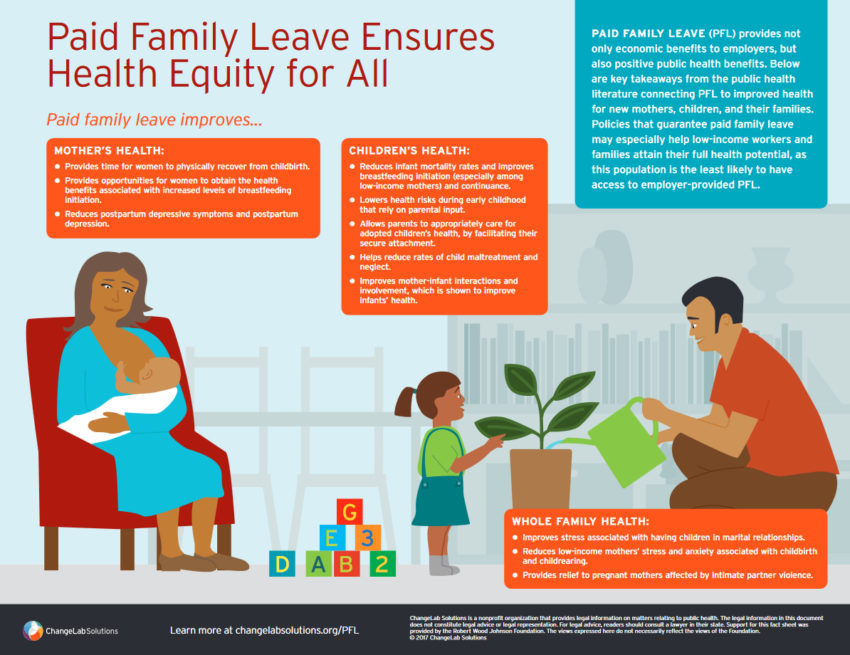
Latinas and all women have increased their ranks in the workforce by 21.4% in the past 25 years, which is good for the economy. But there's a big downside. The United States still lags well behind other “advanced economies” in guaranteeing workers paid family leave, according to the Center for American Progress. “[In 63.9% of American families,] a mother was the breadwinner—bringing home as much or more than her husband or a single working mother—or a co-breadwinner, bringing home at least a quarter of the family’s earnings,” the Center reported. To address inequties that rise from a lack of paid family leave, ChangeLab Solutions has developed materials to cover its importance for Latino and all families.
What is 'Paid Family Leave'?
The new ChangeLab materials ...
Researchers at the University of California, Davis, are investigating the unique, daily challenges and stresses that affect young Latino parents and babies in California, thanks to $2.7 million from the National Institutes of Health. The so-called "California Babies Project" aims to understand how difficult circumstances impact these families. Study leader Leah Hibel and her team will periodically assess stress hormones and chart the emotions of 250 families of Mexican origin in the Sacramento area, according to a news release. "We want to better understand how stress affects daily parent-child interactions," Hibel said, "and how that influences a child’s physical and mental health and school readiness."
The Big Reason for This Study
California is 39% Latino, mostly of ...
Latinos are less likely to seek health screenings or preventive care than their black and white peers, according to a new survey, American Heart Association News reports in English and Spanish. The Healthy Americas Survey indicates that: Only 55% of Latinos say they are vigilant about getting health screenings and checkups, compared with 68% of blacks and 60% of whites.
Latinos were more likely than blacks and whites to say they don’t have significant control over their health.
Only about 25% of Latinos say they earned more than $50,000 a year, compared with 47% of whites and 30% of blacks. “This is dangerous for the long-term health of U.S. Latinos,” Amelie G. Ramirez, Dr.P.H., a health disparities researcher at UT Health San Antonio and director of the Salud ...
Imagine a world where every person has the opportunity to attain full health potential—with no disadvantages due to race, money, etc. That is health equity. Unfortunately, Latinos and other people of color often struggle with health inequity as a result of poverty, structural racism, and discrimination. This causes gaps in how long Latinos live and how they struggle with disease and health, compared to their peers, according to the new Communities in Action: Pathways to Health report from thew National Academies of Sciences, Engineering, and Medicine. The new report does have some good news: Communities have agency to promote health equity. However, community-based solutions are necessary but not sufficient.
Supportive public and private policies at all levels and ...
U.S. Latino, black, and American Indian children have bigger obstacles to success than white and Asian children, according to a new report. The report, the Race for Results from the Annie E. Casey Foundation, scores how children are progressing on 12 key milestones from birth to adulthood. Milestones include math proficiency, graduation data, teen birth rates, employment prospects, poverty, and more. The higher the score (0-1,000), the better children fare. Latinos' actually increased to a score of 429 in 2017 from 404 in this same report from 2014. Yet this score is well below Asian (783) and white children (704), slightly ahead of African-America (369) and American Indian (413) children, and remains a "cause for deep concern," according to the report. "We will lose a ...
Being Latino in America can be stressful. Being a Latino immigrant can be even more stressful, with daily struggles of discrimination, fear of deportation, and cultural identity that can affect your mental health. A new study led by Luz Garcini, postdoctoral fellow at Rice University, looked into the mental health of undocumented immigrants living near the border in California (38.9% Latino). Garcini, just like her research participants, fled violence from her native country Mexico, to come to the United States. Luz learned though that not all immigrants are fortunate. The work that Garcini has done is the first of its kind to prove the prevalence showing extremely high rates of mental illness among undocumented people versus the U.S population.
Study Findings
Garcini and ...
Many Latino families suffer a big lack of access to support for economic and educational success, and quality healthcare. This makes it harder for Latino kids to achieve academically, socially, and physically. However, hope appears to be on the horizon for Latino and all families, according to U.S. Census Bureau data. For the second year in a row, Americans made “solid” financial gains in 2016 as the median household income rose across the country. Also shown as positive signs were the poverty numbers fell, and the rate people without health insurance also fell, according to USA Today.
U.S. Economy on the Rebound
The median U.S. household income climbed 3.2% to $59,039, which followed growth of 5.2% in 2015; this is the largest on records dating to 1968. The combined increase ...