
 by

Share On Social!
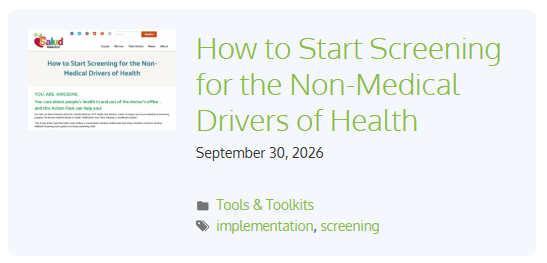
The Salud America! Action Pack, “How to Start Screening for the Non-Medical Drivers of Health (NMDoH),” is featured in two resource databases that help healthcare systems start addressing NMDoH with screening, referrals, and more.
Find our action pack in the University of California, San Francisco’s national database, the Social Interventions Research & Evaluation Network (SIREN).
 Find our action pack in Rice University’s Texas-focused database, Evidence-to-Practice for Non-Medical Drivers of Health (E2 Practice NMDOH).
You can use the new Salud America! Action Pack, “How to Start Screening for the NMDoH,” to launch screening in your clinic, hospital, or healthcare system!
The action pack, created by Dr. Amelie G. Ramirez at UT Health San Antonio, has a conversation-starting model email, fact sheet, checklist on how to develop screening, and a guide that reviews existing screening tools.
“Screening for the non-medical drivers of health can help clinicians better understand patients, connect patients to community support, and spotlight the root causes of health issues,” said Ramirez, director of the Salud America! national health communication program, the Institute for Health Promotion Research at UT Health San Antonio, and the community outreach and engagement team at the Mays Cancer Center.
Why Do We Need Screening for the Non-Medical Drivers of Health?
To truly improve patient and community health, we must address NMDoH issues, such as access to housing, transportation, and food that can make it harder for people to stay healthy.
That’s where screening for NMDoH comes in.
NMDoH screening is a questionnaire given to patients in a healthcare setting to help providers identify their needs. These include issues like financial hardship, housing, and food.
Patients can then be referred to helpful community resources.
In the healthcare setting, NMDoH screening can help systems, hospitals, and clinics to identify and address health-related needs at the individual level. It also has seven other big benefits.
See how screening works for Nemours, FQHCs, and Dallas Children’s!
How Does This Action Pack Help You Start Screening for Non-Medical Drivers of Health in Healthcare?
The Action Pack, “How to Start Screening for the Non-Medical Drivers of Health,” can help healthcare teams work to start or refine screening in their settings.
Led by Dr. Ramirez, the Action Pack is a collaboration from the Salud America! program and the ACS Avanzando Salud Center at the Institute for Health Promotion Research at UT Health San Antonio.
The action pack has these three steps:
- Start a Conversation for Screening of Non-Medical Drivers of Health in Your Healthcare Setting. Use a model email and guide to engage stakeholders in your healthcare setting to start the conversation for screening.
- Go Through a Checklist to Develop a Screening Program for the Non-Medical Drivers of Health. Use a checklist to help you think through all the considerations you and your team will need to explore as you develop an screening program. You can also learn from others who have implemented screening.
- Guide to Select/Adapt Your Screening Tool for the Non-Medical Drivers of Health. Use a guide to select or adapt your screening tool based on a review of existing screening tools.
You can also get technical assistance from a Salud America! action pack coach, who can help customize materials and answer questions.
“Screening for the non-medical drivers of health can help clinicians and non-clinicians identify patients’ immediate needs outside the doctor’s office,” Ramirez said. “This gives provides insight into patients’ real-world experiences, which helps referrals to relevant community resources.”
By The Numbers
1
Supermarket
for every Latino neighborhood, compared to 3 for every non-Latino neighborhood