In the United States, 1.8 million people are living with or in remission from a type of blood cancer, either leukemia, lymphoma, myeloma, myelodysplastic syndromes (MDS), or myeloproliferative neoplasms (MPNs). A blood cancer diagnosis can bring up many worries, emotions, and even confusion. That is why Blood Cancer United is aiming to help people with navigating their diagnosis journey with updated Survivorship Workbooks. Let’s take a look into what these workbooks consist of and how they can help families and communities maneuver cancer diagnoses. download the workbooks!
Workbooks Help Blood Cancer Patients Stay Informed
Blood Cancer United’s workbooks cover a range of topics related to blood cancer: Care plans
Long term and late effects
Healthy behavior ...
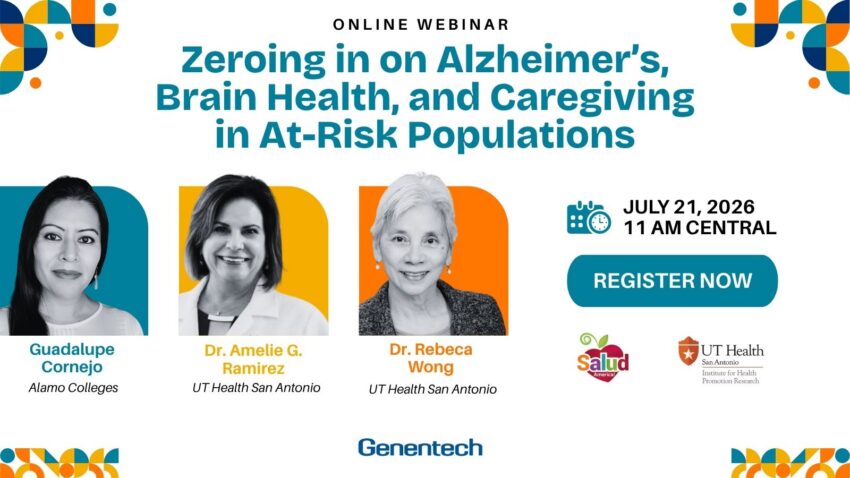
Alzheimer’s Disease is a rising health issue for Latinos and many others. To ensure support for those affected and their caregivers, join UT Health San Antonio’s webinar, “Zeroing in on Alzheimer’s, Brain Health, and Caregiving in At-Risk Populations,” at 11 a.m. Central on Tuesday, July 21, 2026. Webinar host Dr. Amelie Ramirez, leader of Salud America! and the Institute for Health Promotion Research at UT Health San Antonio, will join experts from the San Antonio CAPAS research program, a representative from Genentech, a community health worker, and a Latino caregiver to focus on the impact of Alzheimer’s in South Texas and beyond. Panelists will discuss the state of Alzheimer’s among Latinos and all people, early signs, early diagnosis, and what the condition ...
Skin cancer is one of the easiest cancers to treat and one of the most preventable if you take action to protect your skin from the harm of sun exposure. Yet too many are still being diagnosed with the disease. This is especially true for people in overlooked communities, especially Latinos and others who work under the sun in construction, farming, and other outdoor jobs. May is Skin Cancer and Melanoma Awareness Month and we’re bringing attention to skin cancer by sharing these helpful resources and actions.
1. Calculate Your Skin Cancer Risk
The National Cancer Institute (NCI) has an online tool to calculate your risk for skin cancer. Input your demographics (i.e., eye color) and UV-related habits (i.e., number of sunburns) and get your risk for developing ...
1 in 5 people will get skin cancer in their lifetime. That makes it critical to know what might increase your risk for skin cancer, especially Latinos who work in construction, farming, and other outdoor jobs. May is Skin Cancer and Melanoma Awareness, so let’s explore skin cancer risk.
Skin Cancer Risk Factors
Some physical characteristics can increase your risk for skin cancer, according to the CDC. Skin cancer can be more prevalent in people with lighter skin, eye, and hair colors. DNA can also play significant factor. If your skin easily burns or reddens, has freckles, or moles, you may be at a higher risk for skin cancer. Those with a history of sunburns or tanning, have a family or personal history of skin cancer, or are of an older age may ...
May is recognized as Bladder Cancer Awareness Month, a time to learn about the impact of bladder cancer and spread awareness about bladder cancer resources. The American Cancer Society estimates about 84,530 new cases of bladder cancer. Bladder cancer is the fourth-most common cancer in men and 1 of 4 bladder cancer patients are women. Have you or someone in your family recently been diagnosed and aren’t sure where to start? Check out the following helpful resources from the Bladder Cancer Advocacy Network (BCAN). 1. Bladder Cancer Support Line (Bilingual) BCAN’s Bladder Cancer Support Line offers support by connecting patients with professional oncology social workers. “The call center’s staff will address the emotional, practical and informational ...
Good health is important for all people! With this in mind, Dr. Amelie G. Ramirez, leader of Salud America!, is sharing an important comment to focus on many aspects of health for Latinos and all people as part of the National Institutes of Health (NIH) Strategic Plan for Fiscal Years 2027-2031. Endorse Dr. Ramirez’s comment here. Comments must be submitted by 11:59 p.m. ET on Tuesday, May 26, 2026. Endorese the Comment
Endorse Dr. Ramirez’s Comment on the NIH-Wide Strategic Plan
Dear NIH leaders, As the leader of Salud America!, an organization that promotes health improvement for all people, including Latinos, I know that health research is a priority. Understanding the health issues that impact communities is the foundation for creating better health outcomes ...
In 2024, 15 Latina cancer survivors from across the US and beyond met for the first-ever Latino Cancer Patient Advocate Training Program to become cancer patient leaders.
Since then, the survivors-turned-patient leaders, like Marielle Santos McLeod and Andrea Suarez Vargas have been sharing their stories to help cancer patients, elevate their voices among decision-makers, and create new research opportunities for Latinos and all people.
However, there is still more work to do.
On the heels of the first training, program creators Dr. Barbara Segarra-Vázquez of the University of Puerto Rico and Sandi Stanford of the Alamo Breast Cancer Foundation turned around to do it again.
This time the pair welcomed 16 new Latino cancer survivors to participate in the second cohort of Latino Cancer ...
Cancer persists in the US, especially in overlooked communities. Many of these groups suffer disproportionate cancer rates and worse outcomes, due to long-standing issues that formed differences in education, economic status, access to screening and care, and more. That’s why April is dedicated to bringing awareness and solutions to the challenges these communities face in areas such as cancer prevention, diagnosis, and treatment. Here are seven ways to celebrate National Minority Cancer Awareness Month.
1. Learn About Differences in Cancer Outcomes
Did you know that where you live can dictate your health and what kind of health care you receive? Where you live can increase your risk of adverse health effects, such as hypertension and diabetes, that make you ...
Nicotine-based vapes, or e-cigarettes, are likely to cause cancers of the lung and oral cavity, according to a new study led by the UK’s University of South Wales. “[Our study] is the most definitive determination that those who vape are at increased risk of cancer compared to those who don’t,” said study leader Bernard Stewart. Let’s dive into what the study results mean for those who vape.
E-Cigarettes and Cancer Risk
Little attention has focused on whether e-cigarettes might cause cancer on their own. So, study researchers – pharmacists, epidemiologists, thoracic surgeons, and public health experts – examined clinical studies, animal experiments, and laboratory research to understand the chemicals produced by e-cigarettes, according to a news release. They ...




Endorse Dr. Amelie Ramirez’s Comment on NIH Strategic Plan
Good health is important for all people! With this in mind, Dr. Amelie G. Ramirez, leader of Salud America!, is sharing an important comment to focus on many aspects of health for Latinos and all people as part of the National Institutes of Health (NIH) Strategic Plan for Fiscal Years 2027-2031. Endorse Dr. Ramirez’s comment here. Comments must be submitted by 11:59 p.m. ET on Tuesday, May 26, 2026. Endorese the Comment Endorse Dr. Ramirez’s Comment on the NIH-Wide Strategic Plan Dear NIH leaders, As the leader of Salud America!, an organization that promotes health improvement for all people, including Latinos, I know that health research is a priority. Understanding the health issues that impact communities is the foundation for creating better health outcomes ...
Read More