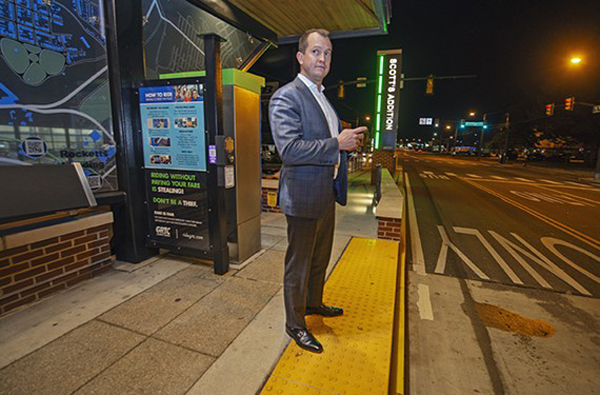
For years, bike share programs have shown sharp divisions along race and class lines. Bike share stations are often located in whiter, wealthier neighborhoods. Whiter, wealthier individuals are far more likely users than those of color. That’s why cities are working to improve equity of bike share programs. In fact, 60% of bike share systems had specific programs to address equity, according to the National Scan of Bike Share Equity Programs from the Transportation Research and Education Center (TREC). But these systems rarely set or tracked outcomes on equity. Below are six ways to correct bike share’s social equity problem, based on examples from the TREC report to help bike share systems move toward equity and from Shared-Use Mobility Center’s list of efforts to ...
Many severe side effects of prescription drugs are not reported, according to new findings from JAMA Internal Medicine. Moreover, the researchers who completed the study comment that current FDA regulatory practices need reform, especially the process used to report harm caused by medical devices. “Over the last 4 decades, the approval and regulation processes for pharmaceutical agents have evolved and increased in complexity as special programs have been added and as the use of surrogate measures has been encouraged,” the researchers write. “The FDA funding needed to implement and manage these programs has been addressed by expanding industry-paid user fees. The FDA has increasingly accepted less data and more surrogate measures and has shortened its review times.”
What ...
Many of our transportation woes are due to lack of realistic options. American cities have largely designed streets for speeding vehicles rather than for people walking, biking or taking the bus, resulting in high rates of traffic fatalities and injuries; air, water, and land pollution; and limited access to destinations needed to stay healthy and climb the economic ladder. Although people-first design has numerous social, environmental, health, and economic benefits; current car-centric policies and practices undermine these efforts. It’s time to better measure and prioritize people-first policies, practices, and projects. Let’s use #SaludTues on February 18, 2020, to tweet about how to shift from car-centric thinking to people-first thinking. WHAT: #SaludTues ...
“I feel like my life is threatened at each intersection.” That is what Andreas Addison said about walking the streets and relying on mass transit during his #NoCarNovember experiences in Richmond, Va., where he is a city council member. He wanted safer streets and more frequent transit for his constituents. So Addison found two models he liked─a D.C. city leader’s omnibus bill (one that combines several measures into one package) for better transit, more walkability, and less car reliance, and Virginia Commonwealth University’s work to make campus safer for pedestrians. Addison then began working on an omnibus bill of his own to create a safer environment for people walking, biking, and taking the bus in Richmond.
Unfair Social and Health Outcomes in Richmond
Life ...
Throughout the modern era, single-family zoning and redlining practices institutionalized economic as well as racial segregation in America. Although redlining is now illegal, single-family zoning—which still occurs to this day—reinforces both racial and economic segregation. Moreover, it contributes to the racial wealth gap seen across the country. "The practice of zoning most residential land exclusively for single-family detached homes is a major cause of affordable housing shortages and long commute times," Eric Kober, an adjunct fellow at the Manhattan Institute and former director of housing, economic, and infrastructure planning at the New York City Department of City Planning, writes in a recent CNN Business editorial. "In expensive cities, this policy makes it ...
What we choose to eat affects everything. However, our current food system is unhealthy and unsustainable, leaving us with options that pollute our air and water, consume large amounts of energy, and contribute to chronic disease and premature death, all while leaving millions undernourished. Transitioning away from an animal-based system to a plant-based system, for example, has numerous social, environmental, economic, and individual health benefits. Let’s use #SaludTues on January 28, 2020, to tweet about how you can raise awareness about and push for policies to support healthy food systems. WHAT: #SaludTues Tweetchat: “Elevating Plant-Based Food Systems”
TIME/DATE: 1-2 p.m. ET Tuesday, Jan. 28, 2020
WHERE: On Twitter with hashtag #SaludTues
HOST: ...
Dr. Amelie G. Ramirez, director of the Institute for Health Promotion Research (IHPR) at UT Health San Antonio and a leading health promotion researcher, has been named to the Women in Cancer Research Council of the American Association for Cancer Research (AACR). The council organizes the activities of the members of the Women in Cancer Research group, including fostering career development and recognizing scientific achievements. They also advise AACR leadership on issues of concern to investigators. Ramirez will serve on the council for a three-year term starting December 2019. “I’m very excited to serve the AACR in this role. I hope to advance our role in cancer research across the continuum from the lab to survivorship,” Ramirez said. She is professor and chair of the ...
James Rojas loved how his childhood home brought family and neighbors together. The L.A. home had a big side yard facing the street where families celebrated birthdays and holidays. Uncles played poker. Aunts tended a garden. Children roamed freely. Mexican elders—with their sternness and house dresses—socialized with their American-born descendants—with their Beatles albums and mini-skirts. Rojas was shocked to find some would look down on this neighborhood. “Why do so many Latinos love their neighborhood so much if they are bad?” he wondered. Rojas, in grad school, learned that neighborhood planners focused far more on automobiles in their designs than they did on the human experience or Latino cultural influences. He wanted to change that. Rojas has spent ...
Earlier this year, the EPA under Andrew Wheeler announced plans to address widespread lead corruption in U.S. public water supplies. In October, the agency released proposed revisions to the Safe Drinking Water Act's "Lead and Copper Rule." These modifications aim to decrease the pervasiveness of the toxin through a series of regulations — including limits on allowed levels of lead in water. Environmentalist groups—including Clean Water Action—are calling for further action. Mainly, they urge for a full replacement of lead services lines throughout the country. If these lines are left intact, they pose a serious concern to Latinos and Americans across the country who face dangerous lead exposure through their drinking water. "Everything else is small potatoes," Erik ...