About the Author

Author Picture

Amanda Merck

Merck completed her MPH with a concentration in Physical Activity and Health. She curates content for Salud America! (@SaludAmerica), a Latino childhood obesity prevention project based at the Institute for Health Promotion Research at UT Health San Antonio. She focuses on the latest research, resources, and stories related to policy, systems, and environmental changes to enhance equitable access to safe places for kids and families to walk, bike, and play.


Connect with Amanda:
Twitter Link

Articles by Amanda Merck

Free Training Helps Early Childcare Providers Grow Healthy Kids


Dr. Kathy Fletcher knows the first three years of a child’s life are critical for preparing kids to grow and mature into healthy and productive students and adults. But what if early childcare providers don’t know how to make it happen? Fletcher, President and CEO of Voices for Children of San Antonio, worried that these providers—who only need a high-school education to be on the job—are eager to help children success, but don’t always have the tools to give local kids the appropriate developmental care and services they need during their formative years to promote healthy development. At least one quarter of children birth to five are in some form of organized out-of-home child care. Investing in professional development for early childhood providers can reduce the ...

Read More
Using ‘ParkScore’ to Bring Latinos Closer to Parks


Everyone in America deserves to live within a 10-mile walk of a park. Sadly, many do not. Latino kids, in particular, tend to lack safe, accessible places to play, which prevents them from getting the physical activity they need for healthy minds and bodies. That's why the Trust for Public Land created the ParkScore. What is a ParkScore? ParkScore assesses a city's park system. It also ranks the nation's 100 most populated cities by park access, park size, and facilities and investment. Minneapolis has the best park score. Check out the many reasons why Minneapolis has such a good score. Laredo, a 95% Latino city in South Texas, comes in 93rd. Here's the full list of ranked cities. City officials can use the ParkScore to guide investment in parks and promote ...

Read More

New Law Allows Texas Schools to Set Up Food Pantries


School is the primary food source for many Latino students living in poverty. So why do some students go hungry, while some schools have extra food that goes to waste? To find an answer, Texas State Rep. Diego Bernal visited schools in San Antonio (63.2% Latino). Bernal found that many kids, even in more affluent school districts, were going hungry while schools threw away, "untouched, unopened, ripe, perfectily edible food," according to the San Antonio Express-News. The reason: “Complexities of overlapping district, state, and federal policies, along with a collection of myths and cautionary tales.” Bernal wanted to help. Helping Schools Store, Share Unused Food He championed legislation (HB 367), with the help of State Sen. José Menénedez, to allow schools to set ...

Read More

Dangerous Street to Get Makeover to Save its Immigrant Culture, Delicious Food


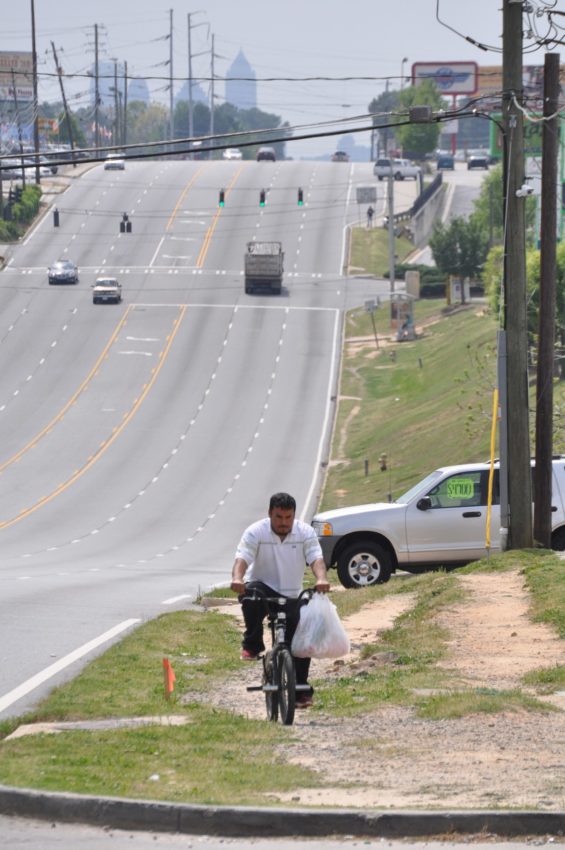
Sadly, more than 1,300 people died in motor vehicle crashes in Georgia in 2013. Beyond the terrible heartache for the families and friends of those involved, these crashes amounted to more than $1.6 billion in medical and work-loss costs. Buford Highway, an eight-mile corridor in Atlanta known for authentic international restaurants, is the most dangerous road for pedestrians in Georgia. Located on the northeast side of Atlanta, which is largely Latino, there were 22 pedestrian fatalities from 2003 to 2012 on Buford Highway. What can reverse this grave trend and save the lives of Latinos and the livelihood of those restaurants? Cars vs. Pedestrians Many cities are plagued by wide roadways, like Buford Highway. Even though this road offers many restaurants, it doesn't ...

Read More

Chicago Schools Partner with Water Agencies to Green Schoolyards


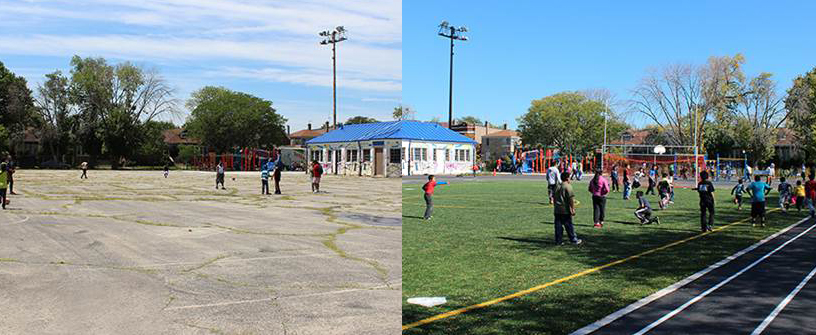
Chicago school before and after green schoolyard playground

Finding safe places for kids to play hasn't been easy for Latino families in Chicago. For example, 30 years ago, the federal government sued the Chicago Parks District for favoring parks in white neighborhoods and neglecting parks in African-American and Latino ones. Schools in Chicago didn't have equitable funding to maintain their own playgrounds over the years, either. At the same time, the nation was shifting to a school day with less time for recess—creating a "recess drought." But school officials wanted to play a role in increasing access to safe green space for Latino kids and families. Solving the 'Recess Drought' (and Preventing Floods) Chicago Public Schools, the third largest school district in the nation, took a big first step in 2011. They passed a recess ...

Read More

Report: U.S. Gets Failing Grade for Walkability


The U.S. is failing five of nine factors that reflect walking and walkable communities, according to a new report card. Children's walking behavior, pedestrian infrastructure, safety, institutional policies, and public transportation were graded an "F" by the new 2017 United State Report Card on Walking and Walkable Communities. The report is from the National Physical Activity Plan Alliance, which developed a system to evaluate U.S. walking and walkability. Why walking is critical in Latino neighborhoods Walking is a natural and inexpensive activity to improve health and prevent chronic disease. However, safe places to walk are often not accessible, particularly in Latino neighborhoods, according to our own research. Thus, many Latino children and adults don't walk and suffer ...

Read More

#SaludTues Tweetchat 9/26: Intersection of Walkability & Residential Segregation


Systematic housing segregation in the 1900s is the root of many social and environmental justice issues. One big one is inequity in neighborhood walkability, which leads to disparities in mental and physical health. Without safe places to walk, Latino families are robbed of opportunities to be healthy and thrive. Use #SaludTues on Sept. 26, 2017, to Tweet about potential solutions to improve walkability for all. Fueled by Richard Rothstein’s book, The Color of Law: A Forgotten History of How Government Segregated America, and America Walks upcoming webinar series, Walking Towards Justice, we will be discussing the intersection of residential segregation and walkability. WHAT: #SaludTues Tweetchat: “Intersection of Walkability & Residential Segregation” ...

Read More

Newborn Screening Resources in Spanish


Almost 23% of the 3.99 million babies born in 2015 were Hispanic. Early diagnosis of certain conditions can make the difference between healthy development and lifelong physical or mental disability for these babies. Newborn Screening In 1963, Newborn Screening begins with a heel stick. Screenings identify babies who may have a variety of genetic, metabolic, hormonal and functional conditions so that precise follow-up testing can be performed. Since 1963, babies with serious but treatable conditions caught by Newborn Screening grow up healthy with expected development. All it takes is a few drops of blood and a simple hearing test. However, Newborn Screening is an evolving system that varies across the country, thus many parents don’t know of the conditions included in ...

Read More