Fresh produce can be a rare commodity in Nogales, Ariz., where 17% of children are food insecure. Yolanda Soto saw the need for families all across Arizona to have fresh produce to improve nutrition and fight obesity. When Soto saw still-edible fresh produce being dumped into landfills every day, she had an idea for a fresh produce distribution program that rescues this food and provides it to food, insecure families. The program, Produce on Wheels - With Out Waste (P.O.W.W.O.W), now gives families, churches, communities and schools more access to fresh, nutritious fruits and vegetables that would otherwise be considered garbage.
Food a Crisis in Nogales
Yolanda Soto started helping families in food-insecure areas of Nogales, Ariz. (95% Latino) since January 1996, when she ...
California teen Elena Dennis wanted to help kids have healthy diets. What better way than to encourage them to learn how to make fresh foods? Dennis, while a high school senior, cooked up an idea for a camp that helps kids discover the fun of learning how to cook, and how to prepare and eat healthy foods from scratch. Bringing kids awareness of healthy foods, she also took the camp on local field trips to farms and farmers’ markets.
The Need for Fresh Foods Locally
Awareness: At the young age of 12, Elena Dennis of Novato, Calif. (23.1 % Latino), started developing a passion for cooking thanks to her father’s home-cooked meals and her attendance at Operation C.H.E.F., a nutrition-based cooking summer camp for kids and teens. “I’ve always been a believer in home-cooked ...
Did you know Applebees and IHOP restaurants have taken soda off kids menus and New York City Restaurants now show consumers which items are high in sodium? Choosing the healthier option when eating out can sometimes be confusing as most restaurant foods have high levels of either fat, sugar or sodium. MomsRising.org and Center for Science in the Public Interest are holding a #FoodFri Tweet Chat, Friday, December 18th, 10-11am PT/1-2pm ET to discuss how to eat healthfully while eating out. Participants will offer helpful suggestions for eating out, discuss efforts to improve restaurant kids' menus, and highlight ways to support access to healthier options in the community. To join this discussion, follow #FoodFri on ...
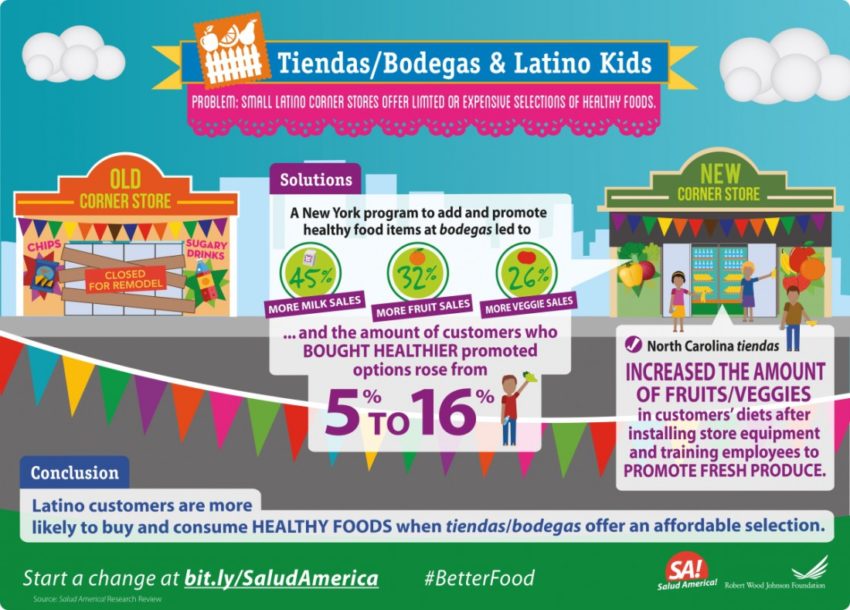
Many people, including Latinos, live in areas with poor access to supermarkets and easy access to corner stores, also called tiendas or bodegas. Research indicates that when corner stores offer a wider selection of healthy foods and promote them, people are more likely to buy them and eat healthier, according to our new infographic on tiendas/bodegas, which is part of the new Salud America! Better Food in the Neighborhood research package on the latest science and recommendations on healthy food options. Share this infographic ...
Many news media outlets covered the release of the new Salud America! Better Food in the Neighborhood research package on Dec. 8, 2015. The new research package offers an in-depth review of the latest science on the U.S. food environment and recommendations. KSAT-TV in San Antonio covered the research as part of its Making Awesome Changes series, which partners with Salud America! to feature people who are driving healthy changes to benefit the health of children and families. Here are a few other top stories: NBC News: Latino Neighborhoods Have Fewer Supermarkets, Less Healthy Options
Latina Lista: Research: Latino Families Have Worse Access to Healthy Food
Medical News Today: Research: Latino families struggle to access to healthy food See all the research ...
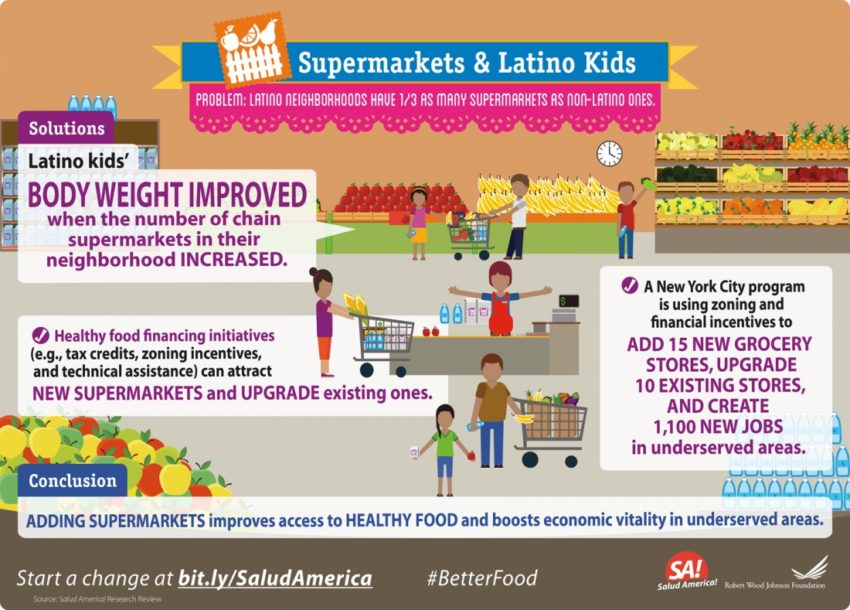
Did you know Latino neighborhoods have one-third as many supermarkets as non-Latino ones? Research indicates that adding supermarkets improves access to healthy food and boosts economic vitality in areas where families experience financial hardships, according to our new infographic on supermarkets, which is part of the new Salud America! Better Food in the Neighborhood research package on the latest science and recommendations on healthy food options for families. Also, kids’ body weight outcomes improved when the number of chain supermarkets in their neighborhood increased. Share this infographic ...
Latinos tend live in neighborhoods with few supermarkets and other sources of healthy, affordable food options, but several promising solutions are emerging, according to a new package of research from Salud America!, a national network for childhood obesity prevention and communication funded by the Robert Wood Johnson Foundation. Salud America!’s Better Food in the Neighborhood research package includes an in-depth review of the latest science on the U.S. food environment and recommendations based on that research. It also includes an issue brief, animated video, and infographics. The research shows that Latino neighborhoods have one-third as many supermarkets as non-Latino ones, corner stores with few healthy options, and more marketing of unhealthy foods. Promising ways to ...
What will happen to the future environment? How are leaders, restaurants, and communities impacting food in neighborhoods? Use #SaludTues to tweet with us on Dec. 8, 2015, as we unveil the results of a new study that explores the ways we can envision a healthier food environment for neighborhoods and communities. WHAT: #SaludTues Tweetchat: “Envisioning a Healthier Food Environment
TIME/DATE: 1-2 p.m., ET, Dec. 8, 2015
WHERE: On Twitter with hashtag #SaludTues
HOST: @SaludAmerica
CO-HOSTS: Food Corps (@FoodCorps); Voices for Healthy Kids (@Voices4HK) We’ll open the floor to your stories and experiences as we explore: The results of a new research package, "Better Food in the Neighborhood," by Salud America!, the team behind the #SaludTues tweetchats.
How ...
Walking down the grocery store aisle is hard when there are temptations for junk foods and sodas on discount, but what if milk or apples were on sale? A new study was developed to analyze healthy food promotions and how they could possibly impact consumers purchasing power for healthier foods. Researchers developed and analyzed an Eat Right-Live Well campaign placed in supermarkets where healthier foods were promoted through signage, product labeling, in-store taste testings, employee training and nutrition education. The campaign was analyzed through sales data from two supermarkets in low-income neighborhoods in Baltimore across a three year period. Researchers from Bloomberg School of Public Health, John Hopkins 's Carey Business School and Center for a Liveable future saw a ...