ALDI has pledged to become the first United States supermarket chain to remove junk food from all checkout areas. On January 12, 2016, the discount retail grocer announced that all checkout lanes will offer healthier items reduced in calories, fat, sugars and sodium. The checkout lanes across ALDI's 1,500 locations are to be stocked by the end of 2016 with items like single serve nuts, trail mixes, dried fruits and various low sugar granola bars. The first stores that will see the promised changes include St. Louis, Los Angeles, Dallas, Houston, Chicago and Minneapolis. The Center for Science in the Public Interest has reported that temptations of junk food, especially placed at kid's eye level are hard to resist for shoppers and children, who's willpower is fatigued after hours ...
Penny Parham is helping students in Miami-Dade County make healthier food choices more easily thanks to highlighted, veggie-promoting "Lean & Green" school lunch food menus. By providing more vegetarian options, officials with the Miami-Dade County Public Schools hope to increase students’ consumption of fruits and vegetables and make healthy food the easy choice. How did they make it happen?
Lean & Green
Penny Parham, the administrative director at Miami-Dade County Public Schools in Florida, realized the school district’s initiative of “Meatless Mondays” were popular for students. However, these vegetarian meal options were only available to students on Mondays. The Miami-Dade school district is the fourth largest in the nation, and having healthy eating ...
Traveling doesn't always allow time for healthy choices, especially when airports are filled with unhealthy options at every corner. But now more vegetable based options are coming to an airport restaurant near you. Many Airports are encouraging travelers to follow the 2015 Dietary Guidelines and offering up more fresh fruits, vegetables, whole grains and legumes in various ways. According to a recent article by foodtank, more than 70 percent of airport restaurants nationwide offer at least one plant-based entree, a 25 percent jump from 2001. Menus offered up include vegetable based plates with influences like Mediterranean vegetable plates and rice bowls. Chicago O'Hare is offering Bibb lettuce in Concourse G, and local vegetable shops are popping up in airport terminals in ...
Updated federal dietary guidelines suggest Americans should consume less sugar, fat and salt and more vegetables and whole grains, The Wall Street Journal reports. The guidelines, which are updated every five years recommend a “healthy eating pattern” with conscious decisions about what we drink and eat. “By focusing on small shifts in what we eat and drink, eating healthy becomes more manageable,” Secretary of Health and Human Services Sylvia M. Burwell said. The guidelines suggest Americans should consume: A variety of vegetables, including dark green, red and orange, legumes (beans and peas), starchy and other vegetables
Fruits, especially whole fruits
Grains, at least half of which are whole grains
Fat-free or low-fat dairy, including milk, yogurt, ...
Chef Ann Cooper founder of the Chef Ann Foundation (CAF) has created an online resource called The Lunch Box, to help support schools who want to change their school food situation. In a recent interview Emily Miller, from CAF told Food Tank that they want to help create healthier food for kids in today's world, where kids can learn the importance of nourishing their bodies and where their food comes from. Miller explains that the best way to teach kids about healthier foods is through school, where kids are already in a learning environment. The Lunch Box resource is an in-depth school food resource, where school food professionals can use free tools to help move from processed foods to scratch-made plates that are sustainable. Including over 200 recipes that are kid-tested, ...
This is part of our Food and Latino Kids: A Research Review »
Future Research Needs
This review of the evidence indicates that researchers should conduct additional and more rigorously designed studies, such as experimental or quasi-experimental studies with less reliance on self-reported data whenever possible. Future research should examine the degree to which increased access to local healthy foods impacts dietary habits and obesity in communities. Researchers also should: Identify other multilevel factors (for individuals, at homes, in neighborhoods, counties and cities), that contribute to obesity and health outcomes. Such factors include stressors, lack of time or interest in preparing healthy foods, prices for healthy foods that far exceed those for unhealthy ...
This is part of our Food and Latino Kids: A Research Review » Increased access to healthy foods in low-income neighborhoods does not necessarily ensure that it will lead to improvements in residents’ diets.
Some studies some no affect on dietary improvement
Two studies of low-income neighborhoods that have reported findings without sub-analyses have shown that increased access to healthy foods does not affect diet quality in low-income neighborhoods. A national study using longitudinal data observed that proximity to a supermarket was not related to diet quality in low-income young to middle-aged adult populations.27 In addition, the first controlled (one intervention neighborhood and one comparison neighborhood), longitudinal study of a PFFFI-funded project found that exposure ...
This is part of our Food and Latino Kids: A Research Review »
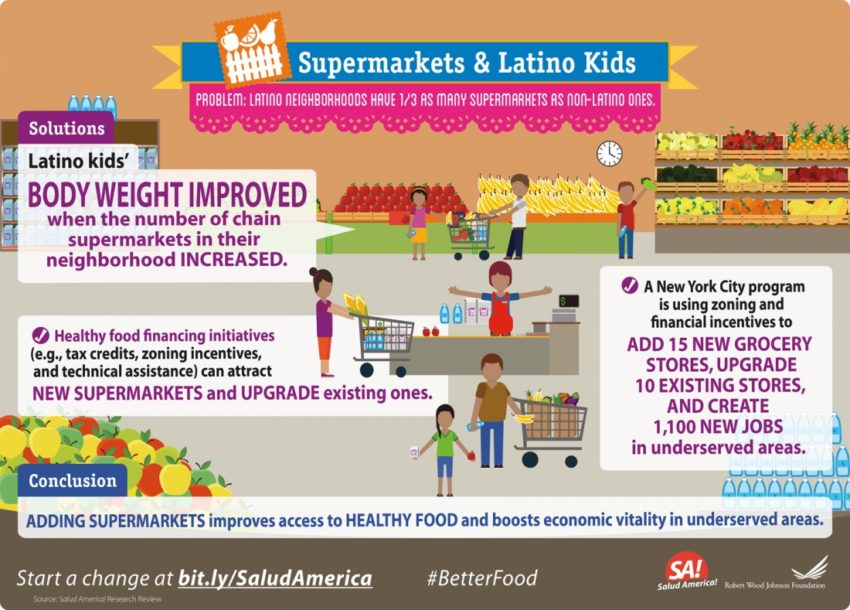
More access to supermarkets results in less obesity risk
Greater neighborhood access to supermarkets catering to low-income populations is linked to a lower prevalence of obesity in adults and children. Evidence from systematic reviews, longitudinal and cross-sectional studies collectively show the relationship between greater access to supermarkets and lower prevalence of obesity. Only two studies have analyzed the relationship between lack of local supermarket access and obesity over a period of time (2 years and 4 years). The data from these studies show mixed evidence in adults and children. One study reported that an increase in accessible supermarkets was associated with decreased BMI for adults who moved from ...
This is part of our Food and Latino Kids: A Research Review »
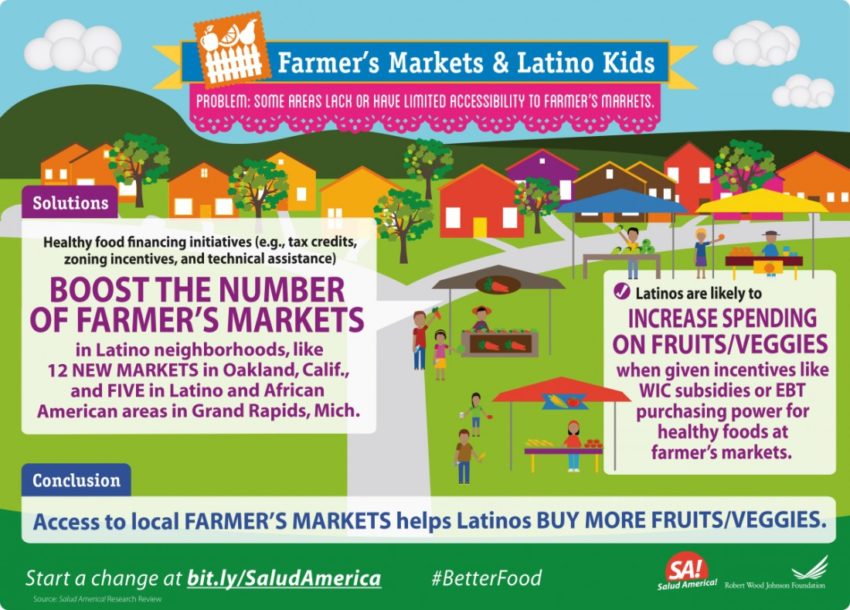
Access to farmers markets is lacking
In the past decade, the number of farmers’ markets in the United States has more than doubled.51 However, many of these markets had not previously been accessible to certain people, including Latino populations.
Efforts to increase number of farmers markets
A number of food financing initiatives have increased the number of farmers’ markets operating in communities impacted by non-medical drivers of health.52 For example, through the activities of community groups, there are nearly a dozen farmers’ markets in communities impacted by non-medical drivers of health in Oakland, California. Latinos comprise 25 percent of these communities.53 Similarly, the Y USA’s Pioneering ...