by
by 
Share On Social!
Human beings need social interaction to live a healthy life.
But did you know how much you socialize can have a direct effect on your brain health?
Social isolation is not only linked to negative brain health, but the impacts also can be worse depending on where you live, according to a recent study from UT San Antonio and Princeton University.
Check out our new fact sheet, How Does Social Isolation Impact Brain Health in Aging Adults?, to help our abuelos and abuelas across the globe understand how maintaining an active social life can impact their brain health as they age.
This fact sheet was created by Dr. Amelie G. Ramirez of Salud America! and UT Health San Antonio based on a research brief from the San Antonio Center for AD/ADRD Population Aging and Social Studies (San Antonio CAPAS) at UT Health San Antonio.
Why Does Social Isolation and Social Interaction Matter for Older Adults?
Older adults are more at risk for social isolation than younger adults.
As we age, there are significantly fewer opportunities to socialize — friendships grow distant; you aren’t regularly going into an office space or school, and children grow up and start to have families of their own.
That’s why many seniors rely on their significant others, community centers, adult learning programs, and more to fill the social void.
These gaps in socialization increased tenfold during the COVID-19 pandemic.
Social interaction is a top way older adults can decrease their risk for Alzheimer’s and dementia. That is why researchers continue to study how beneficial socialization can be to the brain health of seniors across the globe.
How Does Social Isolation Impact Brain Health in Aging Adults?
The How Does Social Isolation Impact Brain Health in Aging Adults? fact sheet seeks to help older adults and families understand how lack of social interaction differs from population to population and steps to take to minimize the impact it has on brain health.
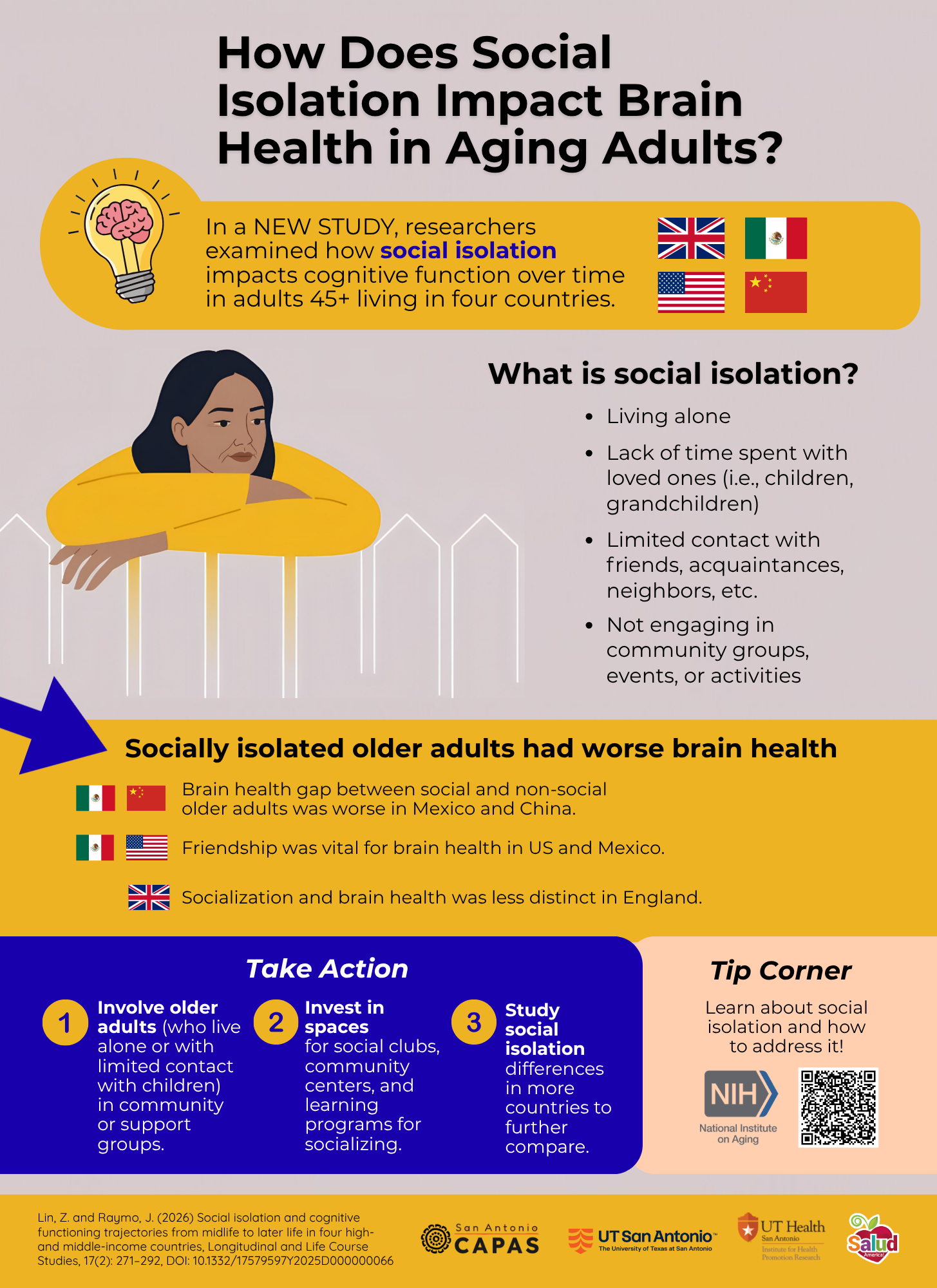
The fact sheet covers what social isolation looks like, who is impacted by social isolation, and how it differs depending on where you live and your background.
Also, explore ways communities can create opportunities for older individuals to socialize and learn what researchers can do to improve gaps in socialization.
The information in the fact sheet is based on findings from the recent study, Social isolation and cognitive functioning trajectories from midlife to later life in four high- and middle-income countries, led by researchers Zhiyong Lin of UT Health San Antonio and James Raymo of Princeton University.
The study is also featured in a research brief.
Download the fact sheet to discuss how social isolation may be impacting you or your loved one’s brain health or print it out as a resource for your community center, health provider’s office, school, or senior living center.
You can also use the guide to advocate for the creation of socialization opportunities in your community.
Addressing Alzheimer’s and Dementia in South Texas
Alzheimer’s and related dementias continue to ravage communities and families in South Texas, where many Latinos call home.
There are many societal and background-prevalent factors that contribute to inconsistencies in the Alzheimer’s and dementia care continuum.
Many of these factors stem from some of the modifiable risk factors included on this list.
To address some of these inconsistencies, UT San Antonio launched the San Antonio Center for Alzheimer’s Disease and Related Dementias (AD/ADRD) Population Aging and Social Studies (CAPAS), which is funded by the National Institute on Aging.
Led by Drs. Rebeca Wong and Fernando Riosmena, CAPAS seeks to bring together multidisciplinary groups of experts and research networks in demography, sociology, AD/ADRD epidemiology, neuropsychology, public health issues, and experience conducting longitudinal studies for AD/ADRD research and Latino aging.
“By combining our strengths, we can address Alzheimer’s disease from every angle — from molecules and biomarkers to families, neighborhoods and communities,” Dr. Wong told UT San Antonio Today.
View our bilingual fact sheets here:
For more information on Alzheimer’s Disease, dementia, or what researchers are doing to improve health outcomes in aging Latinos and all older adults, please visit the CAPAS center website.
This series is curated and published by Salud America! with partnership and support from the San Antonio Center for Alzheimer’s Disease and Related Dementias Population Aging and Social Studies (CAPAS) at UT Health San Antonio, funded by the National Institute on Aging. CAPAS is striving to address issues related to the aging Latino population in South Texas.
Explore More:
DementiaBy The Numbers
142
Percent
Expected rise in Latino cancer cases in coming years