by
by 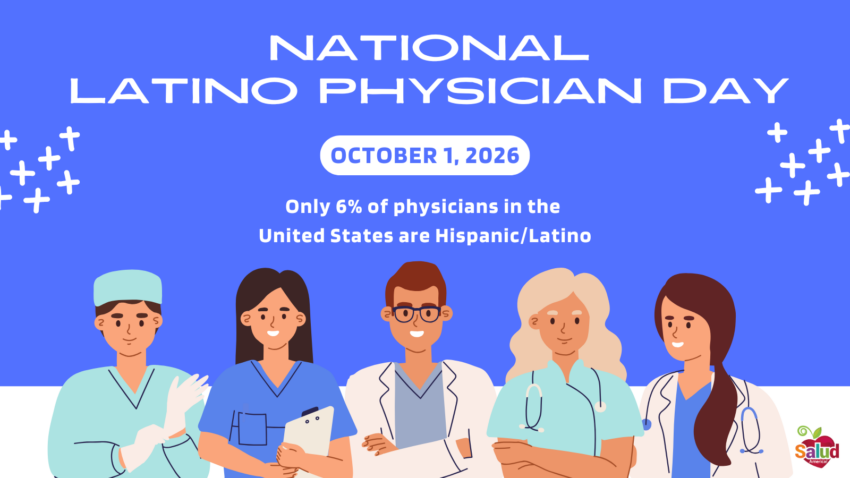
Share On Social!
As of 2025, Latinos make up 20% of the U.S. population.
In some areas, like California, Latinos comprise 40% of the population and are expected to rise to 50% by 2050, according to the National Latino Physician Day website.
Many of these populations encounter hurdles to healthcare, including language, access, and more, leading to worse health outcomes.
One way to address this is by increasing the number of Latino physicians, who only make up 6% of the physician workforce.
As the nation continues to experience a shortage of health care workers, how do we increase the number of Latino physicians?
That’s something National Latino Physician Day on Oct. 1, 2026, is striving to bring awareness to every year.
How Did National Latino Physician Day Start?
National Latino Physician Day was established in 2022 by Drs. Michael Galvez and Cesar Padilla to draw attention to the Latino physician shortage.

“The mission of National Latino Physician Day to improve the quality of care for the United States Latino patient population by increasing the number of Latino physicians who provide … concordant care,” according to a National Latino Physician Day news release.
In 2023, National Latino Physician Day was introduced for recognition in the US Senate by Senator Alex Padilla and Senator John Cornyn and in the US Congress by Drs. Raul Ruiz and Yadira Caraveo.
“Having doctors who can communicate in their patients’ language and understand their patients’ [background and beliefs] leads to better health recommendations and outcomes,” Ruiz said in a news release.
Further support for the recognition of National Latino/a Physician Day came on September 17, 2026, when U.S. Representative Raul Ruiz introduced a House resolution expressing support for the designation of October 1 as National Latino and Latina Physician Day.
Celebrate National Latino/a Physician Day on Oct. 1, 2026!
Why is National Latino Physician Day Needed?
This year’s National Latino Physician Day comes on the heels of unprecedented decision to decrease access to Medicaid and Medicare.
Changes to Medicaid and Medicare coverage include increased hurdles to participation, eligibility, renewal, and financial cuts.
These changes are projected to cut the health care coverage of 14 million Americans, including 4 million Latinos, over the next 10 years.
Not only will these changes impact health care access; they will place further stress on hospitals and clinics, which are already short staffed.
In fact, the shortage is projected to reach up to 86,000 doctors by 2036, according to National Latino Physician Day.
This is happening at a time when fear and distrust of health care is high.
A driving force of that fear is the rising presence of immigration enforcement in Latino communities across the country. Their increased presence is causing many to avoid, postpone, and delay of care, resulting in worse health outcomes.
To overcome the threats to Latino health, we must increase the number of Latino/a physicians, according to National Latino Physician Day.
Hurdles to Becoming a Latino Physician
The lack of Latino physicians stems from many issues, including the non-medical drivers of health, such as a lack of financial resources, access to healthy food and housing, and more.
One of the biggest challenges is the lack of opportunities for higher education, which is a requirement for physicians.
While Latino enrollment in 4-year institutions has risen significantly over the last two decades, Latinos are among the students with the greatest risk of withdrawing from post-secondary education programs, according to a recent survey by the Lumina-Gallup State of Higher Education.
Due to differences and background values, Latino students face high levels of stress.

This leads to a higher risk for mental health issues that may be left untreated because of the stigma surrounding mental health and could contribute to the higher drop-out rate.
For instance, 71% of Latinos didn’t enroll in degree programs because they needed to work to support their families, while 69% cited they couldn’t afford the cost of a four-year degree, according to a 2021 Pew Research Center survey.
In fact, college costs are one of the biggest hurdles to higher education for Latinos.
As of 2023, the average cost to attend an in-state public college was $10,662 a year, which works out to $42,488 for four years of classes, according to U.S. News & World Report.
That’s just for a bachelor’s degree. Fully realized physicians must undergo four years of undergraduate education followed by four years of medical school, complete several years of residency, and a fellowship program for specialty fields.
The average debt for a medical school student is over $200,000.
75% of Latino medical students have debt at a median amount of $200,000, compared to 71% of White students, according to Education Data Initiative.
Latinos are also more likely than other students to take on debt and have difficulties paying back loans, which can impact someone’s ability to buy a home, get a credit card, and more, according to the Pew Research Center.
In addition, Latinos are less likely to still be enrolled beyond the six-year mark on their way to completing a degree compared to their White peers.
Lastly, more recent changes to federal loan borrowing limits have decreased the amount that can be borrowed, creating a gap in affordability for attending higher education institutions, especially in areas that require lengthier education.
Addressing Hurdles to Higher Education
To address these differences and make college and medical school more accessible to Latinos and all people, we must create new pathways to higher education.
Those pathways begin at public education where education inequities begin the moment someone enters kindergarten.
One of the best ways to do this is to increase teachers of all backgrounds at both the K-12 and college level.
Educators who represent the student body can better understand the student’s background and tailor their teachings to the needs of the student.
All public schools around the country are not created the same.
Some schools, especially in impoverished and rural areas, may have less funding and therefore be equipped with fewer resources, such as technology, supplies, and programs that help students prepare for the future.
To address these inconsistencies, The Brookings Institution suggests offering summer school and afterschool programs to help close learning gaps.
At the high school level, school districts should invest in technology programs, such as computer science, and integrating them into regular coursework, to prepare Latino and all students for in-demand jobs in the STEM field.
What’s more, creating partnerships between high schools and Hispanic-serving institutions (HSIs) can also open doors for students to enter higher education.
Currently there are more than 500 HSIs across the country that educate more than 4.7 million students, according to a White House news release.
That number is expected to decrease over the next few years as grant funding for these institutions has been significantly reduced or cut entirely.
However, it isn’t enough for them to exist, the Department of Education must also invest in the growth and resources that these institutions can provide.
Which brings us back to National Latino Physician Day.
Explore More:
Health & CohesionBy The Numbers
3
Big Excuses
people use to justify discriminatory behavior