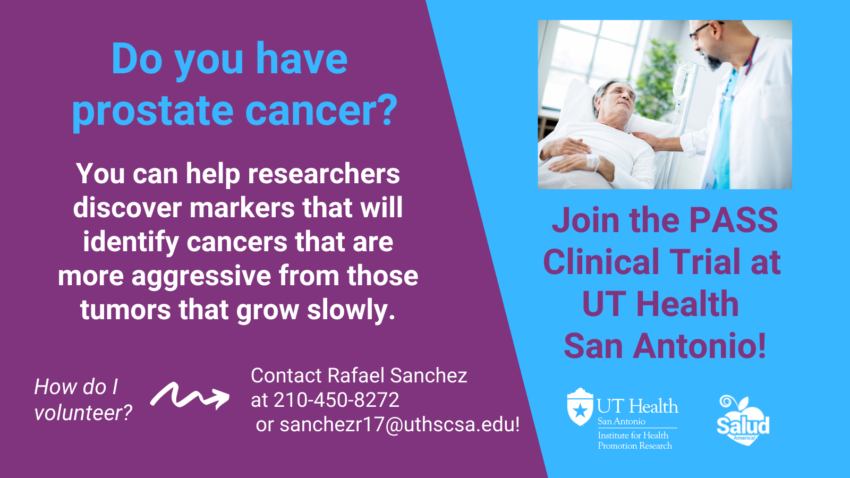
For Latino men, prostate cancer is the most common cancer diagnosis. While there is good news—from 2014-2018, Latino men were 20% less likely to face a prostate cancer diagnosis than their white peers—Latino men are more likely than their white peers to be diagnosed at a younger age, and with a higher risk of disease. This is why researchers at UT Health San Antonio are conducting the Prostate Active Surveillance Study (PASS) Clinical Trial in partnership with the Canary Foundation, a nonprofit dedicated to the early detection of cancer. The study is for men age 21 and older who have chosen active surveillance as a management plan for their prostate cancer. Active surveillance is defined as close monitoring of prostate cancer with the offer of treatment if there are changes ...
Dr. Mirella Díaz-Santos has a personal fight to end Alzheimer’s Disease. Her grandmother was diagnosed with Alzheimer’s when Díaz-Santos was in school. “I needed to know more about how this ‘disease’ can change someone who you love so much. How can it change it completely?” Díaz-Santos said. Díaz-Santos is an assistant professor in residence at University of California at Los Angeles (UCLA) in the department of neurology and psychiatry. She’s also the director of research of the Hispanic Neuropsychiatric Center of Excellence at the Semel Institute for Neuroscience and Human Behavior and is involved with the Women’s Alzheimer’s Movement to bring awareness to Alzheimer’s within the Latino community. Although she’s experienced bias and discrimination ...
Between 1980 to 2019, police violence caused 30,800 deaths, according to a new report published in The Lancet. Latinos experienced the second-highest rate of police violence-driven fatalities, after Blacks. The report also found that police-violence-related deaths among people of color far outweighed the number of cases reported in the U.S. National Vital Statistics System (NVSS), which tracks fatality data. “Mounting evidence shows that deaths at the hands of the police disproportionately impact people of certain races and ethnicities, pointing to systemic racism in policing," according to the data. “Proven public health intervention strategies are needed to address these systematic biases.”
The Report and Its Findings on Police Violence
In 2019, the US incurred 13% of ...
Latinos represent 18.5% of the U.S. population, but are far less than 10% of those in federal cancer and drug studies. This makes it hard for researchers to create treatments that work best for Latinos. To address this issue, you’re invited to join us for “How to Encourage Latinos to Participate in Clinical Trials,” the first webinar of a new series, “Let’s Address Health Equity Together,” at 11 a.m. CST on Dec. 14, 2021. This Zoom webinar will help health care professionals understand the lack of Latino participation in clinical trials and explore strategies and system-changing advocacy actions to improve Latino enrollment in clinical trials. "This webinar will help doctors, nurses, researchers and other healthcare professionals take action for diversifying ...
You don’t have to stop smoking in one day. Start with Day 1. On Thursday, Nov. 18, 2021, you can join thousands of people who will begin their smoke-free journey with the Great American Smokeout. This annual event from the American Cancer Society encourages smokers to make a plan to stop smoking. Need help? Enroll in Quitxt, a free English or Spanish text-message service that turns your phone into a personal “quit smoking” coach from UT Health San Antonio. To join Quitxt, text “iquit” (for English) or “lodejo” (for Spanish) to 844-332-2058. “For the Great American Smokeout, we’re excited to share Quitxt to provide real-time help with motivation to quit, setting a quit date, handling stress, and much more, all on your phone,” said Dr. Amelie G. Ramirez, ...
Maria Maldonado knows what it’s like to experience the tragedy of COVID-19. She lost five family members to the virus in the past year, including her mother. “It was just a tidal wave. And it was just very hard for us to go through something so tragic, back to back. It was a very difficult time,” Maldonado said. When the vaccine became available for adults, Maldonado couldn’t wait to get one. “I was not hesitant at all. Why? Because I trust science. They developed it fast, but they still took the protocols and the safety measures that they had to take,” Maldonado said. Once the vaccine was available for children ages 5 to 11, Maldonado got her 9-year-old son Jacob vaccinated. She hopes that other Latino parents will vaccinate their children and help protect ...
In the U.S., Latinos are uninsured nearly three times more than their white peers. Given that Latinos are projected to grow to 25% of the population by 2045, this lack of healthcare coverage will continue to endanger the health of many more individuals, families, and the healthcare system. A recent federal report shows just how large this problem is and why it is critical that civic and business leaders address it. “Latinos have consistently been overrepresented in the uninsured population,” states the report from the Assistant Secretary for Planning and Evaluation (ASPE). “Prior to the implementation of the Affordable Care Act (ACA), Latinos had the second-highest nonelderly uninsurance rate among ethnic and racial populations with more than 30% uninsured. “Studies ...
Dr. Amelie G. Ramirez, director of the Institute for Health Promotion Research (IHPR) at UT Health San Antonio and a leading health promotion researcher, will serve as the 2021-2022 chair of the the Women in Cancer Research Council of the American Association for Cancer Research (AACR). The council organizes the activities of the members of the Women in Cancer Research group. This includes fostering career development, recognizing scientific achievements, and advising AACR leadership. Ramirez is currently serving a three-year term on the council through December 2022. “It is a great honor to serve as chair of this group for the 2021-2022 term. Despite the challenges we have seen during the pandemic, I am proud to say we are still making strides and progressing in the field of ...
The AAMC Center for Health Justice and American Medical Association (AMA) co-developed a new guide on inclusive language to advance health equity. “Designed for physicians and other health care professionals, Advancing Health Equity: AMA-AAMC Guide on Language, Narrative, and Concepts provides guidance and promotes a deeper understanding of equity-focused, first-person language and why it matters,” according to the AAMC Center for Health Justice. The guide is broken down sections on language to use to promote health equity, why these narratives matter, and a glossary that defines key terminology. Using inclusive language is important for healthcare providers to ensure that they are giving culturally comprehensive care that is absent of implicit bias or discrimination, which ...