Women who eat a lot of fast food may take longer to become pregnant and be more likely to experience infertility than those who rarely eat fast food, Reuters reports. Women who ate fast food at least four times a week had a 16% risk of infertility and failed to conceive after 12 months of trying, according to a study by the Robinson Research Institute and the University of Adelaide in Australia of 5,598 first-time mothers in Australia, New Zealand and the UK. The risk was only 8% in women who rarely or never ate fast food. This has big implications for Latinas' fertility and the food environment.
Latinas and Fertility
"In families of color, there’s an assumption that when you want to get pregnant, you get pregnant," one woman told the New York Times a few years ago. But ...
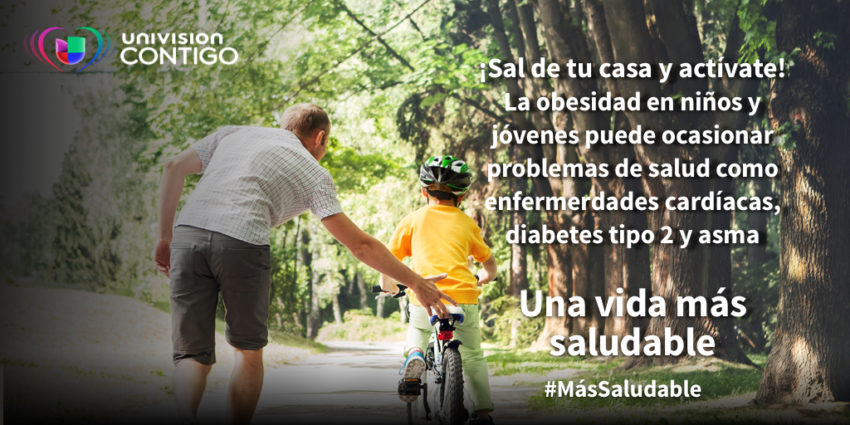
Salud America! is excited to serve as a partner with broadcasting company Univision's new national campaign to promote Latino health this summer. The campaign, Univision Contigo's Una Vida Mas Saludable, aims to inform, entertain and empower our Latino communities to live healthier. The campaign runs from June 18 to July 14. "Univision will cast a spotlight on various health issues impacting the Latino community," according to Univision. "[That includes] being active outdoors, addressing mental health in the Latino community, providing health and wellness tips, and discussing the importance of healthy aging."
How We're Getting Involved
Salud America! is partnering with Univision. We will share Univision Contigo's Una Vida Mas Saludable messages with the hashtag #MasSaludable. ...
When it comes to Latinos and alcohol, there is good news and bad news. Good news: More Latinos have never had even one drink of alcohol (31.8%) than their white peers (15.8%). Bad news: About 1 in 10 Latinos will have alcohol dependence at some point in their lives, according to the National Institute on Alcohol Abuse and Alcoholism. More than 33% of these Latinos will have recurrent or persistent problems compared, a higher rate than their white peers (22.8%). Either way, some Latinos do struggle with alcoholism. That makes it a problem that public health officials should address.
Latinos and Alcohol: Stats
Not all Hispanic groups are equal when it comes to drinking and alcohol-related problems, according to an expert who has been studying the alcohol pattern in Latinos for ...
More than one-third of U.S. high-school students were overweight or obese, including a higher rate among Latinos (37.7%) than their black (36%) and white (26.5%) peers, according to new CDC data. Sharp disparities were also found in Latino sleep habits and health conditions like asthma.
The Data
The CDC's Youth Risk Behavior Surveillance System monitors health-related behaviors. These behaviors usually develop during childhood and early adolescence. They contribute to the leading causes of death among youth and adults in the United States. The CDC Youth Risk Behavior Survey is part of the surveillance system. It examines 121 health-related behaviors of high-schoolers. Today we're examining the data on obesity, sleep, and asthma.
Latino Youth and Obesity
More Latino and black ...
A few years ago, Salud America! found that Latino students are exposed to more unhealthy food in and out of school than their peers. This contributed to poor nutrition and high rates of obesity. Sadly, that situation still exists today. Latino high-school students eat fewer fruits and vegetables and don't eat breakfast daily as much as some of their peers, according to new data released in June 2018 from the CDC's 2017 Youth Risk Behavior Survey.
The Data
The CDC's Youth Risk Behavior Surveillance System monitors health-related behaviors. These behaviors usually develop during childhood and early adolescence and contribute to the leading causes of death and disability as well as social problems among youth and adults in the United States. The CDC Youth Risk Behavior Survey is ...
If you don't get enough sleep, you run a higher risk of heart disease, diabetes, obesity, anxiety, and depression. Now lack of sleep is being tied to Alzheimer’s disease, too. Losing just one night of sleep led to an immediate increase in beta-amyloid, a protein in the brain associated with Alzheimer’s disease, according to a new study by researchers at the National Institutes of Health's National Institute on Alcohol Abuse and Alcoholism (NIAAA). Beta amyloid forms the main component of the amyloid plaques found in the brain of Alzheimer’s patient. It harms communication between neurons. A separate study also recently found that sleep deprivation impacts the beta-amyloid burden in regions of the brain implicated in Alzheimer’s disease. This situation also resulted in ...
Suicide rates have increased drastically across the United States from 1999-2016, according to a new report released by the CDC. Suicide rates are highest among White and Native American/Alaska Native populations. However, suicide rates for Latinos and African Americans are continually rising, the data shows. There were also significant increases in several states including Massachusetts, Vermont, and New Hampshire. Additionally, more than half the suicides in 2015 were among people with no known mental health conditions, according to an article in the Boston Globe. On the heels of two recent celebrity suicides - Kate Spade and Anthony Bourdain - the “data are disturbing,” Anne Schuchat of the CDC told SCNow. “The widespread nature of the increase, in every state but ...
Are you a city or county leader who wants to increase local access to healthy food? You are invited to the Healthy Food Policy Project's new webinar—"Supporting Healthy Food Access: Are There Local Laws For That?"—at 1p.m. EST on Wednesday, June 13, 2018.
About the Food Access Webinar
Food access is an important issues in our nation. For example, fast food and corner stores outnumber supermarkets in many Latino neighborhoods, according to a Salud America! research review. This creates food swamps where obesity rises. Cities and counties are using law and policy to support healthy eating in many ways. Laws can focus on socially disadvantaged groups, like Latinos. They can focus on environmental and economic goals, too. The webinar will shocase the Healthy Food Policy ...
If you work in a health field, you know that climate change impacts health. You know climate change causes asthma and lung disease. You know it spurs natural disasters that endanger food and energy sources. You know Latino and other communities are particularly affected. But how can you talk about climate impact to patients? Or to leaders who can drive solutions? Thankfully, Climate for Health and ecoAmerica have a guide, Let’s Talk Health and Climate: Communication Guidance for Health Professionals. “The health and medical community is uniquely positioned to advance the message that climate solutions are a health priority,” according to the guide. “[The guide] can help make health professionals as adept at talking about climate change as they are at addressing ...