ALDI has pledged to become the first United States supermarket chain to remove junk food from all checkout areas. On January 12, 2016, the discount retail grocer announced that all checkout lanes will offer healthier items reduced in calories, fat, sugars and sodium. The checkout lanes across ALDI's 1,500 locations are to be stocked by the end of 2016 with items like single serve nuts, trail mixes, dried fruits and various low sugar granola bars. The first stores that will see the promised changes include St. Louis, Los Angeles, Dallas, Houston, Chicago and Minneapolis. The Center for Science in the Public Interest has reported that temptations of junk food, especially placed at kid's eye level are hard to resist for shoppers and children, who's willpower is fatigued after hours ...
Schools often have physical activity facilities, but many are not open to the public. Shared use agreements—contracts between a school and a city, county, or sports league that outlines rules for sharing existing facilities—can help neighborhoods have more access to active spaces and help kids stay active and healthy, according to our new infographic on shared use agreements. The infographic is part of Salud America!’s Active Spaces and Kids research package, which tackles the latest issues on the physical activity environment and offers recommendations. Share this infographic today! Salud America! is a Robert Wood Johnson Foundation-funded national childhood obesity prevention and communication ...
Many kids lack access to active spaces and safe streets where they can be physically active. These streets are often plagued with speeding cars and lack of sidewalks. Research shows that when communities adopt a “Complete Streets” policy and organize events such as “Open Streets,” more kids and their families become physically active, according to our new infographic on safe streets. The infographic is part of Salud America!’s Active Spaces and Kids research package, which tackles the latest issues on the physical activity environment and offers recommendations. Share this infographic today! Salud America! is a Robert Wood Johnson Foundation-funded national childhood obesity prevention and communication ...
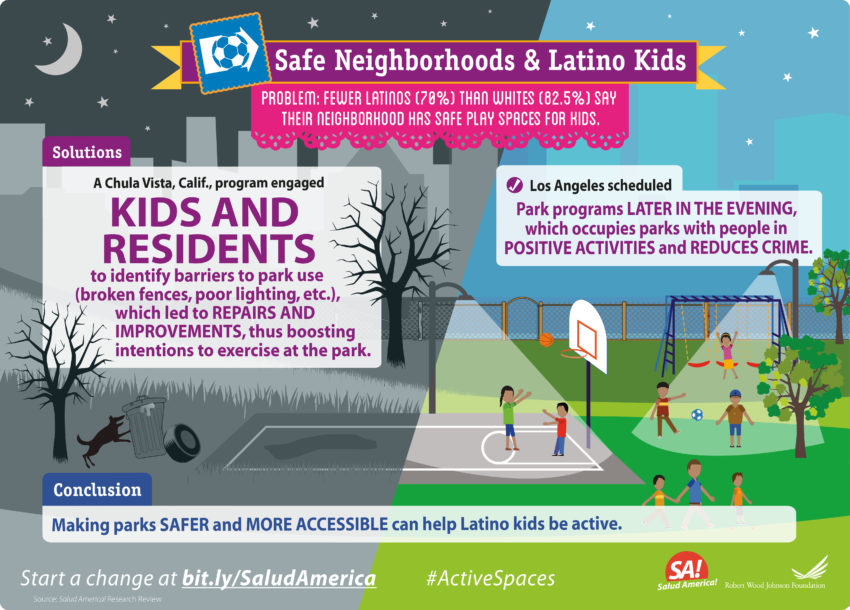
Only 70% of Latinos say their neighborhood has safe, active spaces for kids. Research shows that when communities address challenges to park use such as broken fences, poor lightening and sidewalks, more people visit community parks, according to our new infographic on safe neighborhoods. The infographic is part of Salud America!’s Active Spaces and Kids research package, which tackles the latest issues on the physical activity environment and offers recommendations. Share this infographic today! Salud America! is a Robert Wood Johnson Foundation-funded national childhood obesity prevention and communication ...
Penny Parham is helping students in Miami-Dade County make healthier food choices more easily thanks to highlighted, veggie-promoting "Lean & Green" school lunch food menus. By providing more vegetarian options, officials with the Miami-Dade County Public Schools hope to increase students’ consumption of fruits and vegetables and make healthy food the easy choice. How did they make it happen?
Lean & Green
Penny Parham, the administrative director at Miami-Dade County Public Schools in Florida, realized the school district’s initiative of “Meatless Mondays” were popular for students. However, these vegetarian meal options were only available to students on Mondays. The Miami-Dade school district is the fourth largest in the nation, and having healthy eating ...
Traveling doesn't always allow time for healthy choices, especially when airports are filled with unhealthy options at every corner. But now more vegetable based options are coming to an airport restaurant near you. Many Airports are encouraging travelers to follow the 2015 Dietary Guidelines and offering up more fresh fruits, vegetables, whole grains and legumes in various ways. According to a recent article by foodtank, more than 70 percent of airport restaurants nationwide offer at least one plant-based entree, a 25 percent jump from 2001. Menus offered up include vegetable based plates with influences like Mediterranean vegetable plates and rice bowls. Chicago O'Hare is offering Bibb lettuce in Concourse G, and local vegetable shops are popping up in airport terminals in ...
Did you know that 81% of Latino neighborhoods don’t have a safe recreational facility? That means many kids lack places to play and be active, which contributes to higher rates of physical inactivity and obesity, according to a new package of research from Salud America!, a national network for childhood obesity prevention and communication funded by the Robert Wood Johnson Foundation. Salud America!’s Active Spaces and Kids research package tackles the latest issues on the physical activity environment and offers recommendations. Solutions are emerging to improve access to and safe use of active spaces: Shared use agreements are formal contracts between a school and a city, county, or sports league that outline terms for sharing existing physical activity facilities. They ...
Many kids and families have limited spaces to be physically active. What are the best ways to improve access to “active spaces” like gyms, athletic fields, parks, and playgrounds for all families, including Latinos? Many schools do not provide public access to physical activity facilities. Shared use agreements set up rules for public use of schoolyards after class. Repairing sidewalks, installing street lights, and improving parks can stimulate more physical activity. Creating safer streets can people to walk or cycle to schools, parks, and other family destinations. Also, using marketing and technology to change kids’ physical activity patterns. See the Full Research Review with references (PDF)
Read the Issue Brief in English (PDF)
Read the Issue Brief in Spanish ...
Physical activity is scientifically proven to improve health outcomes. But some kids have less safe physical activity opportunities, including fewer parks and places to walk and bike in their neighborhoods and less time for recess and P.E. in their schools. Join #SaludTues on December 15, 2015, at 1:00 PM EST to tweet about how we can use new research and stories to redefine physical activity for lifelong health, and how parents, schools, cities, nonprofits, and parks can collaborate and ensure access to #ActiveSpaces for all kids. WHAT: #SaludTues Tweetchat: “How to Increase Active Spaces for Kids”
TIME/DATE: 1-2 p.m. EST Tuesday, January 12, 2016
WHERE: On Twitter with hashtag #SaludTues
HOST: @SaludAmerica
CO-HOSTS: @AL_Research @kaboom @americawalks ...