 by
by Share On Social!
Yolanda “Yoli” Barrera Day wasn’t aware she had stomach cancer.
Not very many do because from a health standpoint, stomach cancer looks like any other gastrointestinal ailment.
But for Yoli, stomach cancer preyed on her advancing age.
After months of suffering from symptoms such as extreme fatigue and shortness of breath, Yoli was diagnosed with gastric adenocarcinoma.
It was a diagnosis that most may deem a death sentence, but not Yoli.
Yoli was determined to make it out the other side and help others do the same by becoming a health leader and supporter for change.
Deceptive Symptoms Hiding Stomach Cancer
It was early 2021 and Yoli was feeling more tired than usual.
While the exhaustion was draining, it wasn’t enough to raise suspicion.
Prior to her diagnosis, Yoli described herself as overweight and assumed that it was the reason for her extreme fatigue.
However, her health took a turn when she noticed she wasn’t able to do simple things most people take for granted, such as bending over to pick something up.
That’s when she sought medical intervention.
During her first doctor’s visit, Yoli received a few tests, including an EKG, and everything came back normal.
Although her symptoms were dismissed, they didn’t go away.
In fact, they got worse.
Yoli knew something was horribly wrong while out dancing with her husband — something they thoroughly enjoyed doing.
“We couldn’t get through one song without me just gasping for air, and I thought, ‘That’s just not right,’” she recalled.
She returned to the doctor, who performed blood tests and was stunned to find out that her red blood cell count was lower than expected, and she would need a transfusion immediately.
Soon, Yoli was hospitalized where she underwent a transfusion. While there, she was told she was bleeding from somewhere, but they weren’t sure where and suggested she see a gastroenterologist.
She was no closer to getting the answers she desperately needed.
While at the gastroenterologist, the proposed diagnosis was an ulcer, but an endoscopy revealed the startling source of the bleed.
“I was coming out of anesthesia and all I remember is a nurse on one side of me, and [the doctor] on the other side holding my hand. And I’m like, ‘Why are they holding my hand?’ … And then he says, ‘You’ve got a tumor … Not only do you have a tumor, but you’ve got an ugly looking tumor.’”
The tumor was then tested and that’s when she found out it was malignant.
“Then my journey began,” Yoli told Salud America!
Stomach Cancer is a Different Kind of Beast
The American Cancer Society estimates that in 2025 there will be about 30,000 new cases of stomach cancer in the US.
It’s also estimated that stomach cancer will cause 10,780 deaths in 2025.

Common symptoms of stomach cancer include reflux, stomachache, bloating, occasional vomiting, discomfort, and pain, Yoli said.
“The symptoms are just normal, so people just ignore them, or they say everybody has reflux. Or, oh, I just shouldn’t have eaten that Mexican food last night, or I can’t drink wine anymore because it makes me sick. What sets it apart is that the symptoms are ignored. They’re disregarded,” she explained.
They are also often confused with symptoms of other ailments, illnesses, and diseases.
Due to symptoms that mimic other health concerns, stomach cancer often goes undiagnosed until it’s reached an advanced stage.
This makes the cancer more difficult and expensive to treat, increasing the risk of death.
For those who postpone or delay seeking medical treatment for these symptoms because of lack of insurance or lack of access to care, the consequences are dire.
That’s why many Latinos are burdened with stomach cancer.
When caught early, stomach cancer has a 75% 5-year survival rate, according to the National Cancer Institute.
However, when the cancer has spread to nearby lymph nodes, that rate decreases dramatically to 36%.
At a metastatic level, stomach cancer patients have a 7% 5-year survival rate.
Clinical Trial as Treatment for Stomach Cancer
Luckily, Yoli’s stomach cancer was caught at stage 2, making it easier to treat and manage.
Yoli got multiple opinions on how to pursue treatment, but in the end, there was no way around having her stomach removed due to the location of the tumor.
The treatment for stomach cancer consisted of chemotherapy and radiation followed by surgery.
With the support of her family, she ended up receiving treatment at MD Anderson Cancer Center after being offered participation in a clinical trial as part of her treatment.

Clinical trials are studies with volunteers that test ways to find, prevent, and treat cancer and other diseases. They may also help improve the quality of life for volunteers affected by cancer or reduce the side effects of treatment.
“Clinical trials are so important,” Yoli told Salud America!
Enrolling in the clinical trial cut radiation treatment by a few weeks.
“If we could cut down the time of this horrible treatment that we have to go through, then I wanted to be part of that,” she said. “If that was going to be at the end of the day, the new treatment plan that they were going to use for others, then I definitely wanted that to happen, so I took a chance.”
But before treatment could formally begin, Yoli had to undergo another endoscopy and a laparoscopy.
During that time, she was approached about another clinical trial.
This time they were asking for a sample of the tumor during the laparoscopy procedure and tracking her through her treatment journey.
Yoli happily agreed to enroll in the clinical trial.
She said, “Whatever you can find, and it’ll help you with finding better treatment for others than definitely, so I allowed [the doctor] to do it. I don’t know what all he did, but it didn’t matter. It didn’t matter if it was something that was going to help others in the future, then I’m all for it.”
Life Without a Stomach after Stomach Cancer
While Yoli is now in remission, the effects of cancer as well as her treatment remain.
“Your cancer journey does not end when you are told you [no longer have evidence of a tumor]. There are some long-term effects, and as much as I try to minimize those and try to distract myself with other things, they’re real and they do affect me and my way of life,” Yoli said.
One of the biggest long-term effects of having stomach cancer is having to navigate life without a stomach.
Yoli explained that what she eats, how much she eats, and when she eats determines her stomach’s response more than someone with that organ.
For instance, Yoli was diagnosed with something called dumping syndrome.
Dumping syndrome is a condition that happens when food moves too quickly from the stomach to the small intestine. It can cause nausea, vomiting, diarrhea, abdominal pain, bloating, flushing, and dizziness, according to the National Institutes of Health.
It can be even worse for someone without a stomach and is a common diagnosis among stomach cancer survivors.
“It’s serious,” she cautioned. “If I’m not careful it could be an embarrassing situation, so I have to be very aware of where I’m going and if there’s a restroom available … If I’m traveling, I may not eat at all because I may eat something today, but tomorrow, that thing may not agree with me.”
Yoli’s day takes a great deal of planning.
She admits to not going places in the early morning due to her unpredictable digestive system.
“My system in the morning, it just acts really crazy,” she said.
Another issue that affects Yoli is flatulence.
While embarrassing, it’s a reality for someone without a stomach.
“It’s awful,” she said. “It makes me not want to go room with someone.”
Yoli has had to turn down trips with friends because she couldn’t have her own room.
“It’s just hard because there’s stuff you can’t control.”
She also recently developed trouble swallowing.
“Your intestines were connected to your esophagus, and we’re putting stuff in there and making it do things that the stomach used to do, and it doesn’t always agree with what we’ve told it to do.”
Not having a stomach was difficult for Yoli to adjust to but over time Yoli has learned to accept it and take it in stride.
“You just have to find a way to live with it.”
She’s even turning her negatives into a positive by helping others through their journey with stomach cancer with her work with the Debbie’s Dream Foundation.
Stomach Cancer Health Leader
Throughout her journey, Yoli has been able to rely on family and friends for support.
But she also had help from the American Cancer Society and the Debbie’s Dream Foundation.
 The Debbie’s Dream Foundation is a nonprofit organization dedicated to finding a cure for stomach cancer while educating patients, caregivers, and healthcare professionals about the disease.
They also raise awareness through education and events, provide support for treatment options, such as clinical trials, and help fund research.
Yoli became involved in the foundation after her health care team found no further evidence of disease.
“I told them, ‘I’m a survivor. Now I want to give back. I want to be a mentor. I don’t know that I have all the answers, but I do know that I’m a survivor, and that means something, and that gave me hope. And I want to give that hope to others so that others can be survivors too,’” Yoli said.
Yoli was invited to be a mentor, helping others, including those in her cancer support groups and before long she was joining the foundation in Washington, DC, to ask change-makers to support more cancer research funding.
During the foundation’s last visit to the capitol, Yoli and others, including a representative from the Institute for Health Promotion Research at UT Health San Antonio, met with U.S. Congress Rep. Joaquin Castro, who has an ongoing battle with cancer.
Through those experiences, the Debbie’s Dream Foundation elected Yoli to its board of directors.
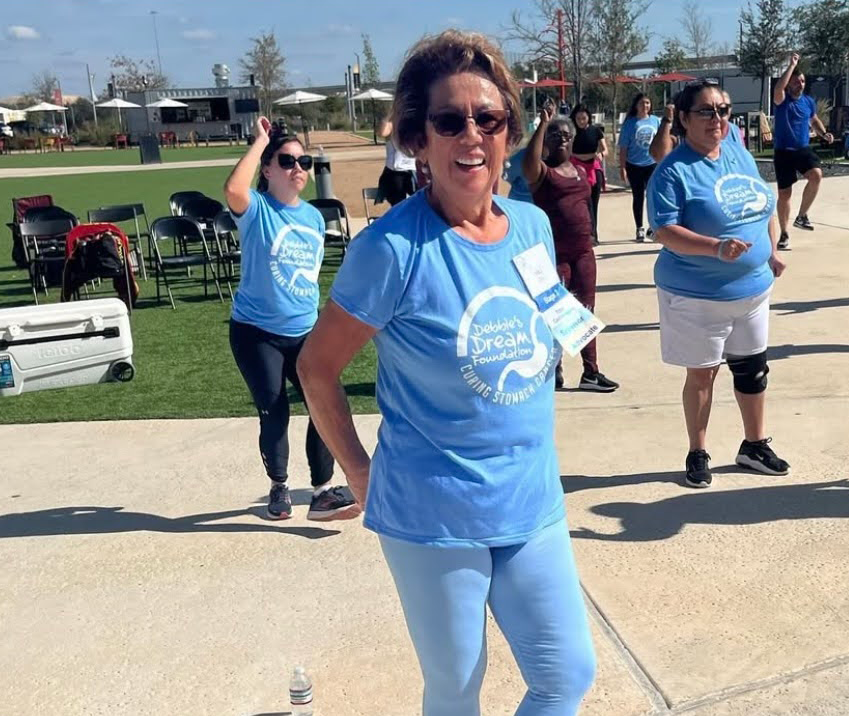
While holding a position on the board, Yoli has dove into local fundraising efforts, including hosting a Zumbathon in San Antonio in 2024 and the first-ever Gut Check for Stomach Cancer 5K Run & 1 Mile Walk from 9 a.m. to noon on Saturday, Nov. 8, 2025, at Greenline Park in San Antonio, Texas.
Register here for the event.
Meanwhile, Yoli is always looking for an opportunity to raise awareness about stomach cancer by sharing her personal story of survivorship.
She continues to share her stomach cancer journey with the Avanzando Caminos Hispanic/Latino Cancer Survivorship Cohort Study at UT Health San Antonio.
She’s even appeared on a KSAT news segment in San Antonio promoting the study.
Share Your Cancer Story with Avanzando Caminos
Yoli is one of hundreds of participants looking to help make a difference in the lives of cancer survivors in South Texas.
The Avanzando Caminos study, aims to improve the Latino cancer survivorship journey by interviewing survivors about their personal experience with cancer.
 By examining areas such as the journeys of cancer survivors, the team is looking to unpack the behavioral, mental, biological, and other influences on post-cancer life.
In analyzing these factors, the study team hopes that they can identify strategies and interventions that may help ease the burden caused by these influences.
“The fact that the research this is being done is to help individuals that have had cancer figure out what to do next,” Yoli told Salud America! in a video testimonial interview. “We need help. We don’t have that in the community.”
The Avanzando Caminos research study at UT Health San Antonio is looking to enroll 1,500 Hispanic/Latino cancer survivors in South Texas.
Participants must have completed primary cancer treatment for breast, lung, liver, stomach, colorectal, kidney, prostate, and uterine cervical cancers in the last 10 years.
Recently, the study announced it would now be enrolling participants who have completed treatment for bladder, melanoma, ovarian, thyroid, and lymphoma cancers.
The study is comprised of seven study visits over five years, which consists of assessment interviews, and some blood draws.
Volunteers are eligible to receive $50 per visit.
To inquire about volunteering for Avanzando Caminos, please contact a member of the study team at the Institute for Health Promotion Research at UT Health San Antonio at 210-562-6514 or email caminos@uthscsa.edu.
You can also visit the Avanzando Caminos website in English or Spanish for more information or fill out a short eligibility survey and a member of the study team will be in touch.
Join the Avanzando Caminos study in English or Spanish.
By The Numbers
1
out of 10
Pedestrians survive when hit by a car at 40 MPH
This success story was produced by Salud America! with support from the Robert Wood Johnson Foundation.
The stories are intended for educational and informative purposes. References to specific policymakers, individuals, schools, policies, or companies have been included solely to advance these purposes and do not constitute an endorsement, sponsorship, or recommendation. Stories are based on and told by real community members and are the opinions and views of the individuals whose stories are told. Organization and activities described were not supported by Salud America! or the Robert Wood Johnson Foundation and do not necessarily represent the views of Salud America! or the Robert Wood Johnson Foundation.