by
by 
Share On Social!
Breast cancer is the leading cause of cancer-related deaths in Latinas.
Despite advances in prevention and treatment, Latina breast cancer continues to be detected at advanced stages when the prognosis isn’t optimistic.
There are several contributing factors to why Latinas face worse outcomes when it comes to breast cancer.
October is Breast Cancer Awareness Month, and to honor all who have been impacted by the disease, we are discussing the top eight things to know about Latina breast cancer.
1. Latina Breast Cancer Diagnosis
Breast cancer is the most common cancer among Latinas, impacting U.S. Latinas at a rate of 106.6 per 100,000 people, according to the American Cancer Society’s 2026 Cancer Facts & Figures report.
This equates to roughly 1 out every 9 Latina women being diagnosed with breast cancer, according to Susan G. Komen.
In 2024, an estimated 31,500 cases of new Latina breast cancer were diagnosed, according to Komen.
Compared to White women (139.5 per 100,000) and Black women (133.2 per 100,000), Latinas don’t have a high rate of breast cancer incidence, according to the ACS report.
However, they have a higher burden of late-stage and more aggressive breast cancer, including triple negative breast cancer and metastatic breast cancer.
Of the Latinas diagnosed with breast cancer, 6% of them are diagnosed at an advanced stage when the cancer has metastasized (left the original site of the cancer and spread) to other parts of the body.
Due to the number of late-stage diagnoses, Latinas face a higher rate of cancer-related mortality.
In 2024, an estimated 3,700 Latinas died from the disease.
Latinas also face a lower 5-year survival rate at 90% compared to 94% for White women, according to Komen.
2. Latina Breast Cancer Diagnosis Age
Like many cancers, breast cancer is considered an aging disease.
According to Komen, the median age for breast cancer diagnosis in the U.S. is 64 with half of women diagnosed before 64 and half after the age of 64.
The median age of Latinas diagnosed with breast cancer is 58 — the youngest among all the most researched groups.
Despite this, 4% of all breast cancer diagnoses are in women younger than 40, which is the recommended age to start screening for breast cancer.
While not as prevalent among younger women, cases have slowly risen by a little over 1% each year.
3. Latina Breast Cancer Risk
Latinas may face a higher risk of breast cancer due to a variety of factors, including lifestyle factors like weight, high blood pressure, and diet.
Most recent data put 78.8% of Latinas as overweight or obese with Latinas being 20% more likely to be overweight than other women, according to the US Department of Health and Human Services OMH.
Researchers believe the increase in cases of breast cancer in young women can be attributed to an inherited gene mutation, like BRCA1 or BRCA2, which are the most well-known gene mutations.
That’s why understanding your family history and genetic testing are vital to preventing breast cancer.
Another risk factor for breast cancer is having dense breasts.
Breast cancer becomes harder to detect in women with dense breasts because it can remain hidden on a mammogram.
These women may need additional screenings to detect cancer before it spreads.
Check out The Breast Density Road Map resource to navigate your way through a dense breast diagnosis.
For more information on breast density and how it influences breast cancer risk, check out our latest webinar.
4. Latina Breast Cancer Prevention
The best way to prevent breast cancer is to follow national screening recommendations.
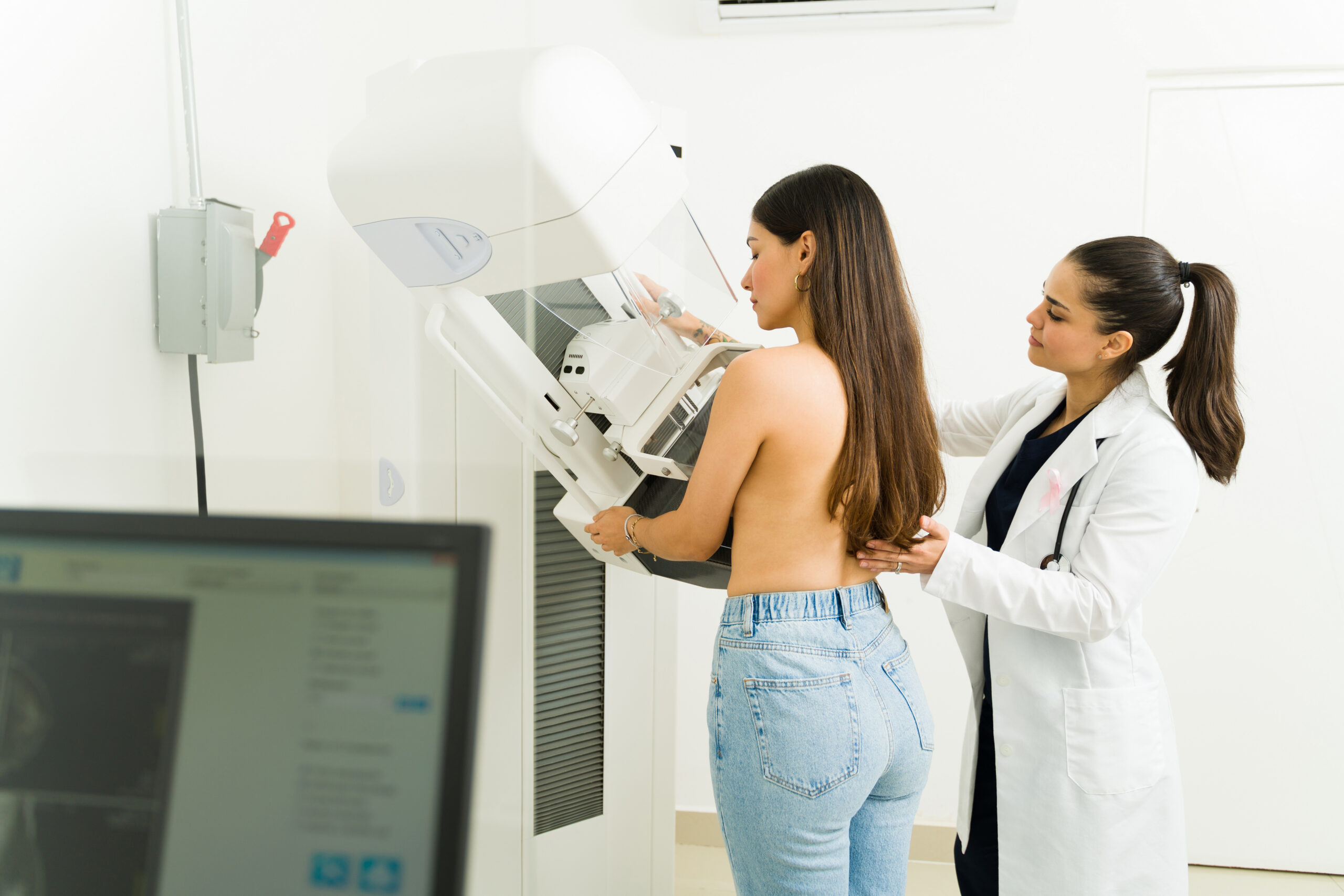
The American Cancer Society recommends women start screening at age 40 and that women between ages 45 and 54 should have yearly mammograms. After age 54, women have the option of getting yearly mammograms or every other year.
Recommendations can change based on breast cancer risk, genetic makeup, and family history.
Mammograms are low-dose x-rays that can measure breast tissue and can detect cancer before symptoms even appear.
While mammograms don’t prevent cancer, they can catch cancer early when it’s much more treatable.
Mammograms reduce the risk of dying from breast cancer by 40% to 50%, according to the National Breast Cancer Coalition.
What’s more, regular cancer screenings lower the risk of advanced breast cancer by 25%, according to the National Institutes of Health.
Mammograms aren’t the only preventative care available.
Women who have a higher risk for breast cancer may be recommended for an MRI, which can make cancer easier to spot.
Lastly, women should be performing self-exams regularly and be familiar with what is normal for them and what’s not.
Those who exhibit symptoms, who are at higher risk, or have abnormal breasts, should follow up with a health professional.
5. Latina Breast Cancer Screening Access
Due to non-medical drivers of health – access to health insurance, access to preventative care such as mammograms, language hurdles, transportation, and more – Latinas have a more difficult time following screening recommendations.
Health insurance continues to be one of the biggest hurdles to breast cancer screenings.
In fact, women without health insurance are less likely than women with health insurance to get mammograms, according to Komen.
In 2023, only 50% of women without health insurance received a mammogram within the last 2 years, compared to 72% with Medicaid or other government-assisted health insurance and 83% of women with private insurance.
When it comes to Latinas and breast cancer screenings, Latinas have similar cancer screening rates to those of White and Asian women, but lower rates than Black women.
What’s more, the mammography rate in the Latina population varies by geographic origin with Mexican Latinas having lower screening rates than Latinas from Central or South America, according to Komen.
More must be done to expand access to insurance and access to cancer screenings.
The National Breast and Cervical Cancer Early Detection Program by the CDC provides free or low-cost breast and cervical cancer screenings.
Learn more about eligibility or locate a program site near you.
6. Latina Breast Cancer Treatment
Treating breast cancer can vary depending on location and severity.
For instance, if the cancer has metastasized to other parts of the body, the cancer becomes more difficult to treat, and treatment can become a lifetime commitment.
Treatment for breast cancer can include surgery, where part of the breast or the entire breast is removed, chemotherapy, radiation therapy, hormone therapy, immunotherapy, or other targeted therapies.
Read more about breast cancer treatment options from the American Cancer Society.
The most important part of treatment is choosing an oncologist that fits your needs and background.
If you are in South Texas, use the Mays Cancer Center’s “Find a cancer care provider” tool to locate an oncologist that fits your needs and cancer type.
Nationally, the American Society of Clinical Oncology’s website offers an oncologist database where you can search for oncologists based on specialty, board certification, and location.
The American Cancer Society’s website breaks down the types of oncologists, considerations that should be made when selecting a provider, a resource to find providers that take Medicare, and much more.
7. Latina Breast Cancer Clinical Trials
Another way to treat breast cancer, mitigate symptoms, or help future generations with cancer is by volunteering for a clinical trial.
Clinical trials are studies that help researchers learn more to help slow, manage, and treat Alzheimer’s and cancer for current and future family members. But without volunteers for clinical trials, the benefits may missthis group.
Visit our clinical trials page to find a clinical trial, read about hero volunteers, and more!
“Volunteers in clinical trials are not only helping themselves, but they’re also building a future with potentially better treatments that can help their families in the future,” said Dr. Amelie Ramirez, director of Salud America!and the Institute for Health Promotion Research at UT Health San Antonio.
Those looking for opportunities based in San Antonio can search the Mays Cancer Center at UT Health San Antonio’s Find a Clinical Trial database to learn more about available clinical trials and eligibility requirements.
On a national level, visit clinicaltrials.gov to find a clinical trial near you.
LEARN MORE ABOUT CLINICAL TRIALS!
8. Share Your Latina Breast Cancer Survivorship Story
The stories of cancer survivors are more powerful and important than you might realize.

Someone’s experience could very well hold the key to ending differences in cancer care and help make a difference for future survivors.
That’s exactly what the Avanzando Caminos Hispanic/Latino Cancer Survivorship Cohort study is attemptingto do by capturing the stories of survivors in South Texas.
The study team at UT Health San Antonio is is now enrolling participants who have completed their primary cancer treatments for prostate, colorectal, lung, stomach, liver, endometrial, breast, cervical, kidney, bladder, melanoma, ovarian, thyroid, and lymphoma cancers.
Through the study experience, program manager Dr. Derek Rodriguez hopes it gives cancer survivors an opportunity to process what they’ve been through.
“We want to be able to promote healing because for the first time in a long time, this may be someone’s first opportunity to give their cancer story,” Dr. Rodriguez told Salud America! “We want to be able to empower others to share their story as well. And we want to be able to better understand, detect, treat, and prevent cancer in the long run for other future survivors.”
To volunteer for Avanzando Caminos or ask questions, contact Dr. Ramirez’s team at the Institute for Health Promotion Research at UT Health San Antonio at 210-562-6514 or caminos@uthscsa.edu.
Alternatively, visit the Avanzando Caminos website in English or Spanish to fill out a quick eligibility survey and a member of the study team will be in touch!
SHARE YOUR STORY WITH AVANZANO CAMINOS!
Explore More:
CancerBy The Numbers
142
Percent
Expected rise in Latino cancer cases in coming years