by
by 
Share On Social!
People need social interaction to live a healthy life.
Yet many aging adults face social isolation, a lack of social contacts and few people to interact with regularly, and loneliness, the distressing feeling of being alone or separated.
How can we avoid social isolation and loneliness as we age?
Check out our new fact sheet, A Guide to Combating Social Isolation & Loneliness, to help our abuelos, familias, and amigos understand social isolation and loneliness and ways to combat them and avoid Alzheimer’s Disease and related dementias.
This fact sheet was created by Dr. Amelie G. Ramirez of Salud America! and UT Health San Antonio and its partner the San Antonio Center for AD/ADRD Population Aging and Social Studies (San Antonio CAPAS) at UT Health San Antonio.
Why Do Social Isolation and Loneliness Matter for Older Adults?
Older adults are more at risk for social isolation and loneliness than younger adults, according to the National Institute on Aging (NIA).
When it comes to social isolation, older adults may have a hard time getting around or have no transportation. Others may experience the loss of a partner or other loved one.
The truth about loneliness is that aging adults are at a much higher risk because there are significantly fewer opportunities to socialize — friendships grow distant; you aren’t regularly going into an office space or school, and children grow up and start to have families of their own.
That’s why many seniors rely on their significant others, community centers, adult learning programs, and more to fill the social void.
Stay Connected as We Age
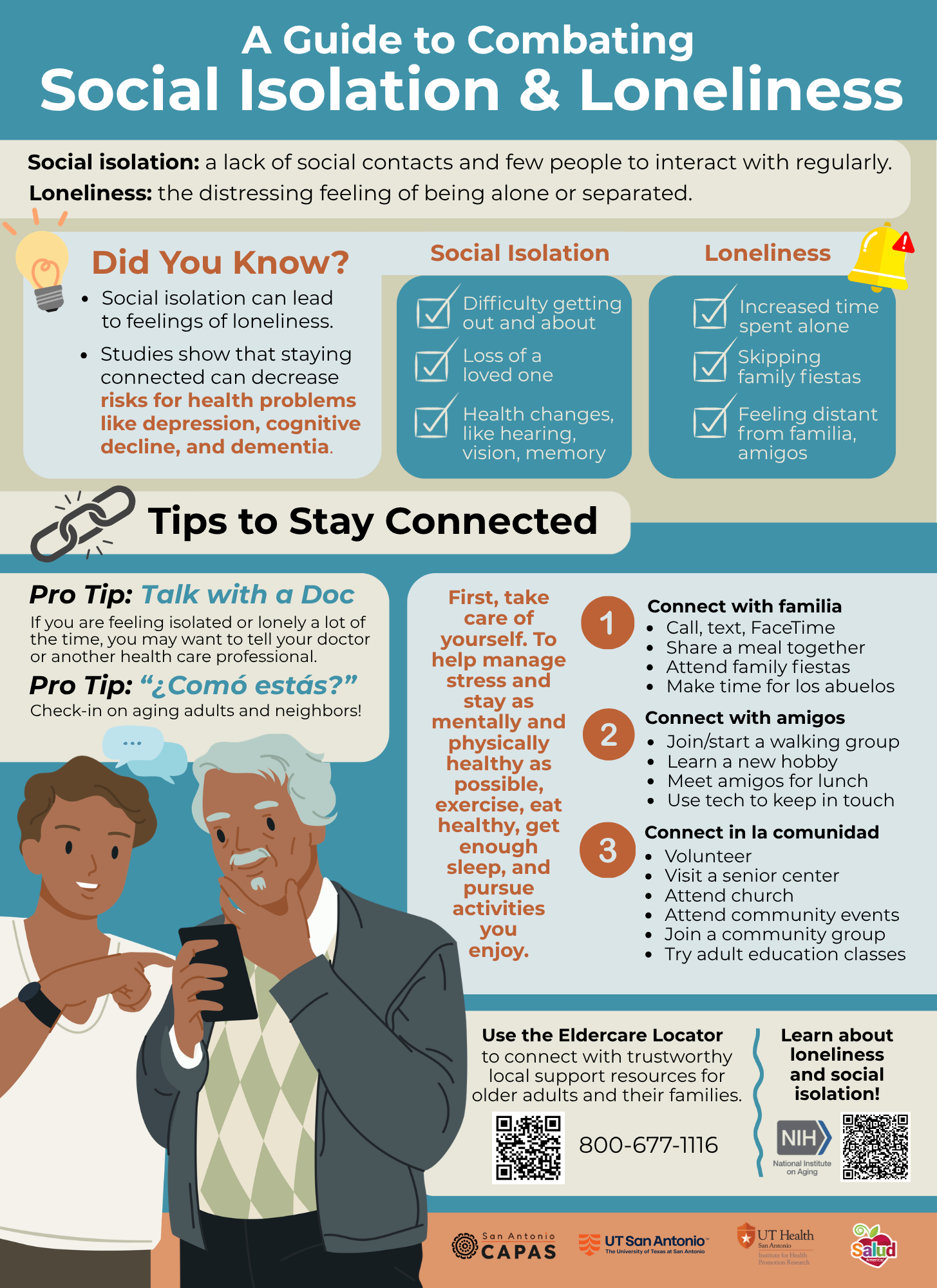
The A Guide to Combating Social Isolation & Loneliness fact sheet seeks to help older adults, their families, and their friends understand the difference between social isolation and loneliness, how they are related, and the warning signs associated with both so they can take action.
The fact sheet tackles the importance of maintaining relationships, being socially active, and how to form connections at a distance.
With the fact sheet, learn how to spot warning signs or situations that may leave loved ones more vulnerable to social isolation and loneliness.
Lastly, discover ways to combat social isolation and loneliness at the family, friends, and community level.
The fact sheet is a companion resource based on findings from the recent study, Social isolation and cognitive functioning trajectories from midlife to later life in four high- and middle-income countries, led by researchers Zhiyong Lin of UT Health San Antonio and James Raymo of Princeton University.
The study is featured in a research brief and a fact sheet.
Download the fact sheet to discuss how social isolation and loneliness may be impacting you or your loved one’s brain health or print it out as a resource for your community center, health provider’s office, school, or senior living center.
Addressing Alzheimer’s and Dementia in South Texas
Alzheimer’s and related dementias continue to ravage communities and families in South Texas, where many Latinos call home.
There are many societal and background-prevalent factors that contribute to inconsistencies in the Alzheimer’s and dementia care continuum.
To address some of these inconsistencies, UT San Antonio launched the San Antonio Center for Alzheimer’s Disease and Related Dementias (AD/ADRD) Population Aging and Social Studies (CAPAS), which is funded by the National Institute on Aging.
Led by Drs. Rebeca Wong and Fernando Riosmena, CAPAS seeks to bring together multidisciplinary groups of experts and research networks in demography, sociology, AD/ADRD epidemiology, neuropsychology, public health issues, and experience conducting longitudinal studies for AD/ADRD research and Latino aging.
“By combining our strengths, we can address Alzheimer’s disease from every angle — from molecules and biomarkers to families, neighborhoods and communities,” Dr. Wong told UT San Antonio Today.
View our bilingual fact sheets here:
- Does Drought Impact Brain Health in Older Latinos? (English/Spanish)
- How Does Social Isolation Impact Brain Health in Aging Adults? (English/Spanish)
For more information on Alzheimer’s Disease, dementia, or what researchers are doing to improve health outcomes in aging Latinos and all older adults, please visit the CAPAS center website.
Never miss an Alzheimer’s and dementia update by registering and signing up to receive the latest information on the aging health issues impacting your community!
This series is curated and published by Salud America! with partnership and support from the San Antonio Center for Alzheimer’s Disease and Related Dementias Population Aging and Social Studies (CAPAS) at UT Health San Antonio, funded by the National Institute on Aging. CAPAS is striving to address issues related to the aging Latino population in South Texas.
Explore More:
DementiaBy The Numbers
142
Percent
Expected rise in Latino cancer cases in coming years