by
by 
Share On Social!
It’s Hispanic Heritage Month!
One of the best ways to honor Hispanic Heritage Month from Sept. 15 to Oct. 15 every year is by honoring yourself – including maintaining your brain health.
Follow these nine ways to support brain health for Hispanic Heritage Month.
1. Familiarize Yourself with Cognitive Decline Risk Factors
Several lifestyle and health factors can impact your risk for Alzheimer’s disease and related dementias.
It’s important to familiarize yourself with these risk factors so you can make the changes needed to improve your brain health.
Here’s how you can lower your risk for cognitive decline:
- Maintain a healthy body weight
- Protect your head from traumatic brain injuries by wearing protective gear
- Support a more active lifestyle
- Quit smoking
- Challenge your mind
- Stay in school
- Control your blood pressure
- Be physically active
- Get a good night’s rest
- Manage diabetes
- Eat a healthy diet
Read more about modifiable risk factors in English and Spanish.
2. Learn How the Environment Can Impact Brain Health
Everything from the food you eat to your social interactions can play a role in your brain’s health.
But did you know the environment can also impact brain health?
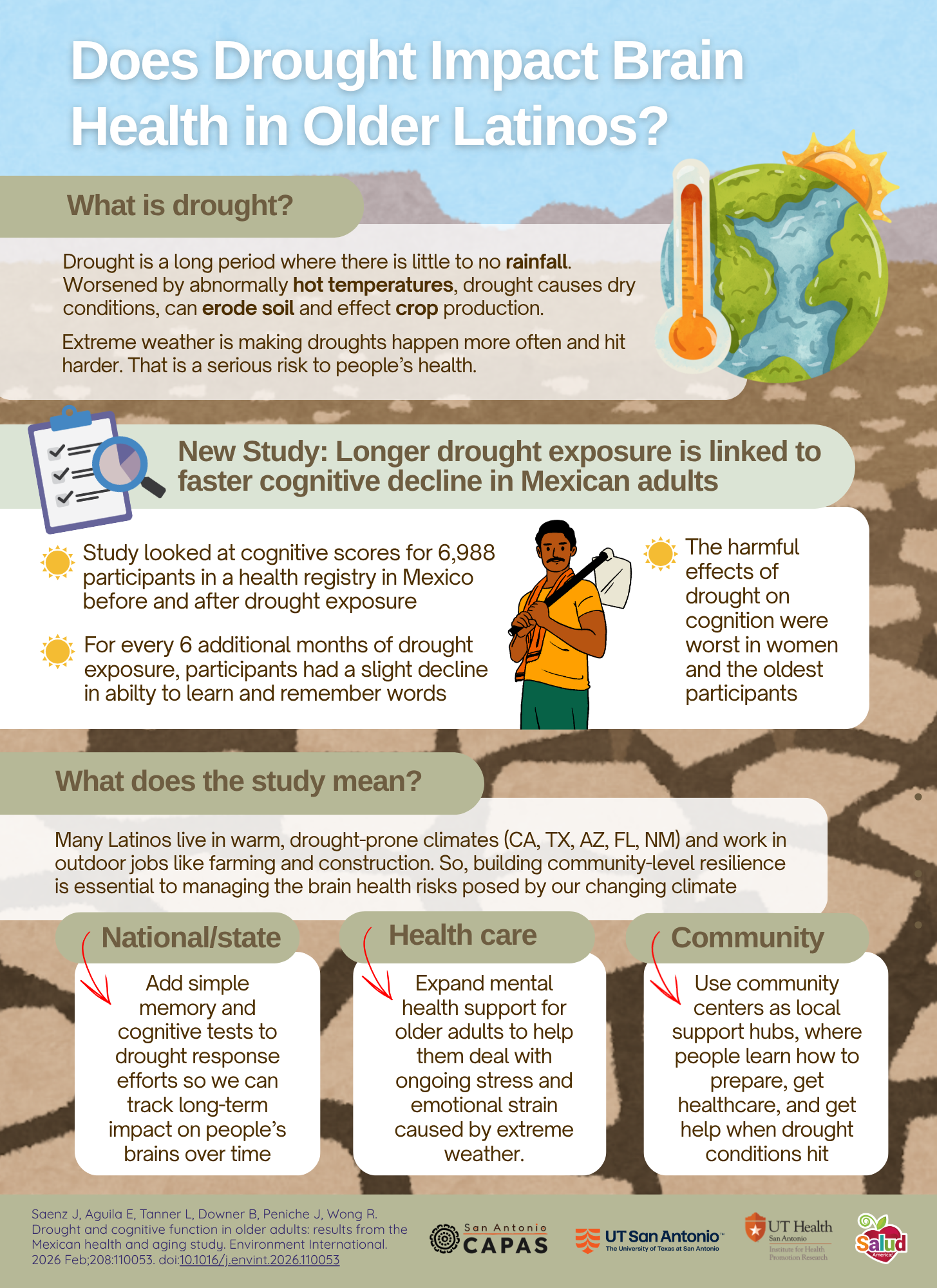
A recent study has linked cognitive decline to drought exposure.
You can learn more about drought’s impact on brain health by checking out the Does Drought Impact Brain Health in Older Latinos? fact sheet.
The fact sheet aims to help adults and caregivers understand how drought conditions impact brain health and give the rest of us a chance to take action to improve health outcomes for aging Latinos and all people.
Download the fact sheet to discuss how drought may be impacting you or your loved one’s brain health or print it out as a resource for your community center, health provider’s office, school, or senior living center.
You can also use the guide to argue for better drought responses in your community.
Download the fact sheet in English and Spanish.
3. Learn About Social Isolation’s Impact on Brain Health
How much you interact with others can also play an important role in your cognitive health, especially for aging adults.
This topic was explored in a recent study, which found that being socially isolated can have negative impacts on your brain health depending on where you live.
The results were featured in a fact sheet that seeks to help older adults and families understand how lack of social interaction differs from population to population and steps to take to minimize the impact it has on brain health.
Download the fact sheet in English and Spanish.
4. Learn How to Stay Connected
Do you understand the difference between social isolation and loneliness?
How about how they work together to impact brain health?
To help aging adults understand the difference between social isolation and loneliness and combat their harmful effects on brain health, Dr. Amelie G. Ramirez of Salud America! and UT Health San Antonio created a new fact sheet!
The A Guide for Combating Social Isolation & Loneliness fact sheet helps aging adults and loved ones look for warning signs and gives tips to help them stay connected as they age.
Download the fact sheet in English and Spanish.
5. Learn How Vision After Stroke Impacts Dementia Risk
Did you know that stroke can cause long-term impacts to your vision?
Those impacts can increase your risk of dementia.
To help aging adults understand the link between vision impairment following stroke and dementia risk, Dr. Amelie G. Ramirez of Salud America! and UT Health San Antonio created a new fact sheet!
The Vision After Stroke: What It Means for Your Brain Health fact sheet covers what types of vision impairment can happen following stroke, how they are linked to increased risk for dementia, and what types have the biggest impact on dementia risk.
Download the fact sheet in English and Spanish.
6. Watch the Latest Brain Health Webinars
Aging looks different for everyone.
But spotting these differences in aging health outcomes is vital for finding interventions to manage and slow down the harmful effects of aging.
This is especially true for some overlooked communities, such as Latinos.
UT Health San Antonio’s, “Zeroing in on Alzheimer’s, Brain Health, and Caregiving in At-Risk Populations,”brought together experts in aging research, caregiving, and community health work to explore these differences from every angle.
Watch the webinar to learn about the state of Alzheimer’s among Latinos and all people, early signs, early diagnosis, and what the condition means for the entire family and caregiving.
7. Explore Alzheimer’s and Dementia Stories
Caregivers, health professionals, and researchers are some of the biggest champions for improving the health outcomes for aging Latinos and all people.
They have first-hand experience and institutional knowledge that can help make a difference for those impacted by Alzheimer’s and related dementias.
For instance, Carlos Olivas is trying to break down stigmas surrounding male caregivers as he cares for his father with Alzheimer’s.
According to Carlos, some days are better than others, but having a routine and laughing through the hard times gets him through these challenging times.
8. Get the Latest Aging Health Updates
There are still so many unknowns when it comes to Alzheimer’s.
Researchers are hard at work learning how different factors impact someone’s risk for Alzheimer’s and related dementias.
Stay informed about the latest Alzheimer’s research efforts by visiting the Center for Alzheimer’s Disease and Related Dementias Population Aging and Social Studies (CAPAS) website at UT Health San Antonio.
Led by Drs. Rebeca Wong and Fernando Riosmena, CAPAS seeks to bring together multidisciplinary groups of experts and research networks in demography, sociology, AD/ADRD epidemiology, neuropsychology, public health issues, and experience conducting longitudinal studies for AD/ADRD research and Latino aging.
“By combining our strengths, we can address Alzheimer’s disease from every angle — from molecules and biomarkers to families, neighborhoods and communities,” Dr. Wong told UT San Antonio Today.
Register and sign up to receive the latest updates on the aging health issues impacting your community and check out the latest health resources for aging adults!
9. Enroll in a Clinical Trial
In addition to research, scientists are currently examining the impact of new therapies that can help mitigate and manage Alzheimer’s symptoms.
These are known as clinical trials and they need your help to make an impact.
“Volunteers in clinical trials are not only helping themselves, but they’re also building a future with potentially better treatments that can help their families in the future,” said Dr. Amelie Ramirez, director of Salud America! and the Institute for Health Promotion Research at UT Health San Antonio.
However, when the pool of participants doesn’t reflect the entire population, these groups may miss out on the benefits that come from these studies.
The reality is that too few overlooked populations, such as Latinos, volunteer for clinical trials or research studies.
Visit our clinical trials page to find a clinical trial, read about hero volunteers, and more!
In San Antonio, visit the Glenn Biggs Institute for Alzheimer’s & Neurodegenerative Diseases at UT Health San Antonio, log on to the Mays Cancer Center website for more on cancer clinical trials, and navigate the UT Health San Antonio website for all open clinical trials.
On a national level, visit clinicaltrials.gov to find a clinical trial near you.
LEARN MORE ABOUT CLINICAL TRIALS!
Editor’s note: This blog post was curated and published by Salud America! with support from the San Antonio Center for Alzheimer’s Disease and Related Dementias Population Aging and Social Studies (CAPAS) at UT Health San Antonio, funded by the National Institute on Aging. CAPAS is striving to address issues related to the aging Latino population in South Texas.
Explore More:
DementiaBy The Numbers
25
years
of life expectancy between some U.S. cities.