by
by 
Share On Social!
We know age-related vision impairment is a risk factor for dementia.
But what happens when a person’s vision is damaged by a stroke, resulting in double vision, loss of visual field in each eye, or cranial nerve dysfunction?
Stroke survivors who suffered vision impairment showed a 2.3-fold increase in the odds of having dementia than those without vision issues, according to a new research brief.
See the new research in our new fact sheet, Vision After Stroke: What It Means for Your Brain Health, to help our abuelos and caregivers understand how vision impairment following stroke can impact their brain health.
This fact sheet was created by Dr. Amelie G. Ramirez of Salud America! and UT Health San Antonio based on a research brief from the San Antonio Center for AD/ADRD Population Aging and Social Studies (San Antonio CAPAS) at UT Health San Antonio.
How Does Stroke Impact Vision?
Stroke is a life-threatening medical emergency.
Caused by a sudden loss of blood flow to the brain, stroke is a leading cause of death, can take away your ability to talk, walk, see, and think clearly, and can happen to anyone, even if you’re young, according to the National Institutes of Health (NIH).
About 65% of stroke survivors have vision problems.
Most people who experience vision loss due to stroke don’t fully regain their vision, although some recovery is possible, according to the American Stroke Association.
How Does Vision Impairment After Stroke Impact Brain Health?
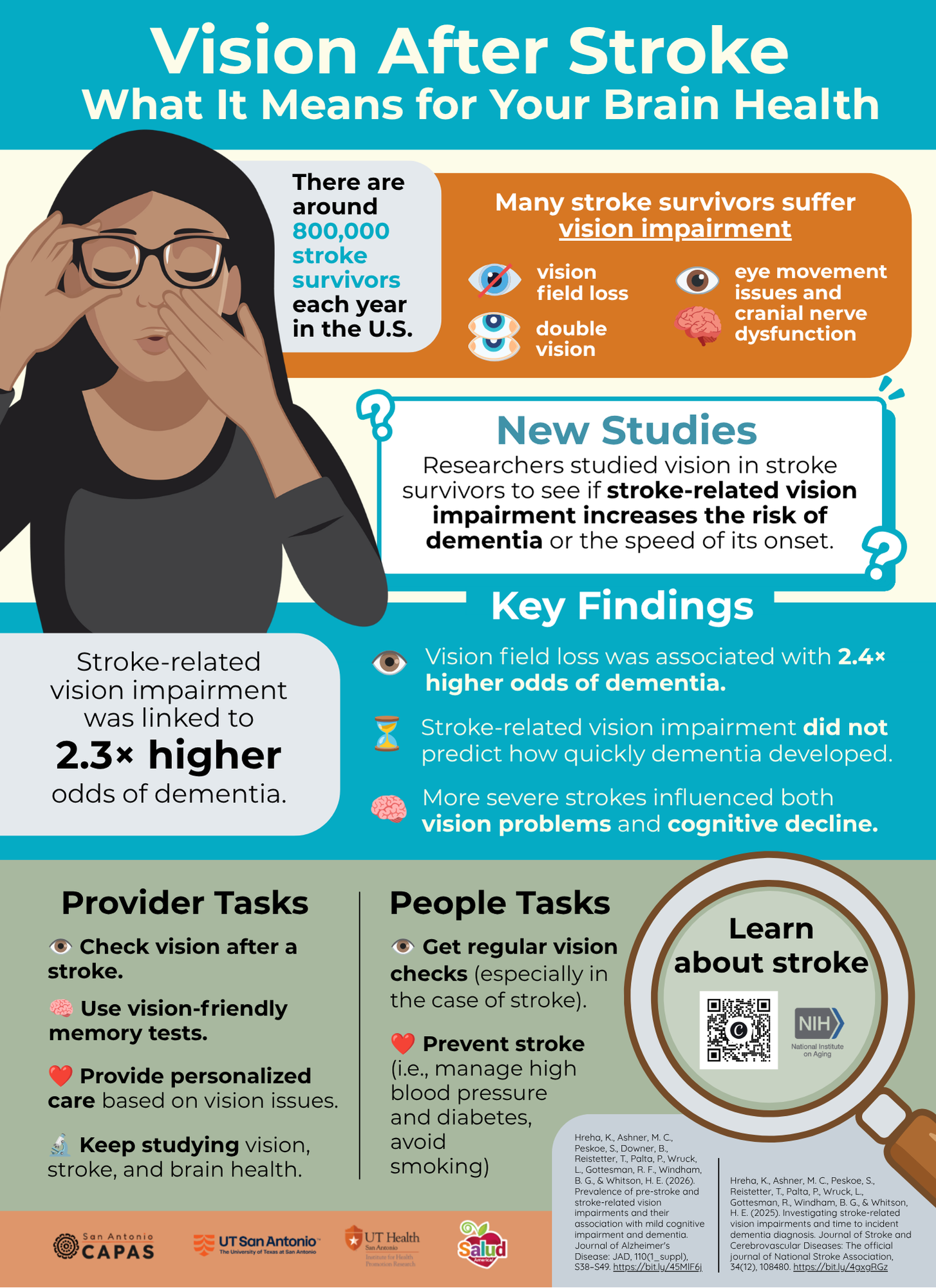
The Vision After Stroke: What It Means for Your Brain Health fact sheet covers what types of vision impairment can happen following stroke, how they are linked to increased risk for dementia, and what types have the biggest impact on dementia risk.
Also, it explores how individuals, clinicians, eye care providers, and researchers can help improve dementia outcomes by identifying interventions on eye health after a stroke.
The fact sheet also showcases new findings two recent studies, Prevalence of pre-stroke and stroke-related vision impairments and their association with mild cognitive impairment and dementia, and Investigating stroke-related vision impairments and time to incident dementia diagnosis, led by researchers from Duke University School of Medicine, University of Texas Medical Branch, UT Health San Antonio, University of North Carolina at Chapel Hill, University of Mississippi Medical Center, and the NIH.
The study is featured in a research brief from San Antonio CAPAS at UT Health San Antonio.
Download the fact sheet to speak up for better access to vision screenings and stroke prevention in your community.
Or print it out as a resource for your community center, health provider’s office, school, or senior living center.
Addressing Alzheimer’s and Dementia in South Texas
Alzheimer’s and related dementias continue to ravage communities and families in South Texas, where many Latinos call home.
There are many societal and background-prevalent factors that contribute to inconsistencies in the Alzheimer’s and dementia care continuum.
Many of these factors stem from some of the modifiable risk factors included on this list.
To address some of these inconsistencies, UT San Antonio launched the San Antonio Center for Alzheimer’s Disease and Related Dementias (AD/ADRD) Population Aging and Social Studies (San Antonio CAPAS), which is funded by the National Institute on Aging.
Led by Drs. Rebeca Wong and Fernando Riosmena, CAPAS seeks to bring together multidisciplinary groups of experts and research networks in demography, sociology, AD/ADRD epidemiology, neuropsychology, public health issues, and experience conducting longitudinal studies for AD/ADRD research and Latino aging.
“By combining our strengths, we can address Alzheimer’s disease from every angle — from molecules and biomarkers to families, neighborhoods and communities,” Dr. Wong told UT San Antonio Today.
View our bilingual fact sheets here:
For more information on Alzheimer’s Disease, dementia, or what researchers are doing to improve health outcomes in aging Latinos and all older adults, pleas visit the CAPAS center website.
This series is curated and published by Salud America! with partnership and support from the San Antonio Center for Alzheimer’s Disease and Related Dementias Population Aging and Social Studies (CAPAS) at UT Health San Antonio, funded by the National Institute on Aging. CAPAS is striving to address issues related to the aging Latino population in South Texas.
Explore More:
DementiaBy The Numbers
25
years
of life expectancy between some U.S. cities.