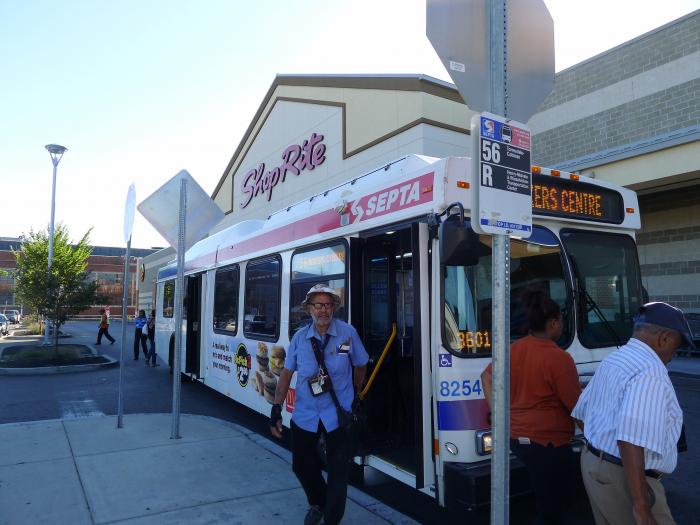
Everyone deserves a safe and reliable way to get to healthy food—whether a supermarket, corner store, food bank, farmers market, or community garden. Unfortunately, many Latinos and people in low-income communities, rural communities, and communities of color are disproportionately burdened by long and unreliable commutes, as well as unsafe routes to nutritious food. That’s why the Safe Routes to Healthy Food Task Force worked for two years to refine the concept of safe routes to healthy food. Now they’ve released a new report with policy implications, opportunities, and recommendations. “This collaboration demonstrated that improving access to healthy foods for people without cars can be improved by a variety of sectors, including: transportation, healthy food access, ...
Proposed changes to the Community Reinvestment Act (CRA) could bring back redlining, relax affordable housing definitions, and reduce the number of bank loans, investments, and services in low- and moderate-income communities and those of color, experts say. The CRA was developed in 1977 to curb redlining—discriminatory lending—and push banks to better serve communities. Now, federal agencies are proposing changes to modernize the complex law. But housing advocate Miriam Axel-Lute and others worry it weakens the CRA and is a “clear invitation to return to redlining.” “In addition, some investments in infrastructure and sports stadiums in low- and moderate-income communities would now qualify for CRA credit without any requirement that they primarily benefit low- and ...
Sitting around a fire can be a great source of warmth and fun for most; however, it also has the potential to cause a host of health complications. Tiny toxins—PM2.5 (pollution particles measuring 2.5 micrometers or less)—commonly known as “combustion particles” come from these fires and can cause some severe health impacts, research shows. Even worse, those using wood-burning stoves can face some of the worst effects. "We are increasingly concerned about particulate matter air pollution and other forms of air pollution," Dr. Joel Kaufman, professor of environmental and occupational health sciences, medicine and epidemiology at the University of Washington in Seattle, told the American Heart Association. "There's increasing evidence that certain pollutants are associated ...
Food deserts cause countless American families to struggle with access to nutritious, healthy meals. While this issue is pervasive, government agencies are trying to make progress in this issue with novel approaches — using the ever-growing technological landscape. In 2014, the Farm Bill passed by congress introduced an Online Purchase Pilot (OPP) that gave beneficiaries an option to use SNAP to purchase groceries online for delivery. A recent study out of Yale University found this program has the potential to help those families who live in areas that lack access to fresh foods and produce. "For individuals using SNAP, there's been a lot of bad rap about the quality of food that they purchase, and there's not been a lot of focus on trying to support individuals getting ...
Updated 7/15/21 For more than a year, the COVID-19 pandemic has afflicted many. In the U.S., certain local, state governments declared lock-downs and stay-in-place quarantines — efforts geared at limiting the spread of the novel COVID-19. Then lock-downs reopened, then locked down again as cases rose. Across the world, cases and deaths continue, as does public health responses, including vaccines. Governments, businesses, and people continue to grapple with the coronavirus pandemic. Latinos are experiencing worsening health inequities, disparities in exposure, testing, prevention and treatment, and job impact. Latinos are experiencing disproportionately more cases and deaths, too. As equitable vaccine distribution becomes the focus, Latinos aren't getting enough ...
Food insecurity is an issue gripping American families—including those in the Latino community—across the country. These individuals, who live in what experts call food deserts, can lack access to healthy, nutritious meals. Dwayne Wharton, an Independent Consultant with Dwayne Wharton & Partners and the former Director Of External Affairs at The Food Trust, joins Salud Talks to discuss this issue and what progress is needed to ensure Latinos and all Americans have access to healthy foods. Check out this discussion on the Salud Talks Podcast, Episode 21, "Dietary Discrimination"! WHAT: A #SaludTalks discussion about widespread food insecurity impacting countless Latino and all American families
GUEST: Dwayne Wharton, an Independent Consultant with Dwayne ...
Traffic fatality rates—in decline for 50 years—are rising again. Why? Not enough effort to get vehicles off the road, traffic safety experts say. Reducing vehicle travel can boost safety. It has many social, environmental, and health benefits, too, especially for Latinos who face many transportation barriers. Yet historical transportation planning had misplaced focus in four keys area: vehicle throughput to sprawling areas, vehicle travel safety over transportation system safety, vehicle safety over roadway safety, and reducing high-risk driving over all driving. Here is a breakdown of each issue, and why we desperately need reform.
1. Historical Focus on Vehicle Throughput to Sprawling Areas
What is sprawl? Reid Ewing, a nationally recognized transportation-planning ...
A soda tax can stir up controversy. Health experts say they curb consumption of unhealthy sugary drinks. Detractors say they're bad for local businesses. Many don't like taxes in any instance. But most people miss what happens after soda tax revenue comes in. That's why we are excited to share a new video series, Health Investments for Berkeley, which celebrates the community-led public health work paid for, in part, by the nation's first-ever soda tax enacted in Berkeley, Calif., in 2014. The series, created by the Praxis Project, an Oakland health justice group, has four parts: Berkeley Unified School District
Healthy Black Families
Multicultural Institute
Ecology Center "This series is intended to flip the national narrative around soda taxes that ...
The number of children living in single-parent households has grown significantly over the past 50 years. In fact, it has actually doubled — jumping from 13% to 32% in 2017, according to a new Pew Research Center analysis of US Census Bureau data. High cost-of-living, including necessities such as food and transportation, can significantly impact single parents. Worse, it can prohibit their ability to break cycles of poverty or build substantial wealth.
Single Latino Parents
In the US, there about half of each sing-parent race group are white, roughly 15% are Black, about one-fourth are Latino/Hispanic, and a small share are Asian. "These gaps are driven largely by racial differences among the large share of solo parents who are mothers," Gretchen Livingston with PEW ...